



Parents today expect the same real-time visibility from their childcare center that they get from a food delivery app. When that expectation isn't met, parents disengage. They don't re-enroll.
For childcare directors, choosing the right parent-teacher communication app isn't just about messaging. It's about staff adoption, family retention, multilingual support for diverse communities, and whether the tool fits into how your center actually runs.
This guide reviews the 7 best parent communication apps for childcare centers and preschools, with an honest look at what each one does well, where it falls short, and which centers it suits best. Whether you're running a single-site daycare, a small network of preschools, or a Montessori program, there's a tool here that fits.
Features to look for in childcare parent communication apps
Not every communication app is built with childcare directors in mind. Many started as school tools, consumer messaging apps, or K-12 platforms that were later adapted for early childhood settings. Before evaluating specific products, it's worth being clear on the criteria that actually matter for how a childcare center operates — because the right answer for a 15-child home daycare is genuinely different from the right answer for a 200-child multi-room preschool.
Here are the six factors that most consistently determine whether a communication platform succeeds or fails after implementation.
1. Multilingual support for your community
There's a meaningful difference between a platform that offers a translated interface and one that translates messages in real time as they're sent.
Ask vendors specifically:
- Is translation automatic and real-time, or does the teacher have to select a language for each message manually?
- Which languages are supported, and are those the right languages for your specific families?
2. Admin oversight and access control
Lack of visibility into parent communications creates compliance risk and makes it difficult to maintain consistent standards.
Look for platforms that offer a consolidated admin view of communications across all classrooms, the ability to set role-based permissions (so a teaching assistant can't accidentally send a center-wide alert), and audit logs that can be referenced if a parent dispute requires documentation.
This matters more as your center grows. Single-teacher programs can rely on trust and proximity; centers with five or more staff members need structural oversight built into the tool.
3. Integration with your other tools
If your attendance system, billing platform, and communication tool don't talk to each other, your staff ends up logging the same information in multiple places, and information gets out of sync. Before choosing a standalone communication tool, ask whether it integrates with your existing systems, and at what level.
💡 Pro Tip
A data sync that updates once a day is meaningfully different from a real-time integration.
4. Data privacy and compliance
Children's data is among the most sensitive data any organization handles. In the US, any platform collecting data from or about children under 13 must comply with COPPA. Centers serving families in the EU must meet GDPR standards. If you operate in the UAE, Singapore, or Malaysia, check whether the vendor has data residency options for those jurisdictions, since some local regulations require that data be stored within the country.
5. AI Assistance
Despite rising parent expectations, creating and logging individual updates for toddlers or infants in a full room is never easy. Teachers always juggle between managing screens and their caretaking duties. A good parent communication platform should facilitate their tasks with AI features that help create in-depth updates for each child that go beyond a simple “Good day today!”
What are the 7 Best Parent Communication Apps for Childcare Centers?
| Feature | illumine | Brightwheel | HiMama (Lillio) | ClassDojo | Bloomz | Transparent Classroom | Tadpoles |
|---|---|---|---|---|---|---|---|
| Pricing model | Per student/month from $1.All plans include communication. | Flat $65/monthUp to 25 students | $30 per classroom/month | Free core plan | Free basic;Premium on request | $0.75 per child/monthAdjustable for closures | From $25 per user/month |
| Multilingual support | YesReal-time translation (20+ languages) | No | No | No | No | No | No |
| Admin oversight | Full Access ControlRole-based permissions & audit trail | BasicNo role-based permissions | BasicNo admin-level visibility | BasicTeacher-level only | PartialLimited director oversight | No | No |
| Operational integrations | All-in-OneAttendance, billing, and enrollment | PartialNot deeply integrated | PartialLimited billing | No | No | PartialGoogle Calendar only | No |
| Data privacy | COPPA, GDPRInternational data residency options | COPPA compliant | Standard encryption | Standard encryption | Standard encryption | Standard encryption | Standard encryption |
| Parent messaging | YesFull parent-initiated chat | LimitedReply only | PartialComment only | No | Limited | Partial | Yes |
| Activity updates | Real-time | Yes | NoDaily summary only | Yes | Yes | Partial | Yes |
| Best for | Single centers & networks wanting all-in-one | Single US-based centers | Curriculum-led programs | School-age programs | Event-heavy centers | Dedicated Montessori | Small daycares |
1. Illumine
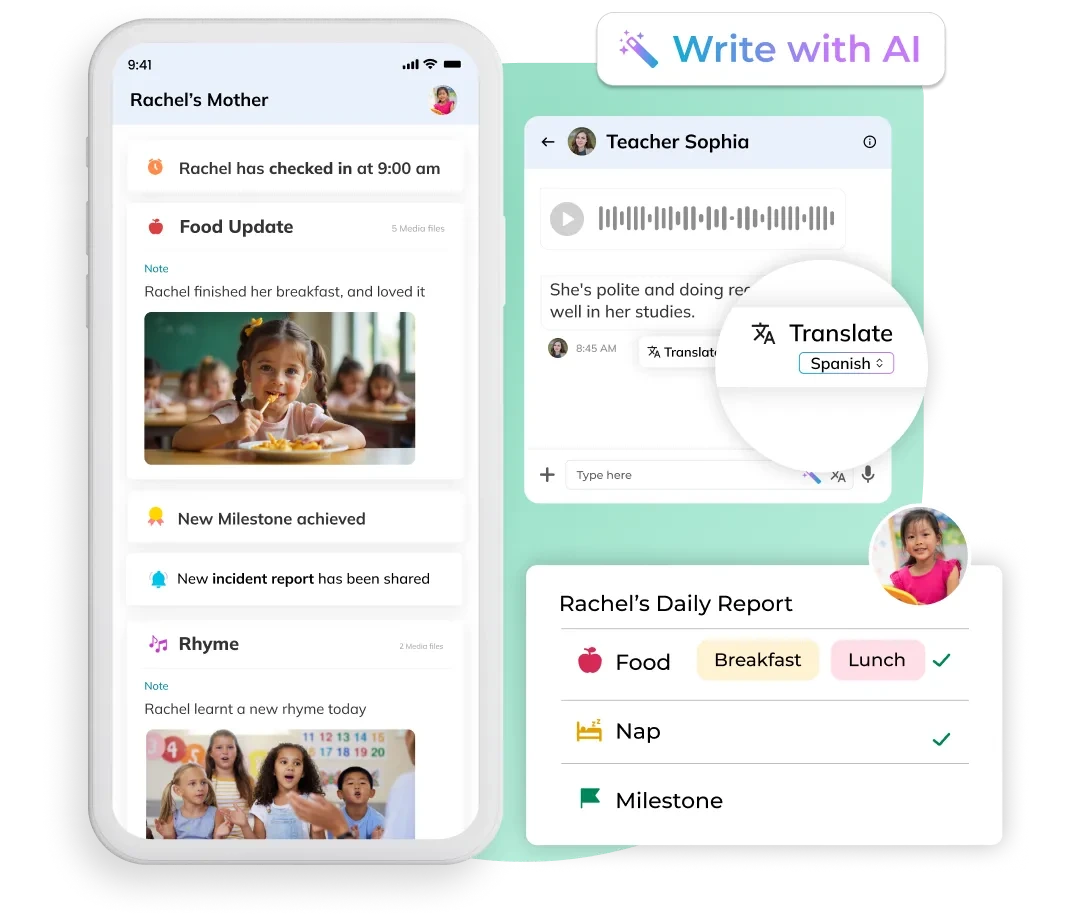
illumine is an AI-powered childcare software solution, where the communication layer is part of a broader childcare management platform that also handles child attendance, billing, enrollment, and learning assessments.
Designed with an intuitive interface, Illumine empowers administrators, teachers, and parents alike to optimize school operations and enhance the quality of care and education for young children.
The parent communication module is a standout feature, offering tools that make interactions with families engaging, organized, and impactful:
Key features:
- The daily activity feed gives parents a structured view of their child's day, grouped by category (meals, naps, photos, activities, etc) rather than a raw chronological stream.
- The ticketing system is worth highlighting for directors specifically. When a parent submits a concern, leave request, or sensitive instruction, it appears as a tracked item that requires resolution. Everything has a timestamp and a closed/open status, which is useful for compliance and for staff accountability.
- Group messaging, newsletter creation, emergency alerts, and event calendar sharing are all included across plans. There's no tier where basic communication features are locked away behind an upgrade.
Limitations:
Teachers who've used simpler standalone apps like ClassDojo may find the interface more involved initially. Illumine offers onboarding support, but centers should plan for 2–3 days before the team is fully comfortable.
Price:
Plans starting at $1 per student per month for the Standard tier.
Best for:
Single-site centers and small networks (2–100 locations) that want parent communication fully integrated with attendance, billing, and learning.

2. Brightwheel
Brightwheel is a popular childcare management software designed for smaller childcare centers, preschools, and daycares. Accessible on mobile devices, it allows parents to receive real-time updates on their child’s activities, including photos and videos. Teachers and childcare owners can manage attendance, share updates, and communicate with parents, while administrators can track attendance, handle basic billing, and generate reports.
While ideal for smaller centers, Brightwheel's features may feel limited for larger or multi-location operations, as it lacks advanced billing options, customization, and robust reporting tools needed for more complex needs. It’s best suited for providers seeking a simple solution for everyday tasks and parent engagement.
Key Features:
- The SMS alert layer is useful for centers where not all parents consistently check a dedicated app.
- Reminders and time-sensitive updates can go out via text, reducing the "I didn't see the notification" problem that plagues app-only platforms.
- Extended family access allows grandparents or other caregivers to receive updates without being the primary account holder
Limitations:
- Communication is limited to two categories — General and Pickup/Dropoff. This is a significant constraint for centers where parents need to communicate about allergies, behavior concerns, medication instructions, or anything that doesn't fit a preset bucket.
- Parents cannot message individual teachers directly; they can only message the classroom.
- Photo sharing is one image at a time, and parents cannot upload photos from their camera library, only live captures. For milestone sharing and portfolio-style documentation, this is limiting.
- There is no group messaging between subsets of parents, multilingual translation, and no video sharing.
Price:
$65/month for up to 25 students. Pricing scales up from there.
Best for:
Single-site US daycares and preschools with predominantly English-speaking families, where the priority is easy parent updates and basic communication, and where billing, learning documentation, and multilingual support are handled separately or aren't yet a priority.
3. Lilio
Lillio comes at parent communication from an educator-first angle rather than an operations-first one. The platform is strongest when the goal is documenting children's learning journeys and sharing that documentation with families in a meaningful way. For directors running Montessori programs, Reggio-inspired centers, or any setting where pedagogical documentation is central to how you communicate your value to parents, Lillio gives teachers a structured way to build that narrative. That's genuinely differentiated from most other platforms in this category.
The tradeoff is that Lillio is less focused on the operational side of running a center. If your communication problems are entangled with billing follow-ups, enrollment workflows, or multi-site staff coordination, you'll likely find yourself reaching for additional tools.
Key Features:
- The message scheduling and templating features reduce the burden on teachers who communicate with families at a consistent cadence. A director can build templates for common updates, and teachers can send them with minimal editing.
- The "Crew" feature allows parents to be organized into groups with different access levels, which is useful for centers that communicate differently with, say, room parents versus the general parent body.
- The Headlines section aggregates a month's worth of photos and videos into a curated summary — a small feature that parents reliably appreciate, and that requires no extra work from teachers.
Limitations:
- Reaching specific features often takes more steps than it should, and friction in the tool translates directly into updates that don't get posted.
- The daily activity feed sends a summary once per day rather than in real time. This creates a gap that more real-time platforms don't have.
- Lillio does not support the sharing of lesson plans or assignments directly through the parent-facing app. Parents can see what happened; they can't see what's planned.
- There is no group messaging between parents, and multilingual translation is not built in.
Price:
$30 per classroom per month.
Best for:
Curriculum-led programs (Montessori, Reggio, play-based) where the priority is rich learning documentation and developmental communication with families, and where operational management features are either handled elsewhere or are a secondary concern.

4. ClassDojo
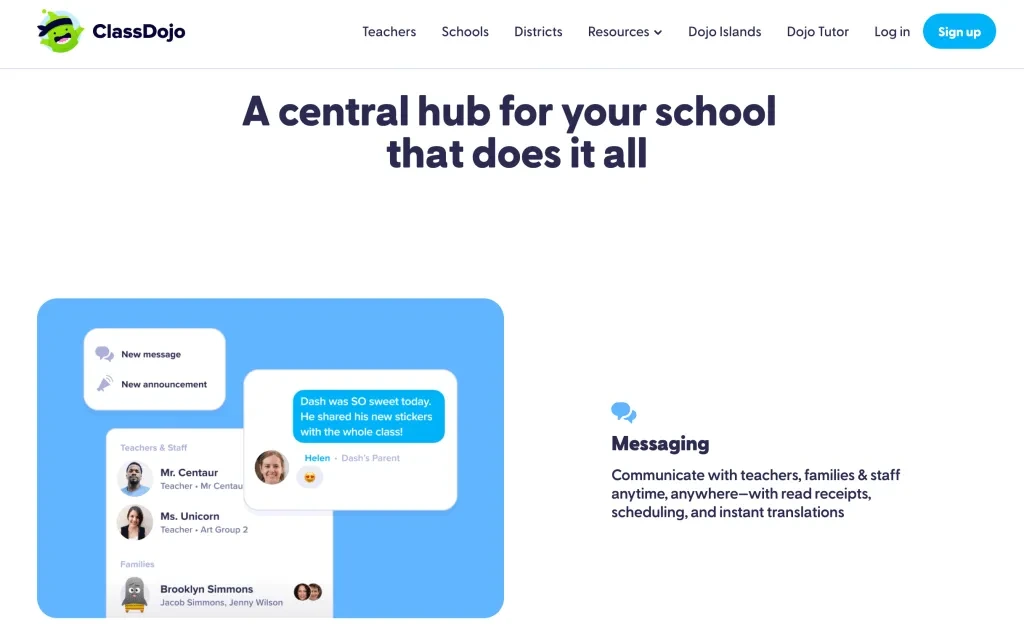
This daycare communication platform is designed to connect teachers, students, and families in a close-knit community. It allows teachers to share learning moments and lessons through photos, videos, and messages. The app provides a variety of features and tools to facilitate virtual classrooms, communication, classroom management, and student engagement.
The platform's behavior tracking system is genuinely useful for school-age programs where behavior communication with families is a regular operational need. For a pure preschool or infant-toddler program, it's mostly irrelevant.
Key Features:
- ClassDojo's media sharing is rich and flexible — photos, stickers, videos, and voice notes can all be sent through the platform.
- Class Story feature gives teachers a feed that functions as a classroom newsfeed parents can react to. The School Story feature lets administrators send center-wide announcements separately from classroom-level updates, which is a useful structural distinction for larger centers.
- Zoom integration for virtual parent-teacher meetings is built in
- Scheduled messaging and quiet hours give teachers control over when they're reachable, which helps with staff retention and prevents the expectation of 24/7 availability.
- The free tier is genuinely functional — not a stripped-down trial. For centers operating on tight budgets or piloting digital communication for the first time, ClassDojo offers meaningful capability without a subscription commitment.
Limitations:
- Parents cannot initiate a conversation on ClassDojo. For parents who want to flag something proactively.
- There is no group messaging between subsets of parents and teachers. Communication is either one-to-one or broadcast to the entire class.
- Older messages are automatically archived, and parents need to request access to their message history from the teacher.
- The communication channel is fundamentally one-directional in terms of media — teachers share, parents receive, and respond.
- There is no multilingual translation, which is a significant limitation for centers serving non-English-speaking families.
Price:
Free for the core feature set. Custom pricing applies for schools and districts seeking advanced administrative tools.
Best for:
Before-and-after school programs, school-age childcare, and K-12 crossover centers where behavior tracking and school-style communication are central.
5. Bloomz
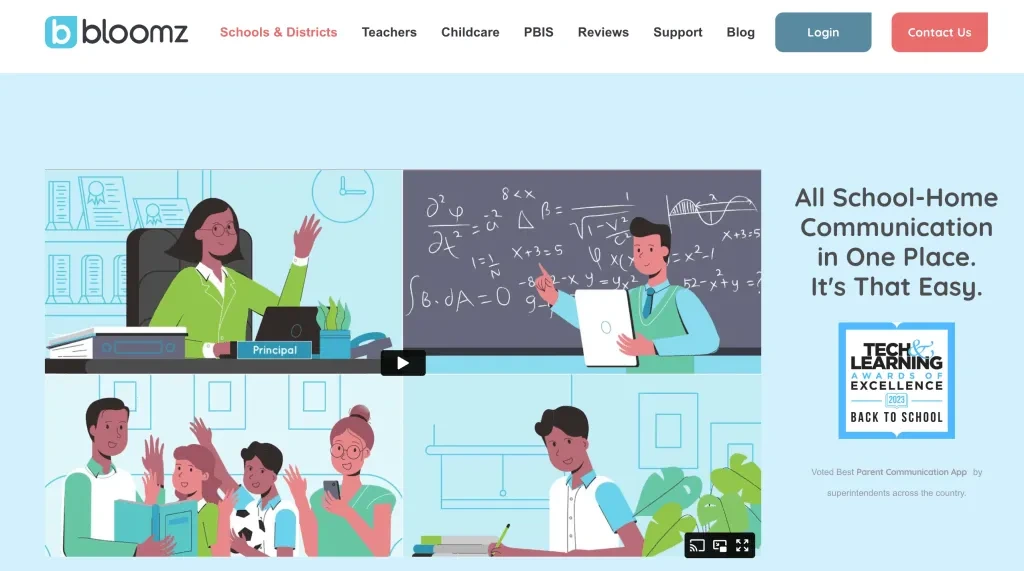
Bloomz is a communication and coordination app designed for teachers and parents. With this app, teachers can send messages, share photos and videos, create and assign tasks, and schedule events and reminders. Parents can stay up-to-date with their child's progress and activities and can communicate with teachers and other parents through the app. Bloomz also provides features like volunteer sign-ups, class wishlists, and behavior tracking to make it easier for teachers and parents to work together towards their common goals.
Key Features:
- The pre-built communication templates are a practical time-saver for centers that send recurring messages — monthly curriculum updates, weekly reminders, health and safety notices.
- Auto-notices for recurring events reduce the volume of manual reminders staff have to send.
- The Student Timeline feature gives parents a longitudinal view of their child's activity history, which functions as a lightweight portfolio and is useful for parent-teacher meeting preparation.
- Digital signature support for forms is a feature that saves real time and paper. Permission slips, health consent forms, and policy acknowledgments can be sent and signed within the app.
Limitations:
- The free tier is too limited to be a realistic long-term option for most childcare centers. Key features are locked behind the premium plan.
- Parent-initiated communication is restricted even in the paid tier. Parents can respond to messages and interact with shared content, but they can't easily raise concerns, send unprompted updates, or flag time-sensitive information the way they can on more open platforms.
- There is no multilingual translation, no built-in billing integration, and no real-time activity feed of the kind parents of infants and toddlers expect.
Price:
A free basic plan is available. Premium pricing is available on request directly from Bloomz.
Best for:
Community-oriented preschools and childcare centers with active parent involvement programs, where event coordination, volunteer management, and formal communication templates are as important as daily activity updates.
6. Transparent Classroom
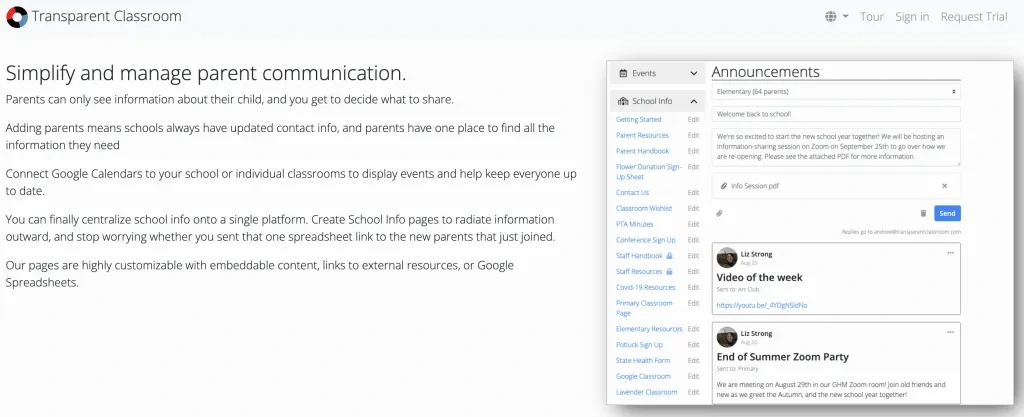
Transparent Classroom is designed to help Montessori teachers document individual children's work across the Montessori curriculum, track progress against learning materials, and share that documentation with parents in a way that reflects how Montessori actually works — not how a conventional activity log thinks it should work. For directors of Montessori programs who've tried to force that documentation into a general childcare app and found it inadequate, Transparent Classroom is a meaningful upgrade.
Key Features:
- The observation and documentation tools are structured around Montessori curriculum areas, which means teachers aren't adapting a generic activity logger to fit their pedagogy
- Parents can actively contribute to the platform by uploading photos and leaving comments, which supports the Montessori emphasis on the home-school relationship as genuinely collaborative rather than one-directional. Teachers can respond to parent observations, creating a documented dialogue around a child's development.
- The analytical tools for identifying learning trends across a child's portfolio are useful for parent-teacher conferences and for demonstrating developmental progress over time.
- Integration with Google Calendar keeps families informed about school events without requiring them to check a separate app for scheduling.
Limitations:
- The mobile app is significantly less capable than the web version, and full functionality requires desktop access.
- There is no comprehensive messaging system. Parents can interact with documentation and leave comments, but there's no structured channel for raising concerns, sending reminders, etc.
- Video sharing is not supported, and photos can only be uploaded one at a time. For a platform built around rich learning documentation, these are surprisingly constraining limits.
- Transparent Classroom is also designed specifically for the Montessori context and has limited relevance for mixed-curriculum or conventional early childhood programs.
Price:
$0.75 per child per month, with pricing adjustable based on enrollment and planned closures.
Best for:
Dedicated Montessori programs where curriculum-aligned learning documentation and developmental portfolios are the core of how the center communicates value to families.
7. Tadpoles
Tadpoles does daily reports, photo and video sharing, attendance tracking, and basic parent messaging, and it does them without much friction. For a small, independently run daycare or family childcare program where the director is also often a teacher, and where operational simplicity is more valuable than feature breadth, that straightforwardness has genuine appeal.
Key Features:
- The daily report system is the core of Tadpoles, and it works reliably. Teachers can log meals, naps, diaper changes, and activities quickly, and parents receive structured reports that give them a clear picture of their child's day.
- Photo and video sharing is real-time, which matters for parents who want to feel connected to their child's day as it's happening rather than receiving a summary at pickup.
- The event calendar keeps families informed about upcoming dates without requiring a separate communication channel.
- The direct messaging feature handles basic parent-teacher communication adequately for centers where the volume of messages is low and conversations are straightforward.
Limitations:
- Tadpoles is English-only. There is no multilingual support or translation capability
- There is no group messaging, which limits the platform's usefulness for center-wide communication or coordinating groups of parents.
- Activity report customization is limited.
- The platform has been noted by users as occasionally slow, particularly when loading media-heavy reports.
- Tadpoles has no billing, enrollment, or learning assessment capabilities. It is purely a communication and daily reporting tool.
Price:
Starting at $25 per user per month.
Best for:
Small, independent daycares and family childcare programs (typically serving infants and toddlers) where the primary goal is reliable daily reporting to parents.

How to choose the best childcare communications app for your center?
Centers that skip a structured evaluation process tend to either pick the wrong tool and live with it for years or switch platforms again, which creates confusion for parents and a second round of onboarding costs for staff.
The process below takes roughly four to six weeks and will give you the information you need to make a confident decision.
Step 1: Structured staff trial
Most platforms offer a free trial period. Assign one classroom and ask them to use the platform as they would in real operation. That means logging actual activities, sending actual updates to actual families, and trying to do it during an actual busy morning rather than in a quiet planning period.
Give your trial teacher a short feedback form to complete at the end of each day covering three things:
- How long the core daily tasks took compared to your current system,
- Whether anything confused or frustrated them
- Whether they'd use it willingly without being asked to
Step 2: Pressure-test
Before you commit to a platform, deliberately test how it handles common high-stakes scenarios like:
- Sending an emergency alert to all families and confirming receipt
- Communicating a sensitive incident to one family privately without other parents seeing i
- Handling a message from a parent who speaks a language your staff doesn't speak
- Managing a pickup authorization change that came in at the last minute
Pro Tip: A platform that handles 90% of your daily communication beautifully but fails on one of your high-stakes scenarios is a platform that will let you down at the worst possible time.
Step 3: Check parent engagement
The most important evaluation happens after you've committed and launched. Set three baseline metrics before you go live and review them at 30 and 60 days post-launch.
- Parent activation rate — the percentage of enrolled families who have created an account and opened at least one update. Anything below 70% at 30 days suggests your onboarding communication to families needs work, or that the app experience itself is creating friction.
- Message read rate — the percentage of updates and messages sent by teachers that are being opened by parents. A read rate below 60% typically indicates either that updates are being sent at the wrong time of day, that the content isn't relevant enough for parents to open consistently, or that parents haven't enabled notifications properly.
- Two-way communication rate — the percentage of teacher updates that generate a parent response of any kind, whether a reaction, a comment, or a reply message.
Compare your options:
See how illumine compares to other childcare platforms

Frequently Asked Questions
What's the difference between a parent communication app and a childcare management platform?
+
A parent communication app handles messaging, updates, and media sharing between staff and families. A childcare management platform does all of that plus attendance, billing, enrollment, and reporting in one system. For most childcare centers, starting with an all-in-one platform is more cost-effective than buying a standalone communication tool and stitching it to your other software. Apps like illumine, Brightwheel, and Procare fall into the platform category; ClassDojo and Bloomz are communication-focused tools.
Can parents use these apps without a smartphone?
+
Most parent communication apps are designed primarily for mobile, but the better platforms also offer a web browser version that parents can access from a desktop or laptop. If your center serves families with limited smartphone access, ask vendors specifically whether their parent-facing portal works on mobile interfaces.
How long does it take to get staff trained and up and running?
+
For most childcare communication apps, basic staff training takes 1–3 hours. Full adoption across your team — where teachers are consistently logging activities and parents are actively engaging — typically takes 2–4 weeks. Platforms that offer dedicated onboarding support and an assigned success manager shorten this considerably. When evaluating vendors, ask specifically whether onboarding is included in the price or billed separately.
What happens to family data if I switch to a different software later?
+
This varies significantly by vendor. Before signing any contract, confirm that you can export all family data in a standard format like CSV or PDF. Make sure to check the vendor's data retention policy: how long do they hold your data after you cancel, and is deletion on request guaranteed?
How do I measure whether the app is actually improving parent engagement at my center?
+
Look at three things in the first 30–60 days: what percentage of enrolled families have created an account, are updates being opened, and are parents replying, not just receiving? A good parent communication platform will surface these stats in your admin dashboard.
Are these apps compliant with child data privacy laws like COPPA and FERPA?
+
Any reputable childcare communication platform should be compliant with COPPA (Children's Online Privacy Protection Act) in the US, and platforms serving families in the EU should meet GDPR standards.