



Scaling Smart is an illumine report for CEOs and executive leaders of multi-site childcare networks. It explains why multicenter operations break as they grow, the infrastructure that lets a network scale without losing quality, and what operators who scale well do differently. It includes perspectives from Tim Seldin, President of the Montessori Foundation, and Matthew Sears, SVP of Technology at Guidepost Montessori.
Key findings
- Across the multicenter childcare operators illumine has spoken with, the average response time to a new enrollment lead is 6 days.
- 72% of multicenter childcare leaders lack real-time visibility into individual center performance, according to illumine data.
- Close to half of US early childhood programs are enrolled below their preferred capacity, with family affordability and staffing the top causes, according to a January 2026 NAEYC survey of more than 7,000 educators.
- Among under-enrolled programs, 37% say pay is too low to recruit and retain qualified staff and 36% say they do not have enough staff, according to a January 2025 NAEYC survey of more than 10,000 educators.
- 22% of early childhood educators are considering leaving the field within the next year (NAEYC, January 2026).
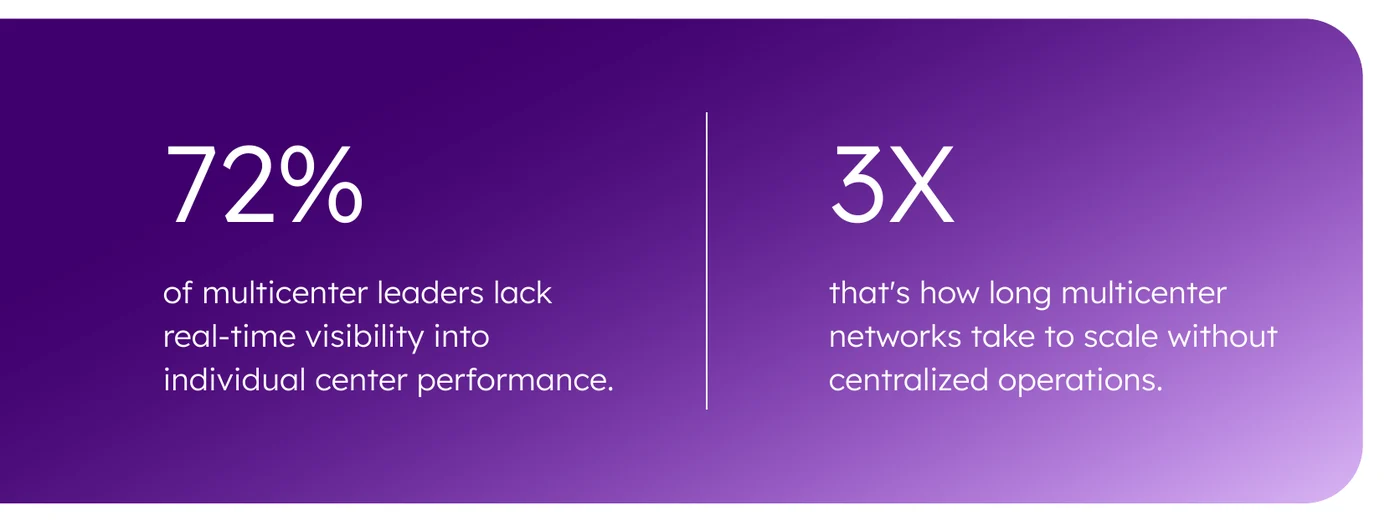
- Multicenter networks take 3X longer to scale without centralized operations, according to illumine analysis.
- The average multi-site operator runs 3 to 5 disconnected tools across its network, according to illumine data.
- The US childcare market is projected to grow from $86.2 billion in 2025 to $147.2 billion by 2033, a compound annual growth rate of 7.0% (Grand View Research).
- Private equity backs 9 of the 11 largest for-profit childcare chains in the US by capacity, yet PE-backed chains serve only about 10% of children in care (Tyton Partners).
How is the childcare industry changing?
The childcare industry is consolidating quickly. Private equity has accelerated platform building, and large operators are achieving economies of scale that fund both higher margins and greater investment in quality and marketing. Tyton Partners reports that nine of the top eleven for-profit chains by capacity, including four of the top five (KinderCare, Learning Care Group, the Goddard School and Primrose Schools), are backed by private equity. Between 2020 and 2022, larger for-profit providers grew their market share by 8%, driven mainly by roll-ups of smaller chains and independent programs.
The market itself keeps growing. Grand View Research values the US childcare market at $86.2 billion in 2025 and projects it to reach $91.9 billion in 2026 and $147.2 billion by 2033, growing at 7.0% a year.
Growth is not evenly spread, though. Child Care Aware of America reports that the number of licensed child care centers declined by 1% from 2024 to 2025, and the CDC's National Center for Health Statistics recorded 3,606,400 US births in 2025, down 1% from 2024. With supply tightening and the pool of young children shrinking, operators compete harder for every enrollment, which makes speed, consistency and visibility across sites more valuable.
As more operators shift into multicenter growth, many assume that adding locations simply means repeating what already works. It does not. Most childcare organizations still operate with:
- Fragmented tools that do not talk to each other
- Manual reporting workflows that drain productivity
- Delayed visibility into enrollment, staffing and revenue
- Spreadsheets that try to function as mission-critical infrastructure
Legacy childcare platforms make this worse. Most were built for single-site centers and retrofitted later for chains, so they offer little real multicenter visibility or consolidated oversight. As a network grows, each center interprets policies its own way. SOPs drift, daily routines diverge, and curriculum approaches soften without standardized coaching. Real consistency only emerges when processes are reinforced through shared data, training and clear systems, not personal leadership alone.
At what point does a childcare network need centralized systems?
The early childhood education sector in North America is entering its enterprise era. Private equity is consolidating regional operators, multi-state platforms are emerging, and brand, consistency and operating margin now shape valuation multiples as much as enrollment counts. Most childcare networks do not fail because of competition. They stall because of complexity.
- At 5 centers, intuition works.
- At 10 centers, intuition fails.
- At 20 to 40 centers, process matters.
- At 100+ centers, systems lead.
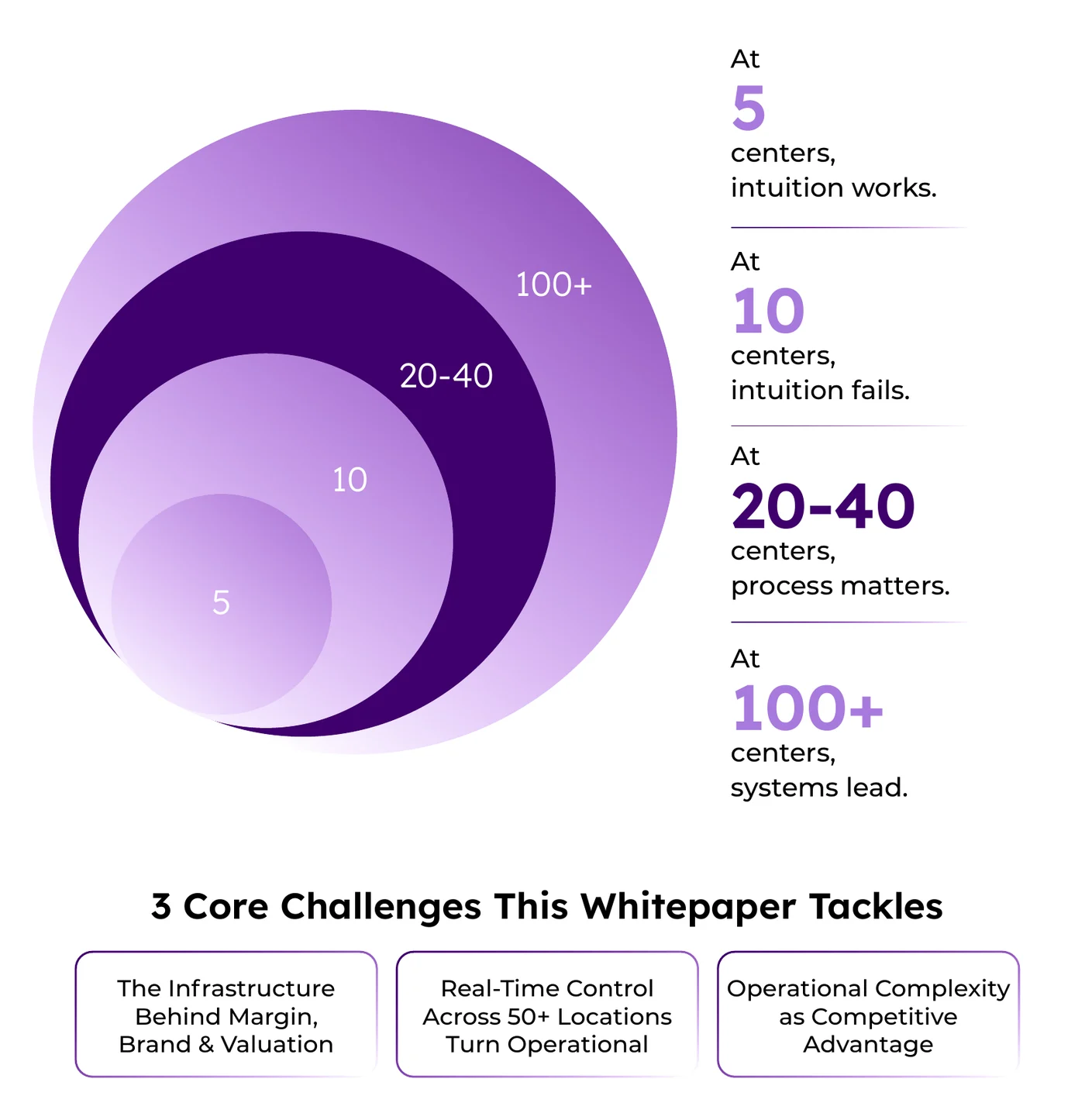
This report focuses on three challenges that follow from that curve: the infrastructure behind margin, brand and valuation; real-time control across 50+ locations; and turning operational complexity into a competitive advantage.
How do you know if you have outgrown your tech stack?
Growth exposes what your systems cannot handle. Most multicenter CEOs have not paused to assess whether their organization is built to scale or simply built to survive across seven dimensions:
- People and leadership
- Compliance and risk
- Enrollment and admissions
- Process and systems
- Financial and revenue
- Operational and quality
- Data and visibility
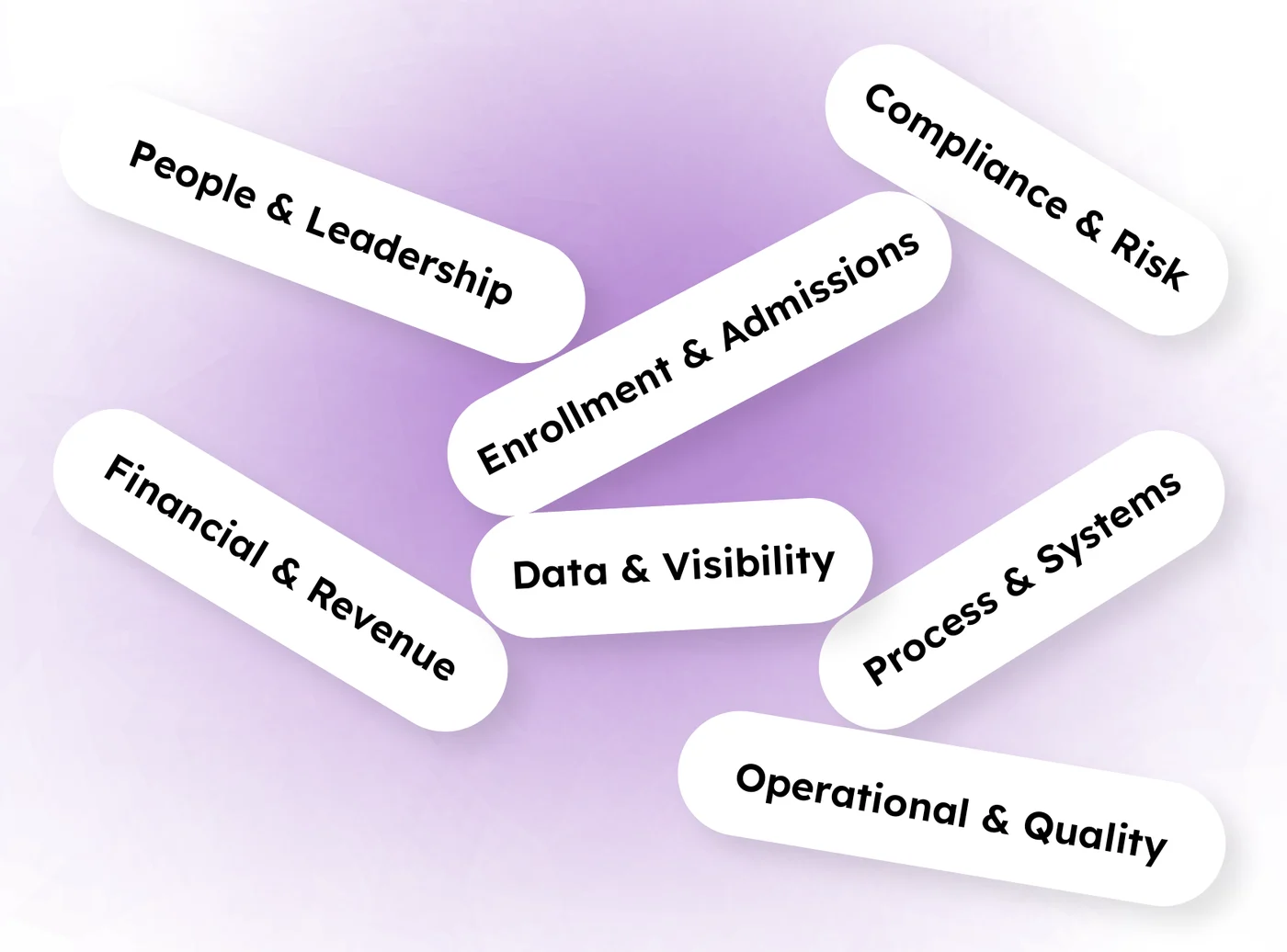
Beneath all of it sits a harder question: are the platforms you run on designed for multicenter complexity, or are they patched-together solutions that made sense at two locations but buckle at 50? The difference between scattered tools pulling teams in different directions and one unified platform giving a single view of the whole network is the difference between managing chaos and leading with clarity.
Why is scaling childcare centers so complex?
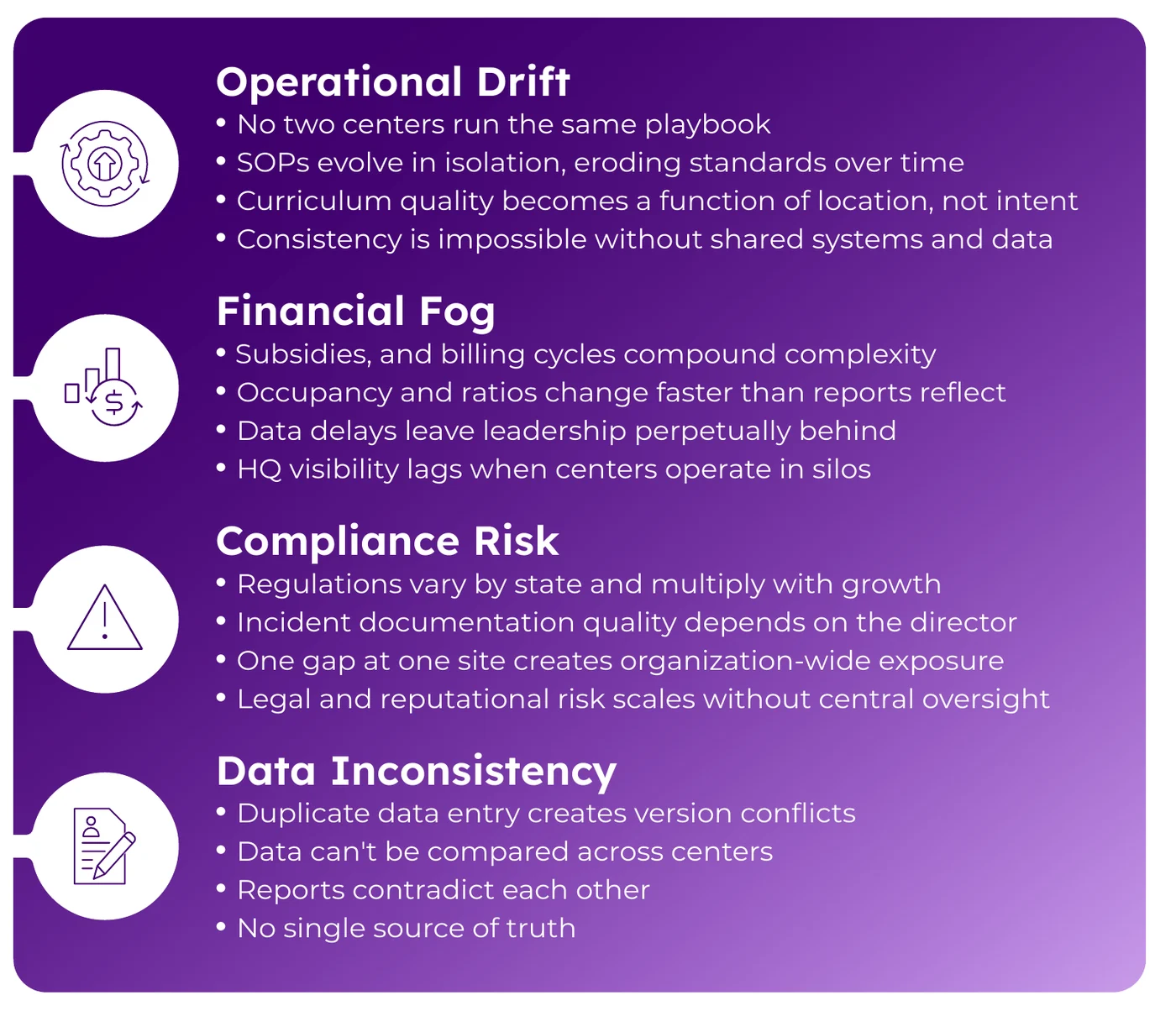
Operational drift
- No two centers run the same playbook.
- SOPs evolve in isolation, eroding standards over time.
- Curriculum quality becomes a function of location, not intent.
- Consistency is impossible without shared systems and data (see how leading networks approach multicenter childcare operations).
Financial fog
- Subsidies and billing cycles compound complexity, which is why growing networks centralize childcare billing and subsidy management.
- Occupancy and ratios change faster than reports reflect.
- Data delays leave leadership permanently behind.
- HQ visibility lags when centers operate in silos.
Compliance risk
- Regulations vary by state and multiply with growth.
- Incident documentation quality depends on the individual director.
- One gap at one site creates organization-wide exposure.
- Legal and reputational risk scales without central oversight and childcare compliance software that covers every site.
Data inconsistency
- Duplicate data entry creates version conflicts.
- Data cannot be compared across centers.
- Reports contradict each other.
- There is no single source of truth.
The question is not whether these challenges exist. It is whether your current platforms are built to handle them. Most multicenter operators run on a patchwork of tools designed for single-site simplicity, and as the network grows, so does the gap between what the systems can tell you and what you actually need to know.
Is your childcare software built for multicenter scale?
The childcare sector is scaling faster than the systems designed to support it. Multicenter networks grow through acquisitions and new builds, yet most still operate like a cluster of independent centers rather than one organization. Every location ends up with its own procedures, and billing rules, enrollment processes and compliance habits get buried inside systems never designed for enterprise growth.
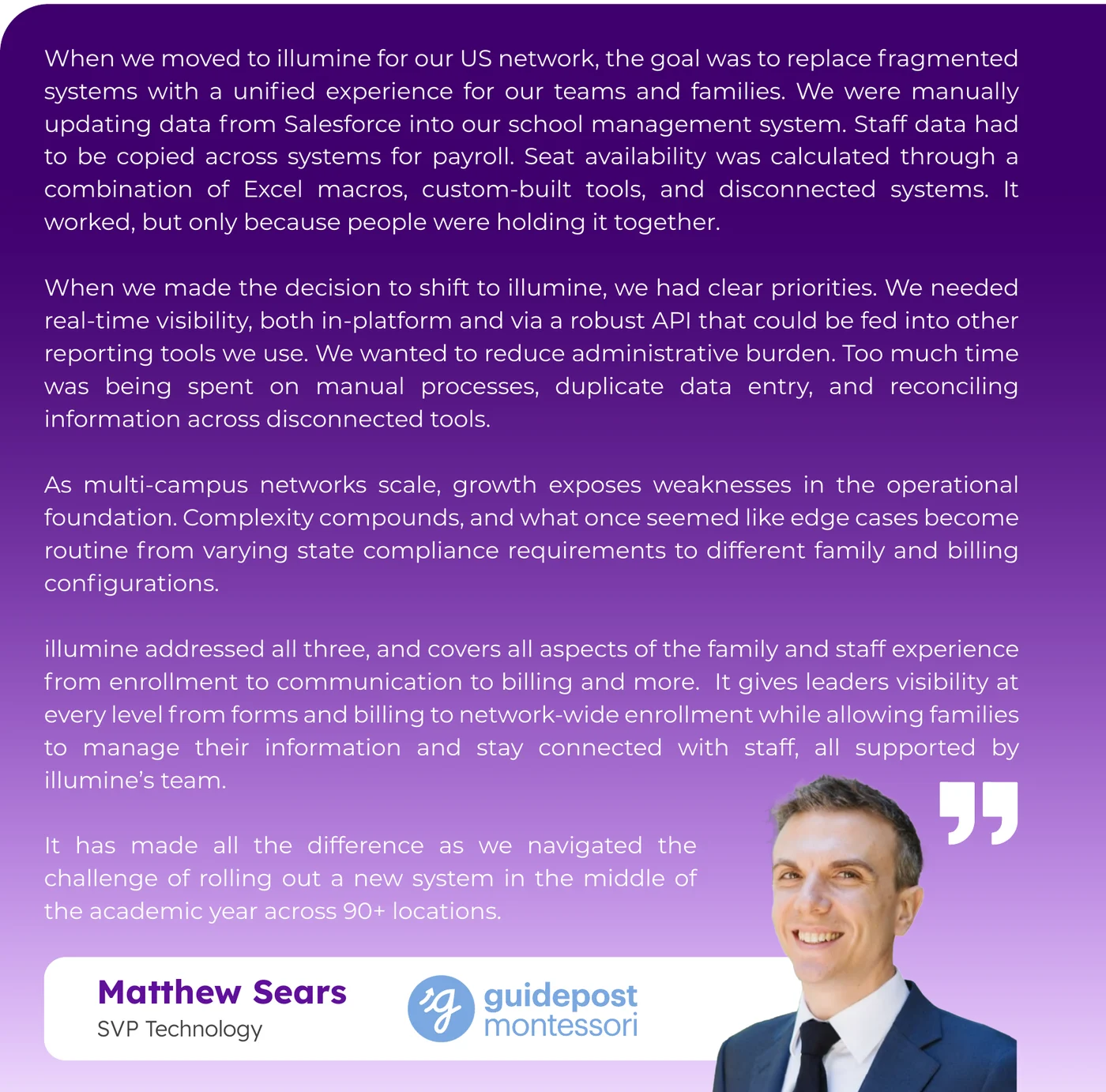
Guidepost Montessori, which operates 90+ locations in its US network, faced exactly this. Matthew Sears, Senior Vice President of Technology at Guidepost Global Education, describes the move to illumine:
"When we moved to illumine for our US network, the goal was to replace fragmented systems with a unified experience for our teams and families. We were manually updating data from Salesforce into our school management system. Staff data had to be copied across systems for payroll. Seat availability was calculated through a combination of Excel macros, custom-built tools, and disconnected systems. It worked, but only because people were holding it together."
"When we made the decision to shift to illumine, we had clear priorities. We needed real-time visibility, both in-platform and via a robust API that could be fed into other reporting tools we use. We wanted to reduce administrative burden. Too much time was being spent on manual processes, duplicate data entry, and reconciling information across disconnected tools."
"It has made all the difference as we navigated the challenge of rolling out a new system in the middle of the academic year across 90+ locations." Matthew Sears, SVP Technology, Guidepost Montessori
For a closer look at how Montessori schools and networks are approaching the same shift, see Tim Seldin's guide Rethinking Montessori Operations.
As multi-campus networks scale, growth exposes weaknesses in the operational foundation. Complexity compounds, and what once seemed like edge cases become routine, from varying state compliance requirements to different family and billing configurations.
What infrastructure do multi-site childcare operators need?
Modern multicenter operations rest on three layers of infrastructure that work together:
- A unified data backbone
- Connected workflows
- Intelligent automation and decision support
Layer 1: Unified data backbone
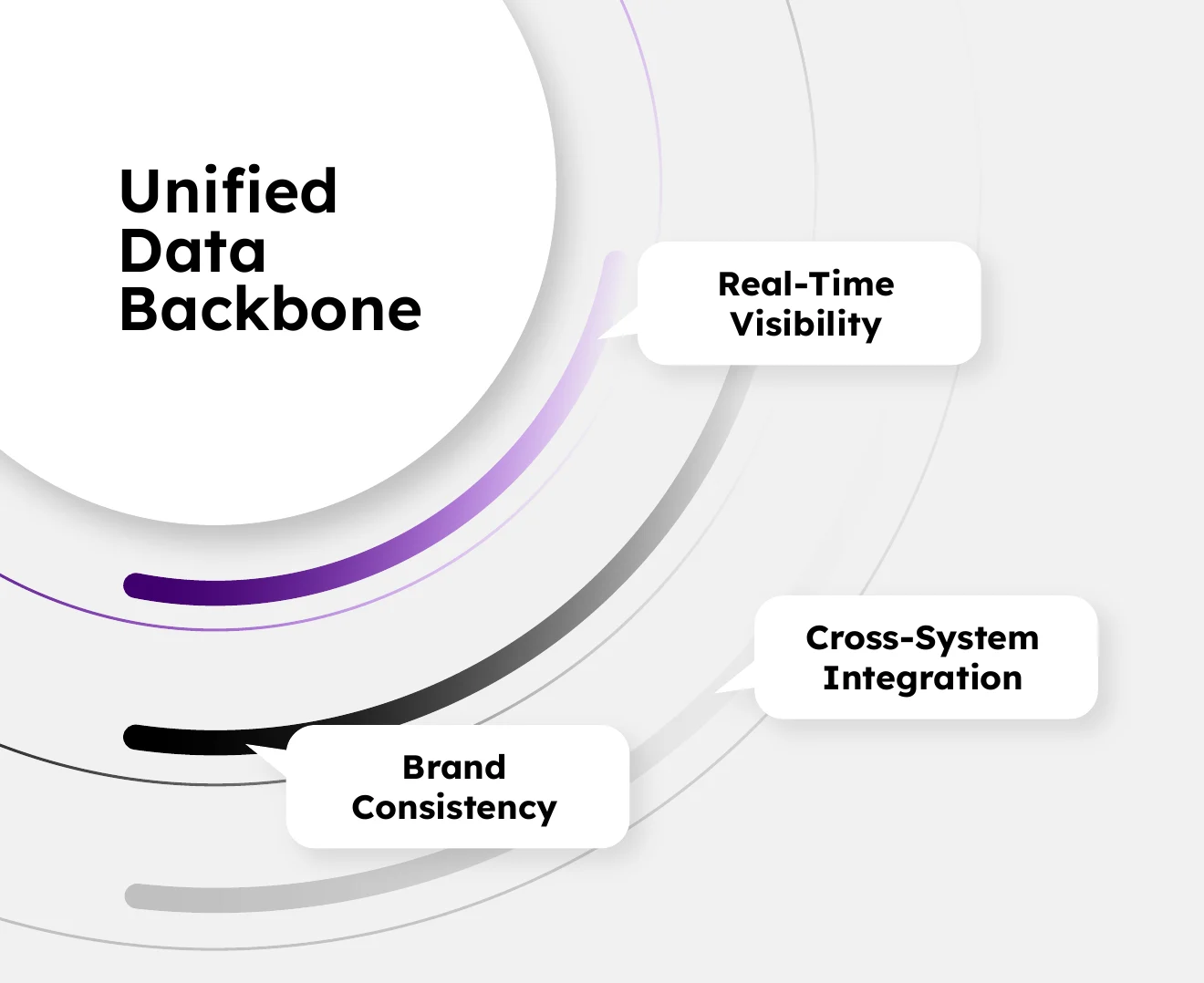
Multicenter organizations cannot scale on fragmented information. When each center tracks enrollment, revenue, staffing and compliance differently, leadership loses visibility into network health. Without a unified backbone, KPIs drift site to site and HQ makes decisions on delayed, incomplete data.
- Real-time visibility. Live data shifts oversight from retrospective reporting to performance management. Center-level cash flow, inquiry-to-admission conversion and channel ROI become visible across the portfolio, and leadership moves from reactive troubleshooting to proactive guidance.
- Brand consistency. Without shared data, friction compounds. Central teams juggle multiple logins, communications vary by location, and events are reported separately. At 50+ centers this creates brand inconsistency, revenue leakage and leadership blind spots.
- Cross-system integration. Scaling needs data that flows across the whole ecosystem, not just centralized data. With integrated systems, KPIs stop living in silos, and finance, operations, HR and enrollment teams work from the same numbers.
What industry leaders say about scaling right
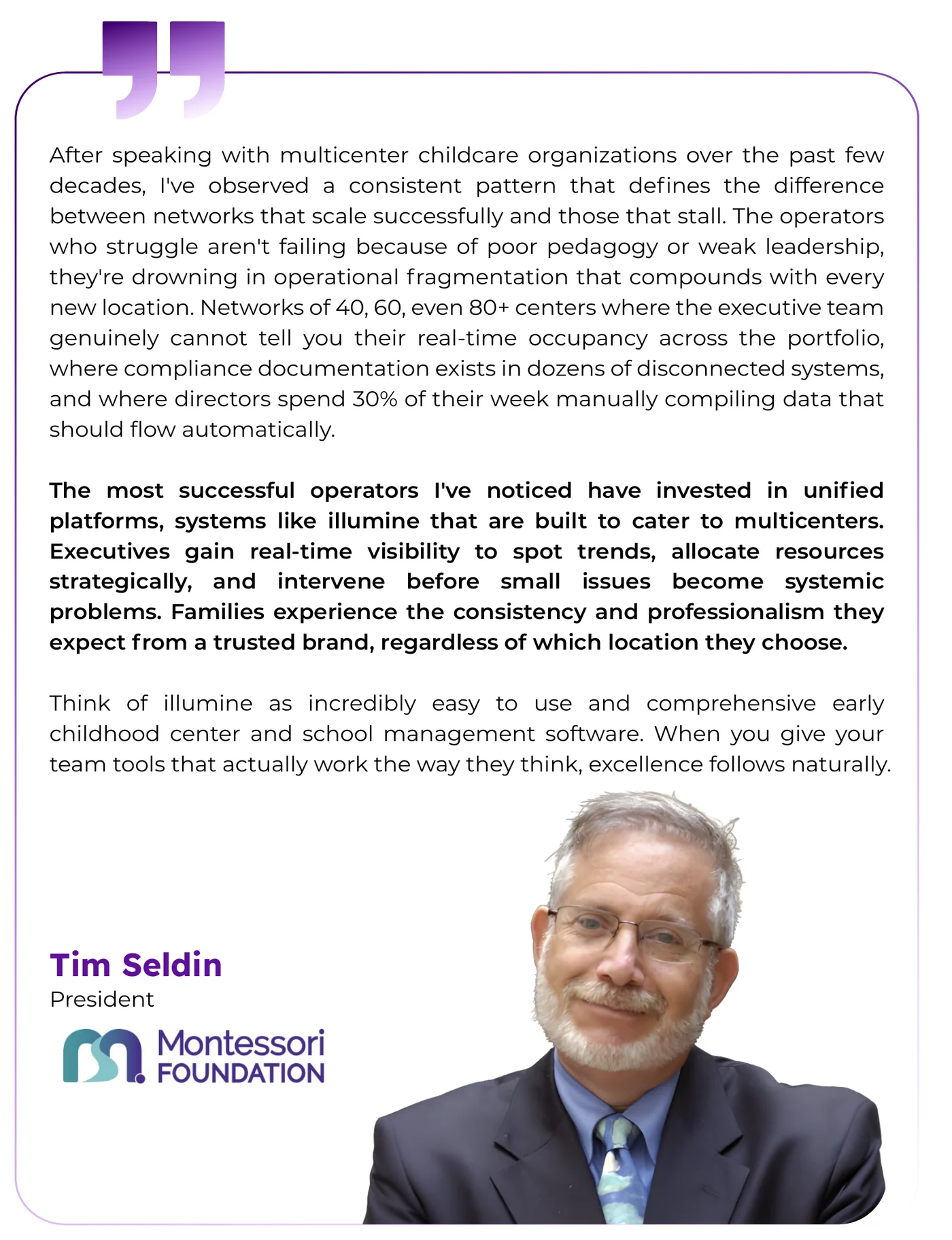
"After speaking with multicenter childcare organizations over the past few decades, I've observed a consistent pattern that defines the difference between networks that scale successfully and those that stall. The operators who struggle aren't failing because of poor pedagogy or weak leadership, they're drowning in operational fragmentation that compounds with every new location. Networks of 40, 60, even 80+ centers where the executive team genuinely cannot tell you their real-time occupancy across the portfolio, where compliance documentation exists in dozens of disconnected systems, and where directors spend 30% of their week manually compiling data that should flow automatically."
"The most successful operators I've noticed have invested in unified platforms, systems like illumine that are built to cater to multicenters. Executives gain real-time visibility to spot trends, allocate resources strategically, and intervene before small issues become systemic problems. Families experience the consistency and professionalism they expect from a trusted brand, regardless of which location they choose." Tim Seldin, President, Montessori Foundation
Layer 2: Connected workflows
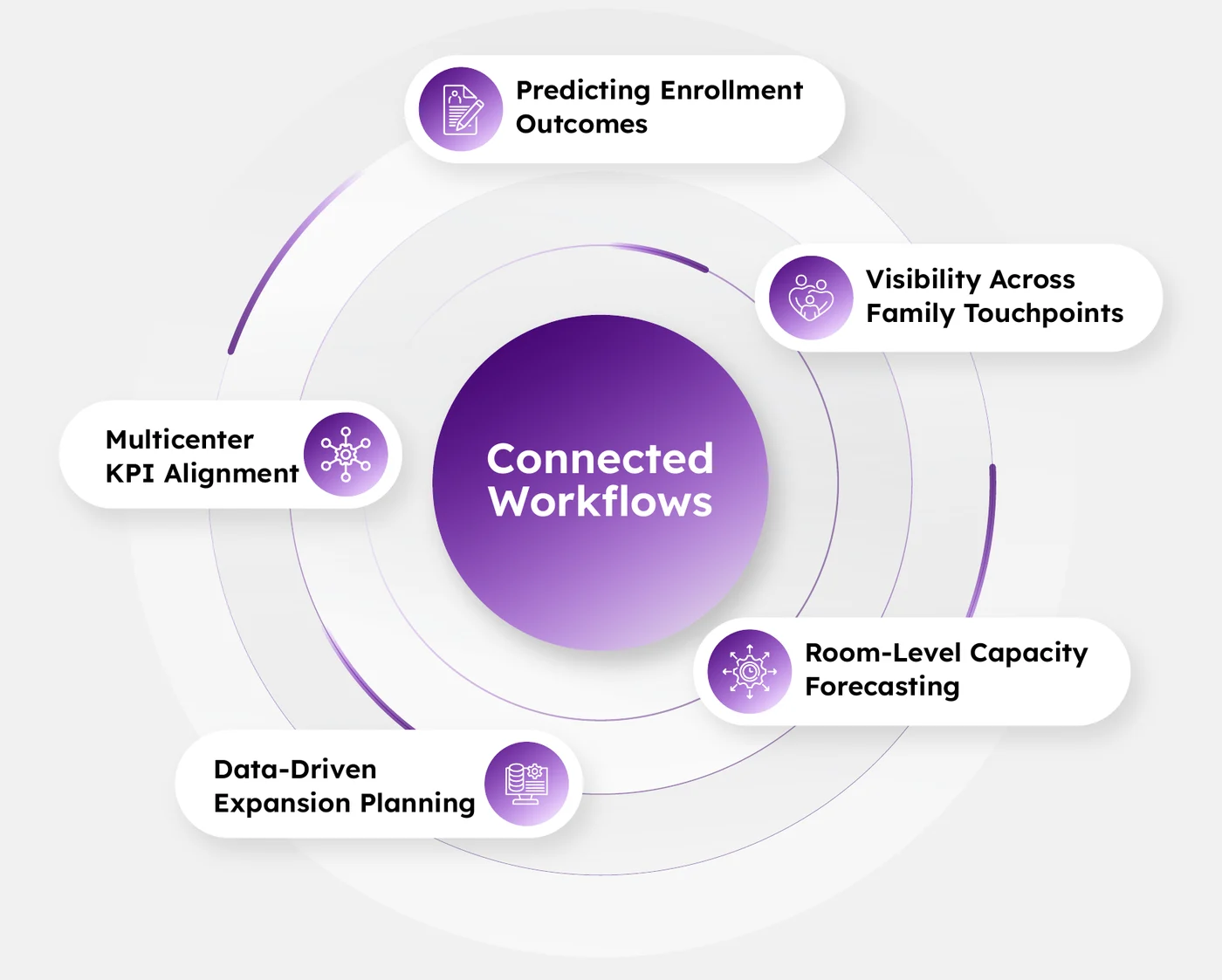
Many multicenter networks run marketing, admissions, staffing and finance as separate functions, each with its own tools, data and assumptions. Families fall through the cracks, enrollment forecasts are unreliable, and HQ makes expansion decisions without a clear picture of occupancy or demand.
Across the multicenter operators illumine has spoken with, the average response time to a new enrollment lead is 6 days. By then, most parents have already moved on. An AI enrollment agent that answers every call and books tours around the clock closes that gap. Connected workflows fix the rest. When every function operates from shared, real-time data, teams gain:
- Multicenter KPI alignment
- Enrollment outcome prediction
- Visibility across every family touchpoint
- Room-level capacity forecasting
- Data-driven expansion planning
Leaders can finally see and act on what is happening across every location, not just the loudest one.
Layer 3: Intelligent automation
The risks that derail centers rarely announce themselves. They accumulate quietly and surface too late. According to illumine data, 72% of multicenter leaders lack real-time visibility into individual center performance, and networks take 3X longer to scale without centralized operations.
- Ratio and staffing alerts. A single absence, an early pickup or a classroom transition can push a center into ratio risk. Automation built on real-time attendance and occupancy data identifies which centers consistently operate near ratio limits, a signal of deeper staffing or scheduling issues.
- Financial intelligence. Automated financial monitoring surfaces issues the moment they emerge, so teams intervene early, collections become more predictable and revenue forecasting becomes more accurate.
- Demand forecasting. Automation highlights programs falling behind and centers drawing more inquiries than their capacity supports, so leaders can reallocate rooms, shift resources or adjust staffing plans.
- Compliance monitoring. Compliance gets exponentially harder across locations. Intelligent systems track gaps, incident patterns and documentation inconsistencies long before they turn into citations.
What are the three levers of successful multicenter operations?
1. Parent experience
A cohesive parent experience is one of the strongest drivers of retention in a multicenter network. Families expect transparent communication, consistent daily updates and a seamless administrative experience, no matter which location they attend. One parent communication platform used by every center is what makes that consistency possible.
2. Enrollment and revenue growth
Close to half of early childhood programs are enrolled below their preferred capacity, according to NAEYC's January 2026 survey of more than 7,000 educators, with family affordability and staffing cited as the top causes. Leaders need real-time visibility into occupancy, upcoming transitions, demand, and conversion rates from inquiry to enrollment, which is what centralized admissions and enrollment software provides.
3. Operational foresight
Staffing is where many networks feel the strain first. In NAEYC's January 2025 survey, 37% of under-enrolled programs said pay was too low to recruit and retain qualified staff, and 36% said they did not have enough staff. A year later, 22% of educators said they were considering leaving the field. Operational foresight means spotting early signals: which centers are trending toward staffing shortages, where parent satisfaction is slipping, and where program performance is falling behind.
Why are CEOs betting on multi-site childcare networks?
The playbook is clear: operators who scale win, and those who do not tend to get acquired by those who do.
The economics favor scale. Based on illumine analysis, a network of 50 centers sharing centralized billing, enrollment and operations can cut administrative overhead by up to 30% per site, and a unified brand converts families at nearly 2x the rate of independent centers. Real-time data across locations means underperforming sites get fixed in weeks, not quarters. For a real-world example, see how Real Kids cut cash collection time across 43 centers.
But most networks hit a wall. Growth exposes every crack: billing inconsistencies, occupancy blind spots and parent experiences that vary site to site. According to illumine data, the average multi-site operator runs 3 to 5 disconnected tools across its network, a reliable margin killer at scale.
The operators pulling ahead have one thing in common: one system, every site, full visibility.
How illumine supports multicenter childcare networks
illumine is a multi-site childcare management platform purpose-built for large, multicenter preschool and childcare groups, serving 4,000+ centers across 60+ countries and supporting 1.5M+ parent interactions every month. It gives group leadership centralized visibility, standardized workflows and real-time operational insight, while helping individual centers deliver a consistent, high-quality parent experience.
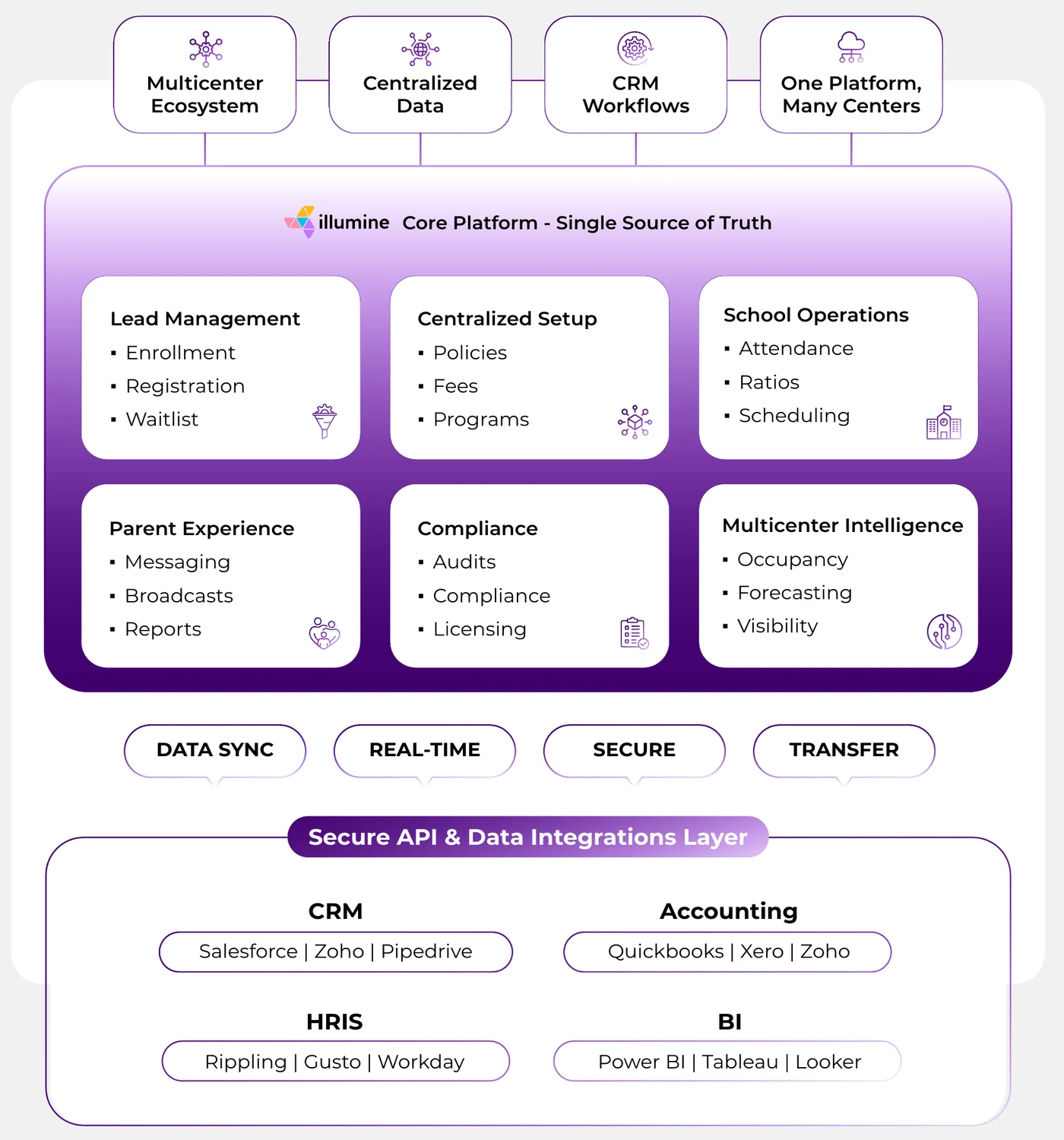
At its core is a single source of truth that connects:
- Lead management: enrollment, registration and waitlists
- Centralized setup: policies, fees and programs
- School operations: attendance, ratios and scheduling
- Parent experience: messaging, broadcasts and reports
- Compliance: audits, compliance tracking and licensing
- Multicenter intelligence: occupancy, forecasting and network-wide visibility
A secure API and integrations layer syncs data in real time with the tools networks already use, including CRM (Salesforce, Zoho, Pipedrive), accounting (QuickBooks, Xero, Zoho), HRIS (Rippling, Gusto, Workday) and BI (Power BI, Tableau, Looker). AI-powered automation flags risks early, supports compliance and reduces repetitive administrative work, freeing directors to focus on quality, people and growth.
Book a demo to see how illumine works across a multicenter network.
Frequently asked questions
When does a childcare network need centralized systems?
The report describes a curve: at 5 centers intuition works, at 10 centers intuition fails, at 20 to 40 centers process matters, and at 100+ centers systems lead.
Why is scaling childcare centers so complex?
Four problems compound with every new location: operational drift as SOPs evolve in isolation, financial fog from subsidies and billing cycles, compliance risk as regulations vary by state, and data inconsistency when there is no single source of truth.
What infrastructure do multi-site childcare operators need?
Three layers that work together: a unified data backbone, connected workflows across marketing, admissions, staffing and finance, and intelligent automation and decision support.
How fast do multicenter childcare operators respond to new enrollment leads?
Across the multicenter operators illumine has spoken with, the average response time to a new enrollment lead is 6 days. By then, most parents have already moved on.
How big is the US childcare market?
Grand View Research values the US childcare market at $86.2 billion in 2025 and projects it to reach $147.2 billion by 2033, a compound annual growth rate of 7.0%.
Contributors
- Tim Seldin, President, Montessori Foundation (LinkedIn, Montessori Foundation profile)
- Matthew Sears, Senior Vice President of Technology, Global, Guidepost Global Education (LinkedIn, Guidepost Montessori)
Methodology
Scaling Smart is an illumine eBook for CEOs and executive leaders of multi-site childcare networks. It combines published market and industry research with illumine's conversations with multicenter operators, and perspectives from Tim Seldin, President of the Montessori Foundation, and Matthew Sears, SVP of Technology at Guidepost Montessori, an illumine customer. illumine supports the Montessori Foundation's work with schools. Market, workforce and supply figures are drawn from Grand View Research, Tyton Partners, NAEYC, Child Care Aware of America and the CDC's National Center for Health Statistics. All other figures reflect illumine data and conversations with operators unless otherwise cited.
Sources
- Grand View Research, US Child Care Market Size and Share Report
- Tyton Partners, Investing Early (Childhood): Trends and Investments in the ECE Space
- NAEYC, An Unsustainable Status Quo: January 2025 survey (full brief, PDF)
- NAEYC, January 2026 child care affordability survey
- Child Care Aware of America, Child Care in America: 2025 Price and Supply
- CDC National Center for Health Statistics, Births in the United States, 2025
- Congressional Research Service, R48252
- PR Newswire, illumine partners with Guidepost Montessori to transform preschool operations with AI
Related reports: Rethinking Montessori Operations, Childcare Enrollment Report 2026, What Will Montessori Leadership Look Like in 2030? and The Costs Draining Childcare Centers: USA Cost Benchmark Report.