


Running one childcare center is demanding. Running multiple centers introduces a different kind of complexity altogether.
On paper, policies are standardized, fee structures are defined, discount rules are documented, and parent communication guidelines are set. But when these policies are translated into daily operations across different locations, the outcomes often begin to vary.
One center delivers a smooth, predictable experience for parents. Another struggles with delayed collections or inconsistent communication. Revenue patterns begin to differ. Some locations perform reliably, while others fluctuate.
These differences rarely come from a lack of intent or effort. They come from how policies are interpreted and implemented at the center level.
Over time, that gap between policy and execution becomes the biggest operational challenge for multi-center childcare organizations.
The Hidden Challenges of Running Multiple Childcare Centers
As organizations expand, visibility and control become harder to maintain. Leadership teams often assume that standardization at the policy level will naturally translate into consistency at the operational level. In reality, the opposite tends to happen.
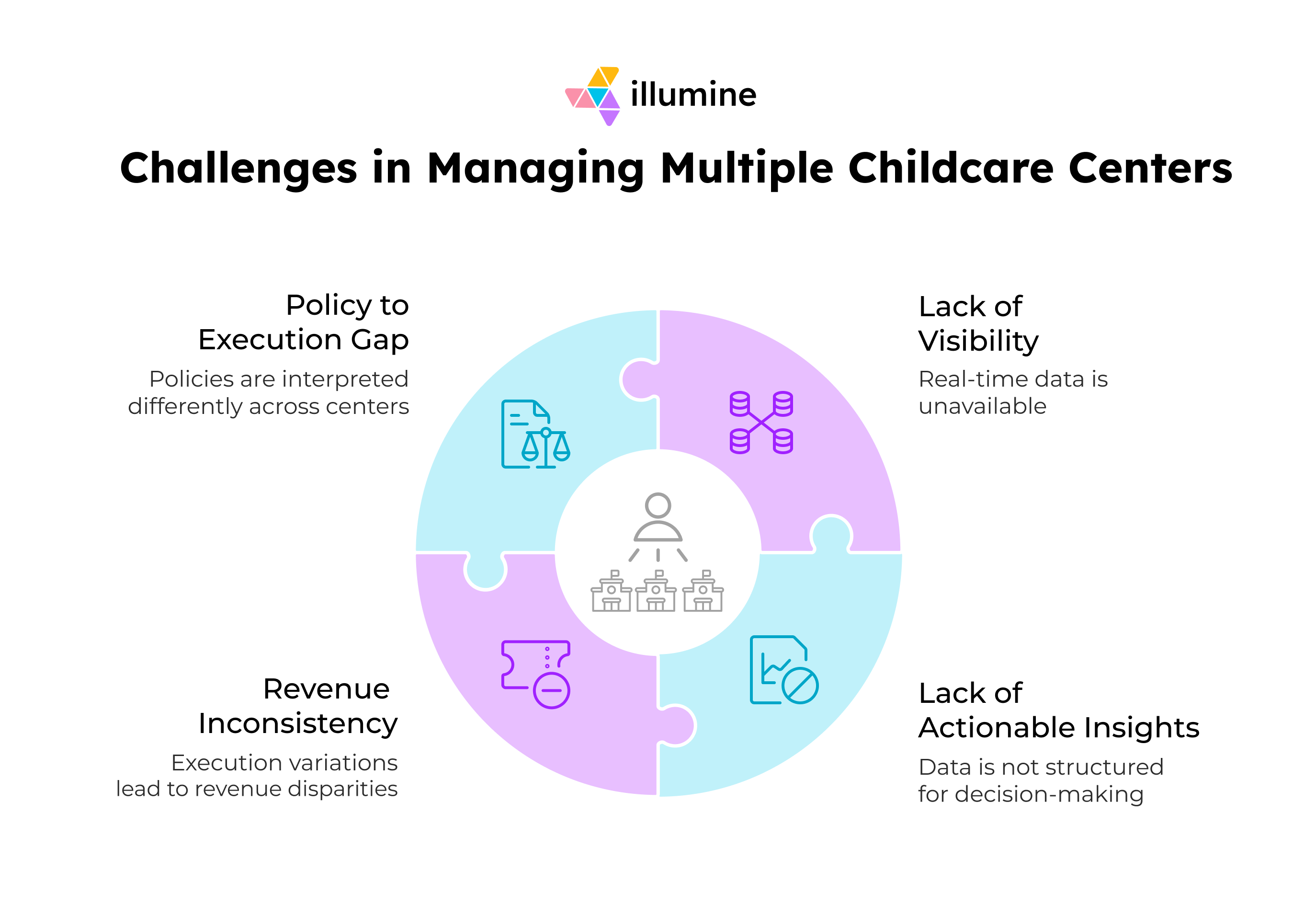
1. Lack of visibility across centers
Most leadership teams do not have a real-time view of what is happening inside each center. Data is often delayed, aggregated, or scattered across systems.
This makes it difficult to understand day-to-day performance or identify issues early. By the time a problem becomes visible, it has already affected operations.
2. Lack of actionable insights
Even when data is available, it is often not structured to support decision-making.
Leaders may see total revenue numbers, overall collections, or high-level reports. But they cannot easily answer:
- Which centers are underperforming and why?
- Where are discounts being overused?
- Which locations are slower in collecting fees?
Without this level of insight, decision-making becomes reactive.
3. Policy to execution gap
Every center operates with its own manager, team, and day-to-day realities. Even with the same policies in place, execution varies.
This shows up in:
- different interpretations of discount eligibility
- variations in fee collection discipline
- inconsistencies in how processes are followed
These differences may seem small at first, but they compound quickly.
4. Revenue inconsistency across locations
When execution varies, revenue patterns follow. Some centers may apply discounts more loosely, delay collections, or deviate from defined fee structures.
Others may follow policies more strictly and perform better. Without clear visibility, these inconsistencies are hard to detect early and even harder to correct.
Why Operational Fixes Alone Don’t Work at Scale
Most organizations try to solve multi-center inconsistencies through operational changes first. They invest in better training, create stricter SOPs, increase the frequency of reviews, and introduce internal audits to keep centers aligned. These steps are useful, and in many cases necessary, but they can only go so far.
The problem is that operational fixes still depend heavily on manual follow-through. They rely on individual discipline, local decision-making, and each center manager’s ability to interpret and implement policies in the same way. At a smaller scale, this may still be manageable. But as the number of centers grows, the chances of variation increase with it.
What works across one or two locations often becomes harder to sustain across five, ten, or more. Small differences in execution begin to show up more often, and over time, they affect both parent experience and financial performance. This is where many organizations hit a ceiling. Processes can guide behavior, but on their own, they do not create consistency at scale. Systems do.
How Childcare Management Software Solves Multi-Center Complexity
Childcare management software plays a critical role in bridging the gap between policy and execution.
Instead of relying on multiple channels like spreadsheets, manual tracking, or fragmented reports organizations can move toward a system where operations are structured, visible, and easier to control. They provide:
1. Centralized operational control
Software allows headquarters to define key configurations centrally, such as fee structures and discount rules. At the same time, it can allow controlled flexibility at the center level.
This ensures that:
- Critical policies are followed consistently
- Unnecessary variations are reduced
- Teams can still operate efficiently within defined boundaries
2. Real-time visibility across centers
Rather than waiting for reports, leadership teams can see what is happening across centers in real time. This includes billing status, collections, outstanding payments, and operational/revenue trends
This visibility makes it easier to identify issues early and act before they escalate.
3. Revenue and collection intelligence
Software moves beyond simple reporting and provides deeper insights into financial performance.
Instead of just seeing how much has been billed, leadership can understand:
- How quickly are payments collected
- Where delays are happening
- How performance varies across locations
4. Standardization of execution
When processes are embedded into a system, they are less dependent on individual interpretation.
This reduces inconsistencies across centers by reducing reliance on manual enforcement. It also helps reduce variability in outcomes. Over time, this leads to more predictable operations.
How illumine’s Multi-Center Dashboard Brings This to Life
For multi-center organizations, the challenge is not just collecting data. It is being able to see patterns, enforce consistency, and act on insights across all locations without relying on manual intervention.
illumine’s multi-center dashboard is designed to do exactly that. It brings together financial visibility, operational insights, and system-level controls into one unified view, so leadership teams can manage performance across centers with far greater clarity.
1. Unified Billing and Accounting Dashboard
At the core of multi-center operations is financial consistency. But in most organizations, revenue visibility is either too high-level or too fragmented to act on.
illumine’s billing and accounting dashboard provides a structured, center-by-center view of financial performance. Instead of relying on aggregated numbers, leadership teams can understand exactly how each location is performing.
From a single dashboard, you can track:
- Total billed, collected, overdue, and outstanding amounts
- Center-wise revenue performance and comparisons
- Discount amounts and credit notes applied
- Monthly revenue vs expense trends
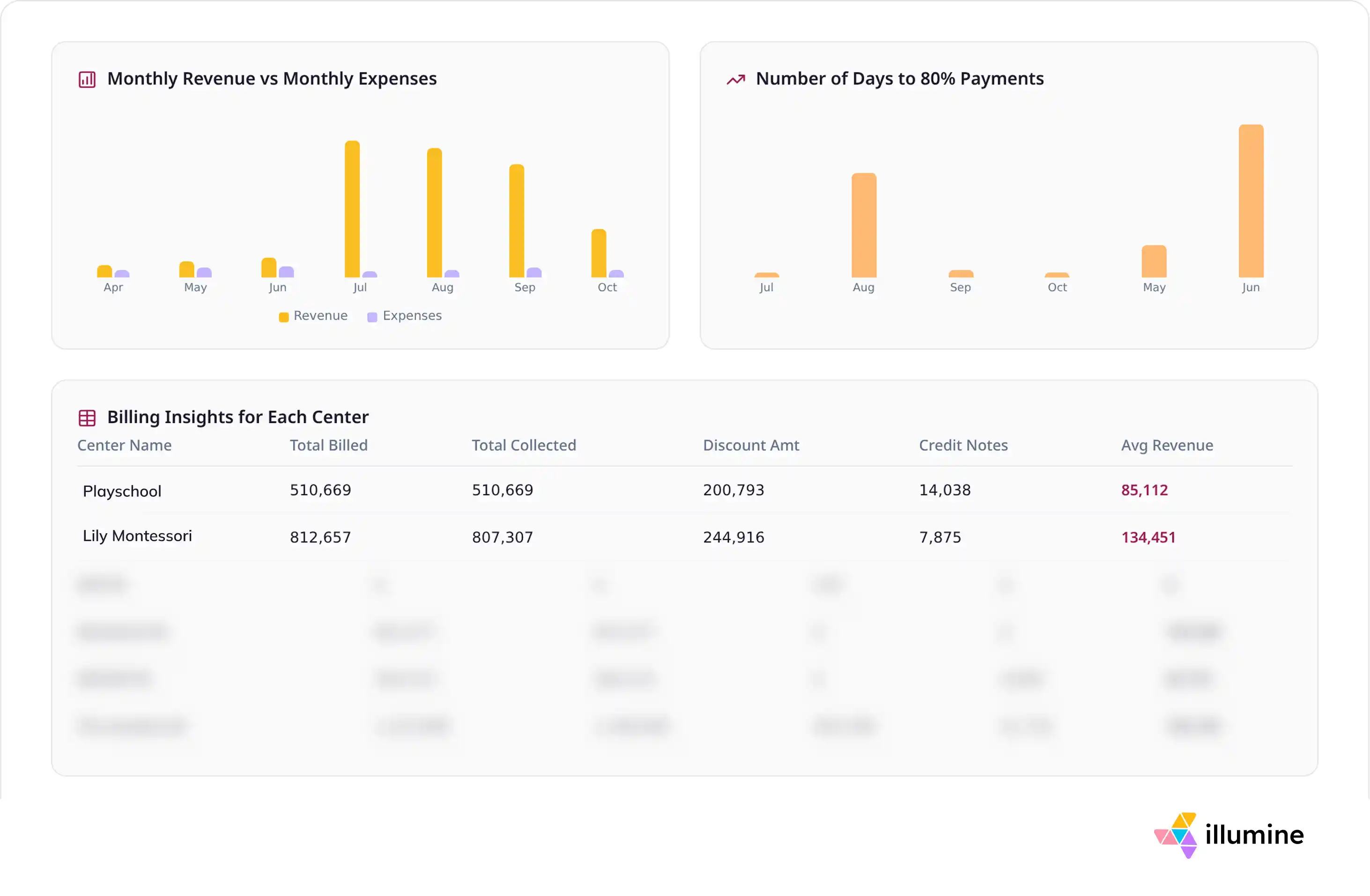
This level of visibility helps answer critical questions that are often difficult to track manually. Which centers are collecting efficiently? Where are delays happening? Are discounts being applied consistently?
In addition, the dashboard introduces a practical metric that reflects cash-flow health: the number of days required to collect 80 percent of fees after invoices are sent. This helps leadership move beyond static revenue numbers and understand how quickly revenue is actually being realized.
2. Occupancy Visibility and Forecasting Across Centers
While revenue reflects past performance, occupancy reflects both current engagement and future potential.
illumine’s occupancy dashboard gives leadership teams a clear view of how each center is performing in terms of enrollment capacity and utilization. Instead of looking at static enrollment numbers, the dashboard provides a more dynamic view of how occupancy is evolving.
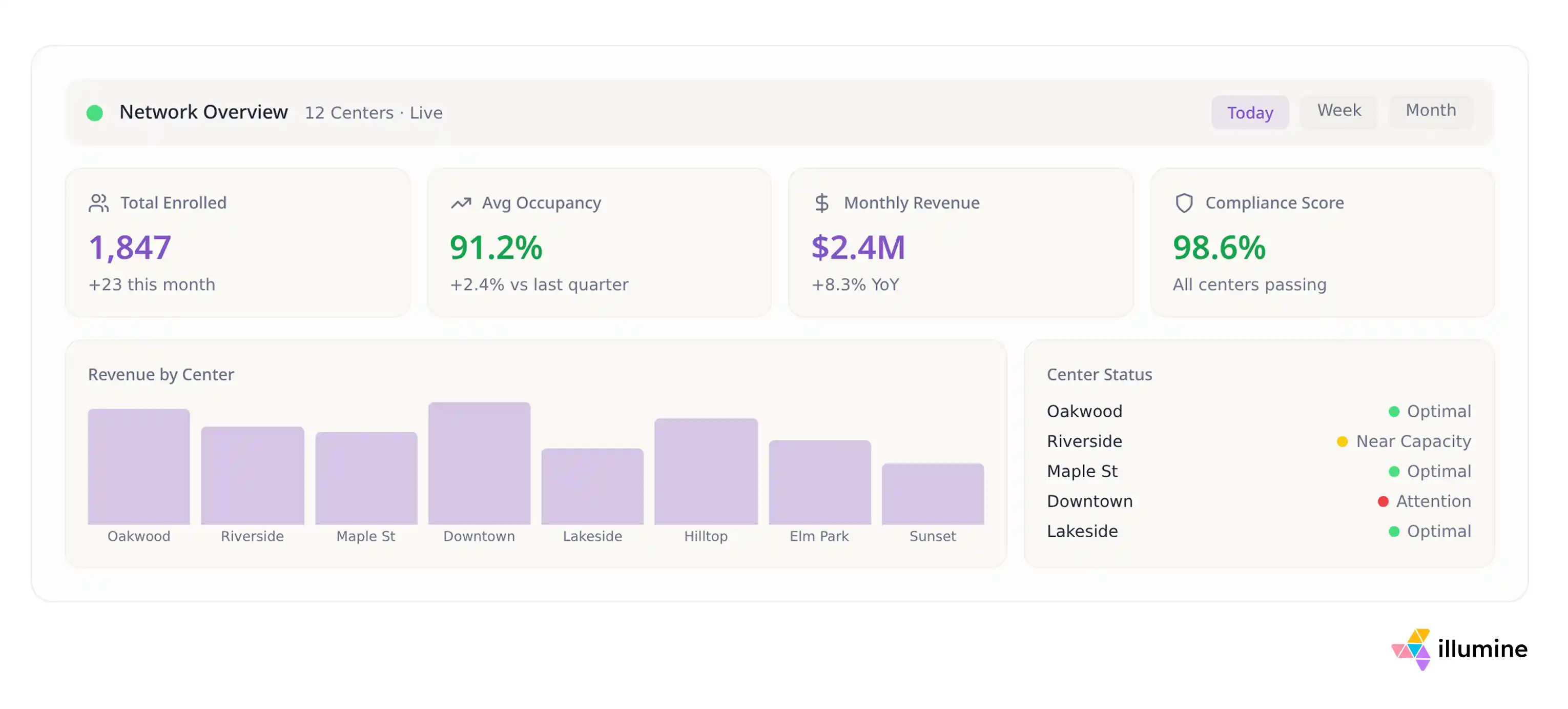
You can monitor:
- Total enrollments across centers
- Percentage of seats occupied in each location
- Monthly occupancy trends to identify patterns
- Projected changes based on retention and new enrollments
This makes it easier to understand not just how full a center is today, but where it is heading.
For example, a center with strong current occupancy but declining retention may show early signs of future revenue impact. Similarly, trends across months can help identify seasonal patterns or shifts in demand.
By connecting occupancy data with revenue trends, leadership teams can make more informed decisions around capacity planning, marketing focus, and resource allocation.
3. Enrollment Funnel Visibility Across Centers
One of the most overlooked areas in multi-center operations is the enrollment process itself.
Many organizations track final enrollment numbers but lack visibility into how efficiently leads are being converted across centers. This makes it difficult to understand whether performance differences are due to demand, process gaps, or channel effectiveness.
illumine’s enrollment dashboard addresses this by providing a structured view of the entire enrollment funnel across locations.
From this dashboard, you can:
- Track conversion rates from inquiry to enrollment for each center
- Compare performance across different locations
- Analyze enrollments by channel to understand what is working in different markets
- View the stages of enrollment for students across centers
This level of insight helps leadership teams move beyond assumptions and identify where improvements are needed.
For example, one center may receive a high volume of inquiries but struggle with conversions, while another may convert efficiently with fewer leads. Similarly, certain channels may perform better in specific regions or audiences.
By understanding these patterns, organizations can refine their enrollment strategies and improve overall efficiency.
4. Governance, Access Control, and Audit Readiness
As organizations scale, maintaining control over who can change what becomes just as important as visibility.
illumine supports this through a structured work hierarchy and configurable access controls, allowing leadership teams to define roles and responsibilities clearly across the organization.
Administrators can:
- Control who can create, edit, or update programs and fee structures
- Define access levels for directors, teachers, and staff
- Restrict changes to sensitive configurations at the center level
This ensures that critical decisions remain aligned with organizational policies while still allowing teams to operate efficiently within their roles.
In addition, illumine supports features that strengthen financial governance and audit readiness.
For example:
- Revenue for specific months can be locked, preventing retrospective changes
- An audit trail captures who made changes, what was changed, and when
This creates a clear and traceable record of activity across the system, making reconciliation easier and reducing risk during audits.
Instead of relying on manual checks or fragmented records, leadership teams have a system that supports both control and accountability at scale.
Final Thoughts
Multi-center childcare operations do not struggle because of poor policies.
They struggle because maintaining consistency across locations is inherently difficult without the right systems in place.
The goal is not to control every decision at every center. It is to create a structure where:
- Key processes are standardized
- Performance is clearly visible
- Issues can be identified and addressed early
With the right dashboard, leadership teams can move from reactive management to proactive control.
And that is what allows multi-center organizations to grow without losing consistency along the way.