



The Childcare Enrollment Report 2026 is a playbook for leaders of multi-site childcare networks on why enrollment performance stays inconsistent even when demand is strong, and how to build an enrollment system that converts predictably across every center. It includes perspectives from Harjit Rai (Otter Learning), Jessica Van Hoose (The Nest Schools), Rajesh Kumar (Kids Kingdom), Ruth Ann Rose (Rose Marketing Solutions) and Gaurav Ranjan (Prime Venture Partners).
Key findings
- Firms that contact a new online lead within an hour are nearly seven times as likely to qualify it as firms that wait even one hour longer, according to research published in Harvard Business Review.
- Across most multi-site childcare networks illumine works with, the average response time to a new inquiry is more than 26 hours, according to illumine data.
- Tour no-show rates run at 35 to 40% without automated reminders and fall below 12% with structured reminder workflows, according to illumine data.
- Families typically need 8 to 11 touchpoints before enrolling, according to illumine data, and usually take 3 to 14 days after a tour to decide.
- Across Rose Marketing Solutions' 18-year portfolio of childcare clients, roughly six in ten qualified families go on to schedule a tour.
- At Otter Learning's high-performing locations, time from inquiry to scheduled tour was 24 hours or less. At underperforming locations it was 7 to 10 days, and enrollment conversion tracked that metric directly.
- US births fell 1% in 2025 to 3,606,400 (CDC), and the number of licensed child care centers declined 1% from 2024 to 2025 (Child Care Aware of America).
- The US childcare market is projected to grow from $86.2 billion in 2025 to $147.2 billion by 2033 (Grand View Research).
Why is enrollment so inconsistent across multi-site childcare networks?
The US childcare market keeps growing: Grand View Research values it at $86.2 billion in 2025 and projects $147.2 billion by 2033. Yet for multi-site operators, enrollment performance remains inconsistent, unpredictable, and dependent on individual directors. Demand is also getting harder to win. The CDC recorded a 1% fall in US births in 2025, and Child Care Aware of America reports that licensed centers declined 1% from 2024 to 2025, so every qualified family counts for more than it used to.
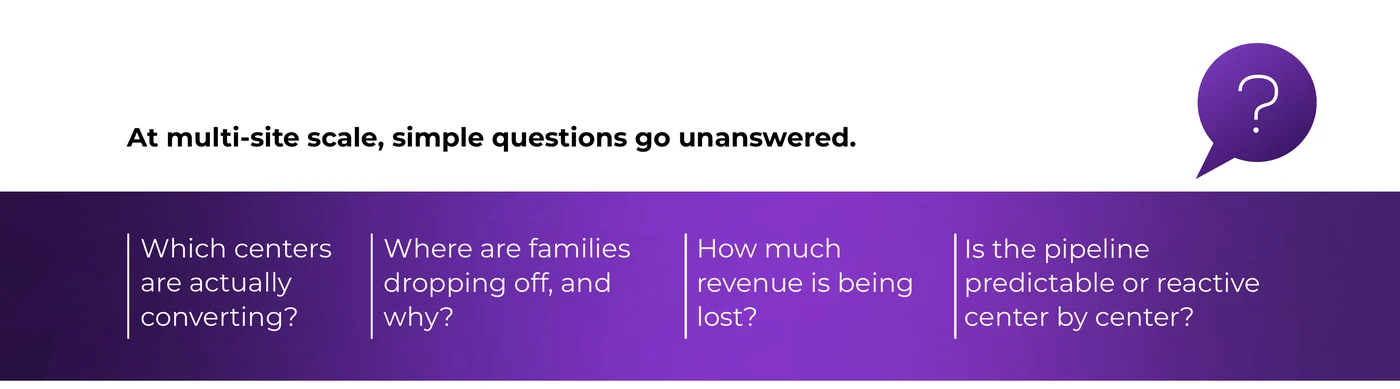
Operators running 50, 80 or 100+ centers face a consistent reality: leads sit in different tools, follow-ups depend on individual directors, and conversion rates vary more than they should. At multi-site scale, simple questions go unanswered.
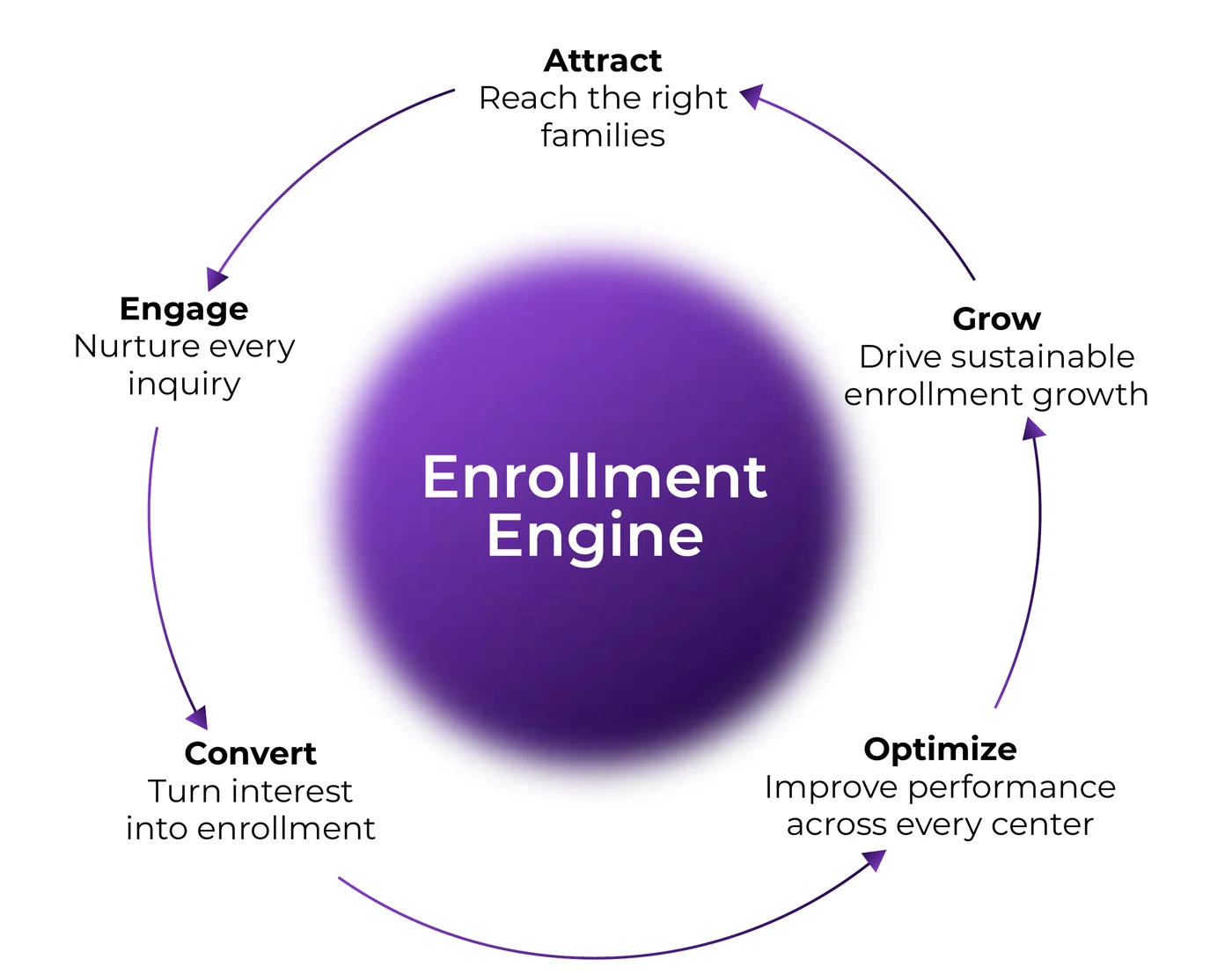
This is not a marketing problem. It is an infrastructure problem. High-performing networks treat enrollment as one engine that attracts the right families, engages every inquiry, converts interest into enrollment, optimizes performance across every center, and drives sustainable growth.
Where do childcare centers lose families after the first inquiry?
The inquiry arrives. A parent fills out a form and waits. Across most multi-site networks illumine works with, response times average more than 26 hours. Research published in Harvard Business Review found that firms contacting a new lead within an hour were nearly seven times as likely to qualify it as those that waited even an hour longer, and families researching childcare are usually contacting several providers at once.
The friction compounds from there: inconsistent tours, director-dependent follow-up and manual registration. According to illumine data, tour no-show rates hit 35 to 40% without automated reminders, compared with under 12% with structured workflows. Families typically need 8 to 11 touchpoints before they enroll, which is why preventing enrollment drop-offs matters as much as generating leads. Demand is not the problem. Conversion is.
Where do most multi-site operators lose families after the first inquiry, and what is one change that has actually moved the needle?
"Families rarely enroll on the day of their tour. They leave with positive intent, return home, discuss the decision, and resolve questions, a process that typically spans 3 to 14 days. During that window, the majority of operators do nothing. The single change that has most consistently moved the needle is structured post-tour follow-up within 72 hours. Not a generic check-in, a substantive conversation that addresses the specific questions raised during the tour and creates a clear path to next steps." Harjit Rai, Senior Vice President Operations, Otter Learning
How should marketing, admissions and registration work together?
Enrollment runs through three connected layers: marketing generates inquiries, admissions nurtures and converts them, and registration finalizes the enrollment.

In most multi-site networks, each layer leaks. Marketing drives inquiries but rarely sees what they become, so leaders cannot link spend to enrollments, and the leak stays invisible because the data stops at the inquiry. It deepens at admissions, where directors lose time to administrative work and high-intent leads slip through. Then comes registration, where the family has already decided, yet a meaningful share of enrollments are still lost to re-entered data, duplicated forms and disconnected billing. Because the layers are connected, the losses compound.
Marketing is measured on leads but rarely sees what happens next. How does that gap shape budget, campaign decisions and optimization?
"We had a client who called us, really worried about her conversion rate. On paper, the marketing was working. Leads were coming in consistently. But enrollment wasn't reflecting it. When our team dug into their CRM, we found over 200 leads that had never received a response. Not a slow response. No response at all. The marketing hadn't failed. The phones weren't being answered. When we brought this to the client's attention, their team quickly identified the cause: staffing coverage during the lunch hour, which happened to be exactly when the highest volume of calls was coming in. It was a solvable operational problem, but it had been invisible because no one was looking at what happened after the inquiry arrived." Ruth Ann Rose, Owner and CEO, Rose Marketing Solutions
Why do enrollment problems multiply across multi-site networks?
You have one center with a 40-family waitlist. You have another center 12 miles away with 11 vacant seats. Neither director knows about the other's situation, and neither system talks to the other. By the time it surfaces in the monthly review, several of those families have enrolled somewhere else. For many networks operating above 20 centers, this is an ordinary Tuesday, and it is why multi-center childcare operations need shared visibility.

As childcare networks scale across locations, what operational visibility is most critical for leadership teams?
"As you scale across multiple sites, the biggest enabler for both marketing and enrollment teams is having a system where everything is connected, from the first inquiry to the final enrollment. Marketing teams gain clear visibility into which campaigns are driving meaningful enrollments, while admissions teams operate with a structured, real-time view of every lead, understanding what stage they're in, what actions are pending, and how to move them forward. From a site or regional leadership perspective, what truly elevates day-to-day operations is visibility, being able to see how each center is performing, where support is needed, and how teams are progressing, without having to piece information together from multiple sources. When that level of clarity exists, teams can focus less on managing processes and more on delivering a consistent, high-quality experience for families across every location." Rajesh Kumar, Co-Founder and CEO, Kids Kingdom
Why don't more tools fix childcare enrollment?
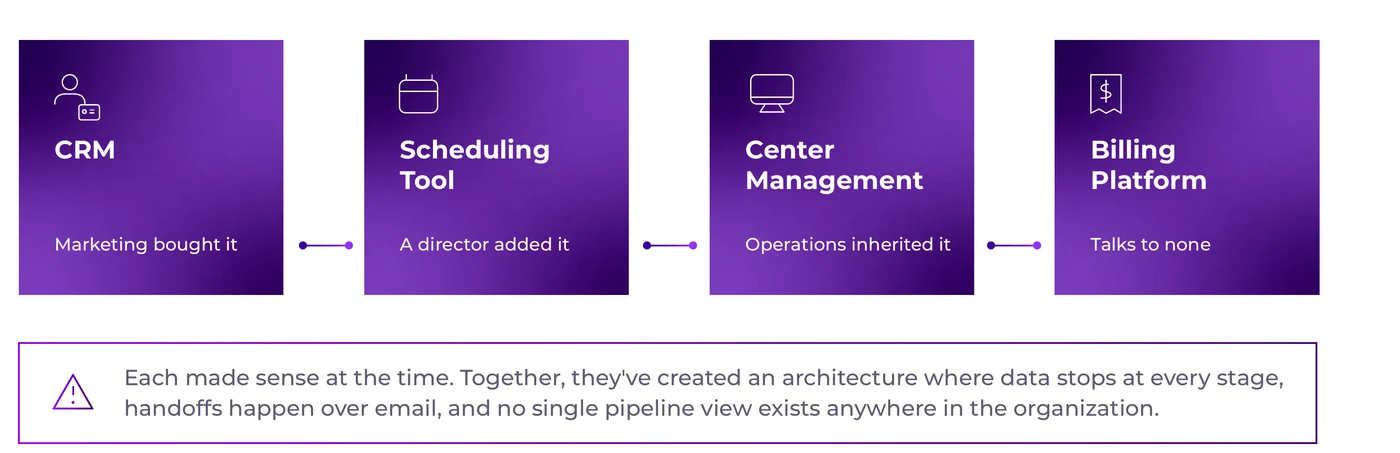
More tools deepen fragmentation. Every new platform is another boundary where data stops, another login directors do not use consistently, another report someone reconciles manually. Most networks above 50 centers are over-tooled and under-connected: a CRM that marketing bought, a scheduling tool a director added, a center management system operations inherited, and a billing platform that talks to none of them. Each made sense at the time. Together, they create an architecture where data stops at every stage, handoffs happen over email, and no single pipeline view exists anywhere in the organization.
What does a connected enrollment system look like?
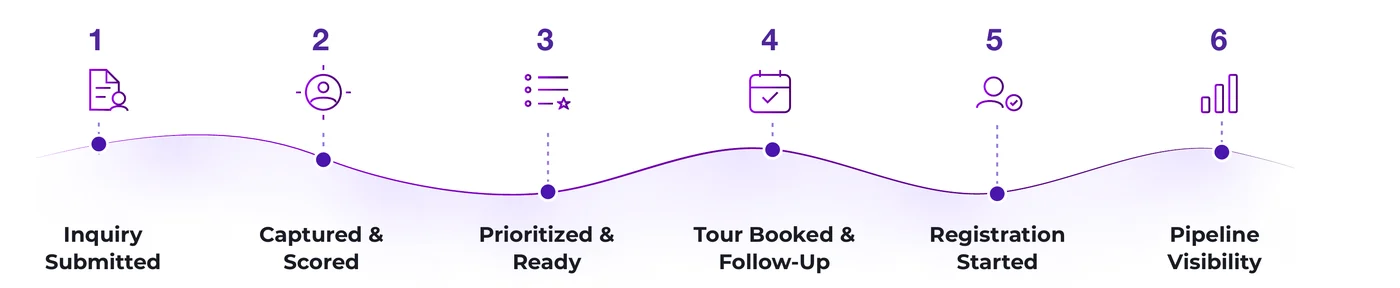
A parent submits an inquiry form, and the lead is captured the moment it arrives. It enters admissions already scored by intent, so it is queued and prioritized rather than sitting in an undifferentiated pile. The admissions team starts each day with that prioritized list, working the highest-intent families first. The tour is booked and follow-up runs automatically, so no family slips through the gap. When a family decides to enroll, registration is already pre-filled with everything captured, removing the re-entry that usually stalls sign-ups. Throughout the journey, leadership sees the full pipeline across every center.
As an investor, what enrollment KPIs do you look at, and how much weight do you put on the systems behind them?
"We look at site-level inquiry volume, inquiry-to-tour conversion, tour-to-enrollment conversion, average time-to-tour, waitlist depth by classroom, and trailing 90-day withdrawal rate, segmented by tenure of each site so we can see the ramp curve, not just the steady state. But honestly, the systems behind those numbers matter more than the numbers themselves. If a CEO can produce that view on demand, with consistent definitions across every location, we know there is an operating system underneath that will survive the next ten openings. If they cannot, we assume the platform is running on tribal knowledge, and tribal knowledge does not scale past the size of the founder's personal attention." Gaurav Ranjan, Principal, Prime Venture Partners
Which enrollment KPIs should childcare operators track?
Building the right system is only half the problem. The other half is knowing whether it is working. Most childcare organizations track activity, such as leads generated, calls made and forms completed. Activity does not equal performance. A high-performing enrollment system is defined by a focused set of metrics that connect demand, conversion and operational efficiency across the full funnel.
Marketing: lead generation to revenue accountability
- Cost per enrollment
- Lead-to-enrollment conversion rate
- Campaign ROI (revenue versus spend)
- Marketing-sourced enrollment %
- Lifetime value by acquisition channel
Admissions: effort to conversion discipline
- Average response time
- Follow-ups per lead
- Lead-to-tour conversion rate
- Tour-to-enrollment conversion rate
- Missed or uncontacted leads (%)
Registration: task to operational performance
- Time to enrollment completion
- Drop-off rate during registration
- Form error rate or rework %
- Time to first payment
- Parent onboarding satisfaction score
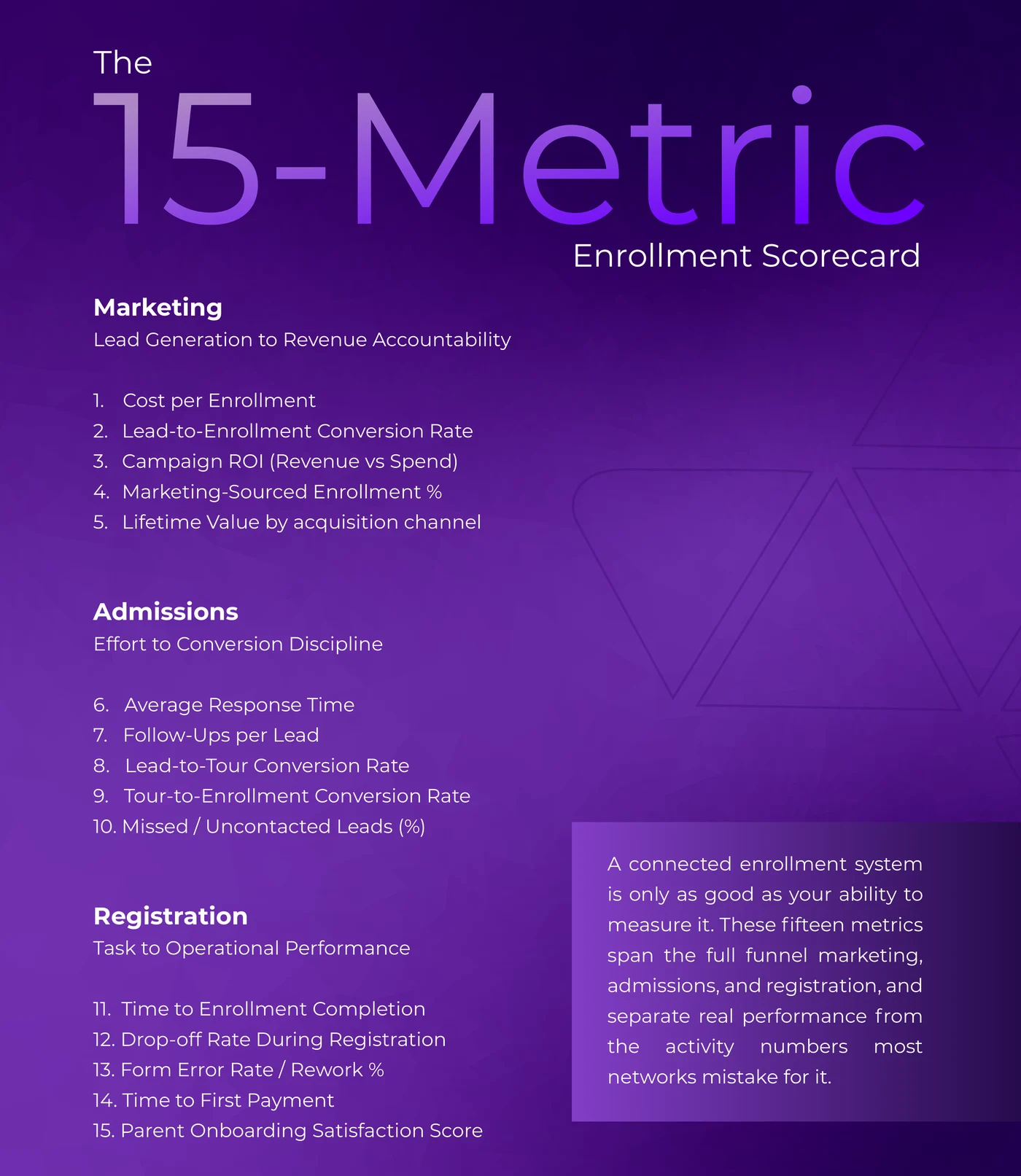
In a connected system, marketing improves campaign efficiency, admissions improves conversion discipline, and registration improves the onboarding experience.
How will AI change childcare enrollment?
Enrollment operations are shifting from reactive processes to intelligent, system-driven execution: from center-level conversion to network-level yield optimization. Increasingly, it is the shift that separates networks that attract serious capital from those that plateau. Instead of relying on directors to respond and follow up, the system engages families instantly, prioritizes high-intent leads, and moves information forward automatically.
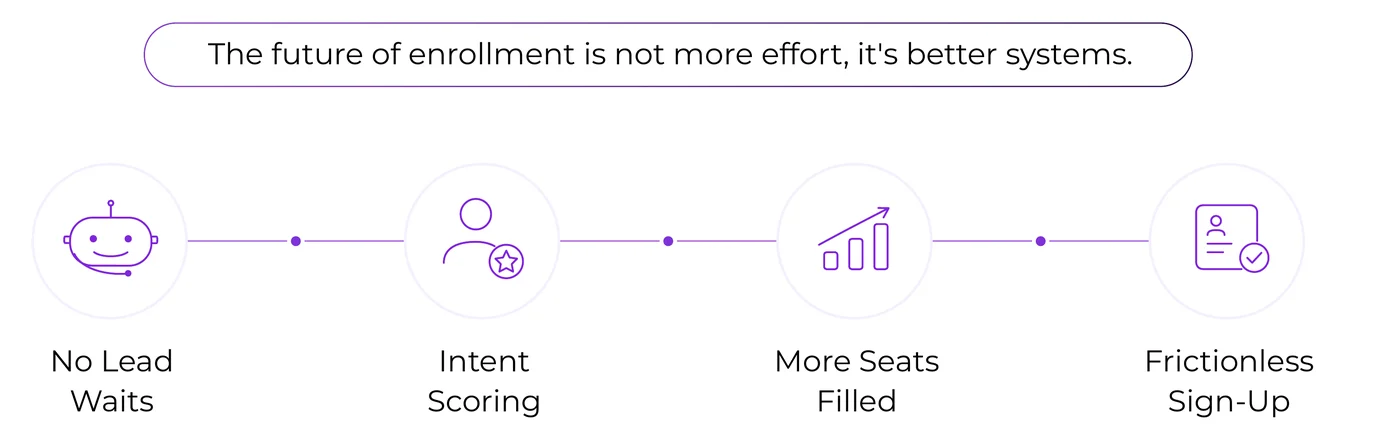
AI handles off-hours inquiries around the clock, so a family that reaches out at 9pm gets an immediate, helpful response instead of waiting until morning. Speed stops being a competitive edge and becomes the baseline every family expects. Leads are scored automatically by intent, so admissions effort goes where it drives yield. Because data flows end to end without manual re-entry, the journey from tour to enrollment compresses from weeks into days. The result is an enrollment engine that performs consistently whether a center handles ten inquiries a week or a network handles a thousand.
What impact will AI have on childcare operations in the next three years?
"The best use of your center staff is not answering a phone call at 7:30 in the evening. It is not scoring leads, it is not manually following up on inquiry forms, and it is not building out communication sequences. Let AI handle that. Voice agents for after-hours inquiries, automated lead scoring, smart form building, follow-up sequences that actually nurture a family from inquiry to enrollment. These are not futuristic ideas. They are available right now, and the operators who adopt them early will have a real competitive advantage." Jessica Van Hoose, Chief Executive Officer, The Nest Schools
How illumine supports a connected enrollment system
illumine connects the childcare enrollment lifecycle from first inquiry to final registration, and supports more than 4,000 centers across more than 60 countries.
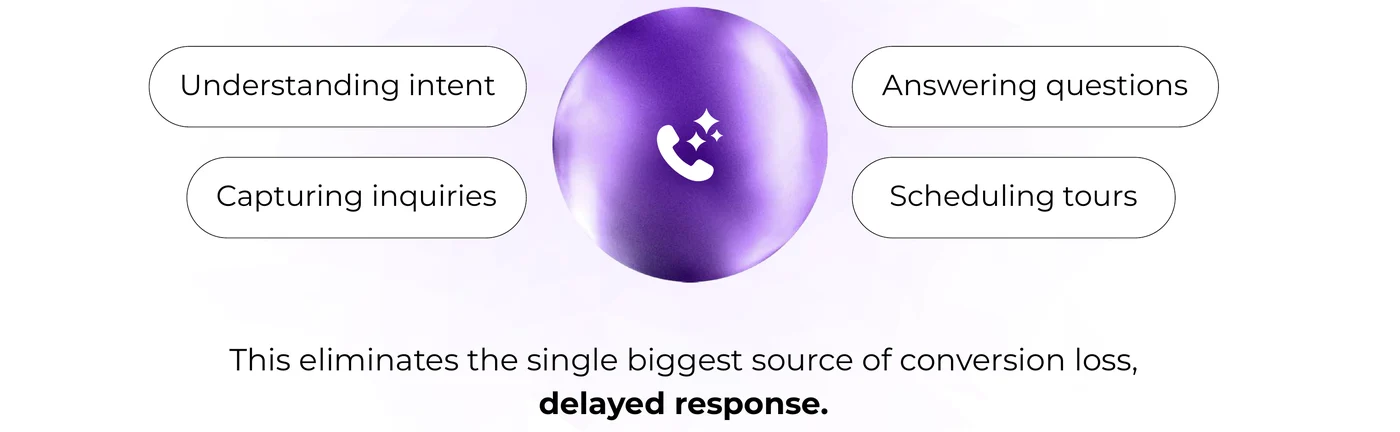
AI-powered voice agent
illumine's AI voice agent answers every inquiry the moment it comes in, capturing details, understanding intent, answering questions and booking tours, so no lead slips through. It removes the single biggest source of conversion loss: delayed response.
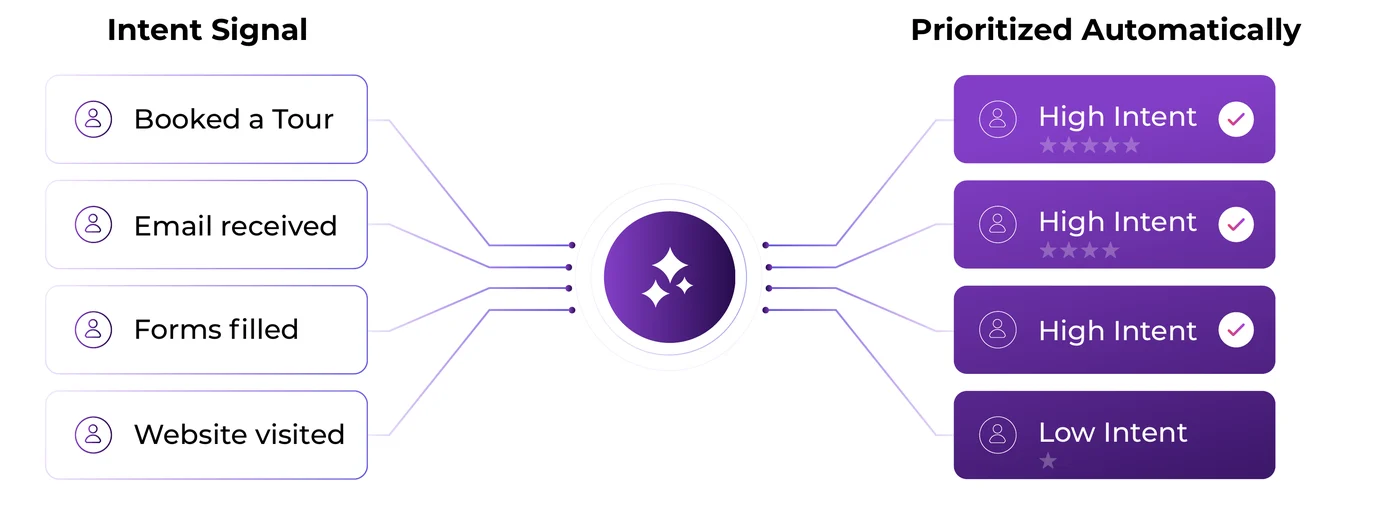
Intelligent lead scoring
Not all inquiries carry equal intent, yet most systems treat them the same. illumine prioritizes high-intent families automatically, based on signals such as booking a tour, replying to email or completing forms, so admissions teams focus where conversion is most likely, without adding workload.
AI-powered form builder
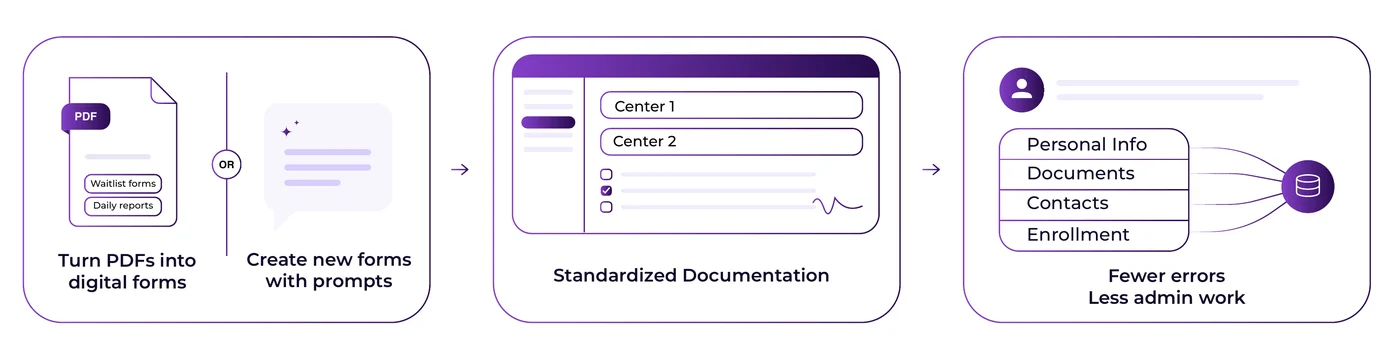
Registration friction quietly kills enrollments. Inconsistent forms, manual data entry and center-specific processes create drop-off even after families decide to enroll. illumine's form builder turns PDFs into digital forms instantly, creates new forms from simple prompts, and standardizes documentation across every center. Data flows directly into the child's record with no re-entry, fewer errors and less admin work.
From fragmentation to flow
The operators leading the next era of childcare growth share one conviction: scale without systems is just complexity with a larger footprint. They have moved past the question of how to generate more demand and are asking a harder one: how do you build an organization that converts, retains and grows with the same consistency at 50 centers as it did at five?
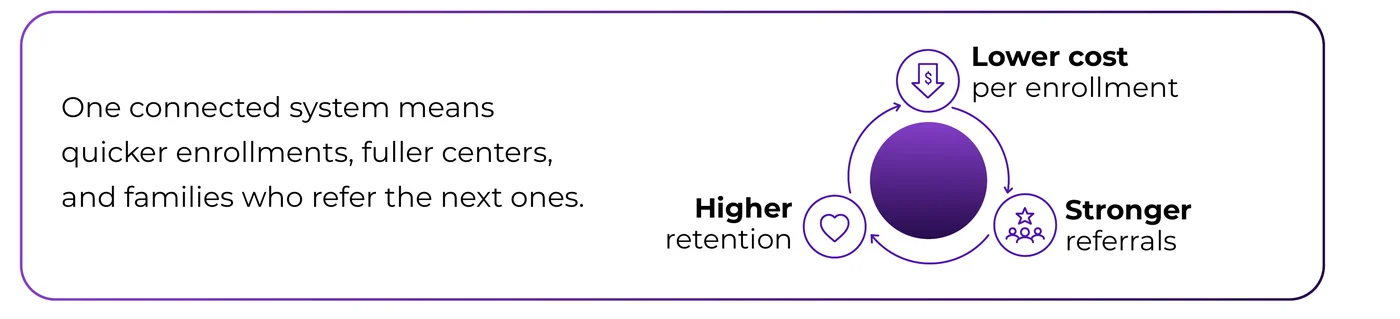
The answer is a redesign of how enrollment operates, from a sequence of manual handoffs between disconnected functions into a single connected system where data flows forward, decisions are informed by real-time intelligence, and leadership can manage performance across the entire network. One connected system means lower cost per enrollment, higher retention and stronger referrals.
illumine's enterprise team works with multi-site childcare networks to evaluate enrollment infrastructure, identify conversion gaps and design connected systems. Book a conversation with the enterprise team.
Leadership perspectives
Gaurav Ranjan, Principal, Prime Venture Partners
From a VC lens, what is the existing challenge with the enrollment engine in childcare, and what is the biggest disconnect you see?
"The core challenge is that enrollment is still run as a relationship-based art form at most operators, when at network scale it has to function as an operating system. The biggest disconnect we see is between what the network-level dashboard reports and what is actually happening at the site: aggregate occupancy looks healthy while two or three centers are quietly bleeding inquiries. Marketing teams measure leads, operators measure enrolled children, and almost nobody owns the funnel in between. That ownership gap is where revenue, and ultimately enterprise value, walks out the door."
How should operators think about time-to-profitability for a new site, and where does enrollment discipline shorten that curve?
"A new center typically burns cash for 12 to 24 months before stabilizing, and the spread between the top and bottom of that range is almost entirely a function of how fast you fill classrooms in the first six months. Disciplined inquiry response, under 24 hours from inquiry to scheduled tour, and structured post-tour follow-up within 72 hours can compress break-even by four to six months. On a single site, that is hundreds of thousands of dollars; on a 20-site rollout, it is the difference between an acceptable fund return and a great one. The capital is already committed the day you sign the lease; the only variable left is execution speed at the front of the funnel."
How should childcare operators be using AI today, and what kind of adoption gives you confidence as an investor?
"The real operating leverage comes from AI that strengthens the full enrollment lifecycle. We look for tools that enhance family communications through personalized, on-brand follow-ups across every site, [and that surface] breakdowns, withdrawal risk, and conversion variance before they become occupancy problems. Together, these tools remove director-level variance and give leadership a real-time view of network health, which is exactly the operating leverage that lets a platform scale past 20 sites without scaling headcount linearly. When we see operators adopting AI tied to funnel metrics and reporting discipline, it is one of the strongest signals that the childcare network is built to compound."
Jessica Van Hoose, Chief Executive Officer, The Nest Schools
Where does enrollment break down, and how does that disconnect shape budget allocation?
"Enrollment breaks down when your systems are not strong and consistent at the center level. Full stop. Marketing teams are generating inquiries, waitlists are growing, and the demand is real. But what happens when that family actually calls? When they show up for a tour? That is where the wheels come off. Turnover is destroying execution. It is incredibly difficult to build a team that knows the process, owns it, and delivers it consistently every single time. So what do owners often do? They push more dollars into marketing. More leads, more inquiries, more top-of-funnel activity. But if the center cannot convert the leads it already has, more leads are not the answer. You are promising the moon, a perfect center, and then families are showing up to a tour that does not deliver on that promise. Invest in your schools, invest in your teams, and the tours will convert. The budget disconnect comes from the fact that marketing teams rarely see what actually happens to the leads they generate. They measure impressions and inquiries. Operators measure enrolled children. Those two things are not connected, and that gap is where revenue walks out the door."
Harjit Rai, Senior Vice President Operations, Otter Learning
What is the hardest part of keeping enrollment performance consistent across locations as a network grows?
"The hardest part is not what most operators expect. It is not marketing spend, competitive pricing, or program differentiation. It is ensuring that the family experience from the moment of first inquiry through enrollment is executed with equal discipline across every location, regardless of who is behind the front desk that morning. As a network grows, operational consistency becomes exponentially harder to maintain. The organizations that sustain consistent performance treat enrollment as an operational system. It means building structure around it. Inquiry response protocols. Documented follow-up cadences. Standardized tour experiences. Logged family conversations. When these elements are consistent, individual director performance variation stops driving network-level outcomes. The practical measure I tracked most closely was time from initial inquiry to scheduled tour. At high-performing locations, that window was 24 hours or less. At underperforming locations, it was 7 to 10 days. Enrollment conversion tracked directly with that metric, not with program quality, not with facility condition. Families investigating childcare contact multiple providers simultaneously. Speed and follow-through determine who earns the tour and, by extension, who earns the enrollment."
How should leaders connect community outreach and enrollment strategy at a network level?
"Community outreach and enrollment strategy are most effective when they are designed together rather than operated in parallel. The common failure is treating outreach as a marketing activity and enrollment as an operations activity, when in reality the family's journey moves fluidly between both. A referral from a community partner who is not connected to your enrollment process creates friction. A well-executed tour that is not supported by community credibility leaves families with fewer reasons to commit. At a network level, the most effective leaders establish community relationships that serve enrollment strategy directly: partnerships with pediatric practices, employers with dependent care needs, community organizations, and faith communities that place trust in the recommendation. These are not passive brand-building efforts. They are structured referral channels with defined touchpoints, tracked leads, and measured conversion."
Ruth Ann Rose, Owner and CEO, Rose Marketing Solutions
Most multi-site childcare networks are not struggling with demand, but conversion remains inconsistent. Where does enrollment actually start to break down after the lead is generated?
"We'd gently push back on the premise. Operators consistently tell us, 'We need more leads. We aren't getting enough people through the door.' The underlying data backs them up. The CDC's National Center for Health Statistics reports that U.S. births fell another 1% in 2025. And for the first time after years of growth, the number of licensed childcare centers slipped 1% from 2024 to 2025. Fewer babies, higher costs, and families making new choices about work and care.
That said, the premise isn't wrong so much as it's incomplete. When you filter the inquiry pool down to qualified leads (families who actually have intent), something interesting emerges. Across our 18-year portfolio of childcare clients, we consistently see that roughly six in ten qualified families take the next action and schedule a tour. That's actually a strong number. The issue isn't that centers are bad at converting interested families. It's that most centers are measuring conversion against every inquiry that comes in, qualified or not. Counting every form fill, web chat, and vague inquiry as a lead inflates the denominator and makes performance look worse than it is. Decisions about where to spend, what to cut, and what to change get made on a distorted picture.
This is something we feel strongly about at Rose Marketing Solutions, and it shapes how we work with every client. We have a human personally qualify every single lead that comes in. Not an automated score, but a real person reviewing each inquiry to determine whether it represents a genuine opportunity. That discipline gives us something most agencies can't offer: accurate, honest data on what's actually happening between inquiry and tour booked. So the real picture is a double challenge. Fewer qualified leads are coming in than before, which means every one of them counts more than ever. And most centers still don't have a clear enough view of their own pipeline to act on it effectively.
On the conversion side, even with qualified leads, the breakdown almost always happens in the hours immediately after an inquiry comes in. Based on our own experience working with operators, the window where the real difference is made is the first 1 to 4 hours. Wait longer, and a family has often already heard back warmly from someone else. The challenge is that directors are managing classrooms, staff, and a hundred other things at once. Hitting that response window consistently isn't realistic without the right support. That might mean a dedicated enrollment coordinator, a clear coverage plan, or technology that sends a warm acknowledgment automatically while a human follows up shortly after.
In our experience with childcare, the families who eventually enroll have often heard from us five, eight, sometimes ten times before they say yes. Most operators are surprised when we tell them that, but it reflects how much persistence and consistency the enrollment journey requires. No structured follow-up, no visibility into where the family is in their decision, no one clearly accountable for reaching back out, and the tour that went so well disappears into silence. The centers that handle this best treat their waitlist not as a list but as a pipeline. They have enough visibility into their own enrollment data to forecast when spots will open, and a process for reaching out to families with a specific timeline and the option to secure their child's spot with a deposit."
Frequently asked questions
How quickly should childcare centers respond to a new inquiry?
As fast as possible, ideally within an hour. Research published in Harvard Business Review found that firms contacting a new online lead within an hour were nearly seven times as likely to qualify it as firms that waited even an hour longer. Across most multi-site childcare networks illumine works with, the average response time is more than 26 hours.
How can childcare centers reduce tour no-shows?
With automated reminders. According to illumine data, tour no-show rates run at 35 to 40% without automated reminders and fall below 12% with structured reminder workflows.
How many touchpoints does a family need before enrolling in childcare?
Families typically need 8 to 11 touchpoints before enrolling, according to illumine data, and usually take 3 to 14 days after a tour to decide. Harjit Rai of Otter Learning found structured post-tour follow-up within 72 hours to be the change that most consistently moved the needle.
Which enrollment KPIs should multi-site childcare operators track?
Track the full funnel, not just activity. For marketing: cost per enrollment, lead-to-enrollment conversion and campaign ROI. For admissions: average response time, lead-to-tour and tour-to-enrollment conversion, and missed or uncontacted leads. For registration: time to enrollment completion, drop-off rate during registration and time to first payment.
How will AI change childcare enrollment?
AI answers off-hours inquiries immediately, scores leads by intent so admissions teams work the highest-intent families first, and moves data from tour to registration without manual re-entry, so the journey from tour to enrollment compresses from weeks into days.
Contributors

- Harjit Rai, Senior Vice President Operations, Otter Learning (LinkedIn)
- Jessica Van Hoose, Chief Executive Officer, The Nest Schools (LinkedIn)
- Rajesh Kumar, Co-Founder and CEO, Kids Kingdom (LinkedIn)
- Ruth Ann Rose, Owner and CEO, Rose Marketing Solutions (LinkedIn)
- Gaurav Ranjan, Principal, Prime Venture Partners (LinkedIn)
Methodology
The Childcare Enrollment Report 2026 is part of illumine's Multi-Site Childcare Leadership Series. It combines interviews with multi-site childcare operators, an enrollment marketing agency and a venture investor with published research from Harvard Business Review, the CDC's National Center for Health Statistics, Child Care Aware of America and Grand View Research. Figures on response time, tour no-shows and touchpoints reflect illumine data from multi-site networks it works with. Figures quoted by contributors reflect their own organizations' experience.
Sources
- Harvard Business Review, The Short Life of Online Sales Leads (2011)
- CDC National Center for Health Statistics, Births in the United States, 2025
- Child Care Aware of America, Child Care in America: 2025 Price and Supply
- Grand View Research, US Child Care Market Size and Share Report
Related reports: Scaling Smart: How Multicenter Childcare Networks Scale Without Breaking, Rethinking Montessori Operations, What Will Montessori Leadership Look Like in 2030? and The Costs Draining Childcare Centers: USA Cost Benchmark Report.
Related webinar: The Multi-Site Childcare Enrollment Playbook for 2026.