



Rethinking Montessori Operations is a 2026 leadership guide by Tim Seldin, President of the Montessori Foundation, published with illumine. It is written for heads of school, directors and network leaders who want to modernize how their school runs without losing what makes Montessori worth protecting. It covers the real cost of fragmented tools, the forces reshaping Montessori enrollment, what a connected operating platform should do, and how Guidepost Montessori made the move across its US network.
Key findings
- In a 2025 survey by Cornerstone Communications and Edsby, 54% of K-12 respondents said their schools use 10 to 15 officially sanctioned apps, and 42% of parents rated their multi-app school experience 5 out of 10 or lower.
- Close to half of US early childhood programs are enrolled below their preferred capacity, with family affordability and staffing the top causes (NAEYC survey of more than 7,000 educators, January 2026).
- 22% of early childhood educators are considering leaving the field within the next year (NAEYC, January 2026).
- US births fell 1% in 2025 to 3,606,400 (CDC National Center for Health Statistics), shrinking the pool of future enrollments.
- The number of licensed child care centers in the US declined 1% from 2024 to 2025 (Child Care Aware of America).
- illumine estimates that fragmented tools cost each Montessori guide 3 to 5 hours every week, time that belongs in the classroom.
- Guidepost Montessori selected illumine as its unified operating platform across more than 90 preschools in more than 20 US states (announced April 2026).
Foreword: a note from Tim Seldin
Montessori schools are entering one of the most significant operational transitions in their modern history. For generations, many of us operated within relatively stable environments. Enrollment was dependable. Competition was modest. Communication expectations were simpler. Administrative systems could remain informal without creating serious organizational strain. That environment has changed, and it is not returning.
This guide exists because school leaders today face pressure from multiple directions at once: declining birth rates, intensifying competition, rising staffing costs, growing parent expectations, teacher fatigue, multi-campus complexity, and the demand for measurable leadership outcomes. At the same time, we are working to preserve something deeply human: environments built around concentration, relationships, observation, and authentic child development.
How do we modernize operationally without losing what makes Montessori worth modernizing in the first place?
I prepared this guide in collaboration with illumine, a developer of AI-powered software built for managing schools and childcare programs. We wrote it in response to our shared recognition of the operational challenges facing Montessori schools. illumine supports the Montessori Foundation's work with schools, and I have found their platform genuinely relevant to the problems we describe in these pages. I want to be transparent about that relationship, while confirming that the observations in this guide come from more than fifty years of working with Montessori schools, and the operational challenges I describe are ones I have found in schools of every size in many countries.
I believe that the answer to our current moment is not less technology, but better-organized technology, and a different way of thinking about the systems behind the school. By the end of this guide, you should leave with three things: a clear picture of where your school stands today, a vision for what a single connected platform would change across the operational functions every Montessori school runs, and the shape of a system that could work for your own organization.
You do not need to act on everything immediately. You do need to know what you are building toward. The sooner you start, the more you and your team will feel the difference by the next school year.
How to use this guide
This is a working document, not a brochure. It is organized in five parts, each building on the last:
- Where we stand: the real cost of disconnected tools, including wasted hours, duplicate entry, and hidden debt that surfaces at the worst moment.
- What is changing around you: a different kind of parent, a harder enrollment market, and attention-economy expectations.
- What to build: one connected platform in place of fragmented tools, across parent experience, teacher sustainability, leadership visibility, and AI.
- The connected journey: the five operational functions every school runs, each shown fragmented and connected.
- Proof and reflection: how Guidepost Montessori and other networks made the move.
About illumine, the partner behind this guide
illumine was founded by Navneet Rastogi, who serves as CEO, Sourabh Agarwal and Purva Goyal. They set out to build something that did not yet exist: a unified, AI-powered platform connecting the full operational life of a Montessori or early education school, from inquiry and enrollment to classrooms, billing, compliance, and family engagement.

illumine first grew across South Asia, Southeast Asia, the Middle East, Australia and Europe before entering the United States. Today it supports more than 4,000 schools and childcare centers across more than 60 countries, from single-campus nurseries to large multi-site networks. Its US entry was accelerated by its partnership with Guidepost Montessori, one of the largest Montessori networks in the world, which selected illumine as its unified operational platform across more than 90 preschools in more than 20 US states.
What the platform does
At its core, illumine's Montessori school software replaces the patchwork of disconnected tools most schools have accumulated with one connected system covering enrollment, tuition and billing, parent communication, Montessori records, classroom observations, lesson planning, compliance, and dashboards. What distinguishes it from earlier school management software is that AI is built into the operational workflows rather than added as a feature.
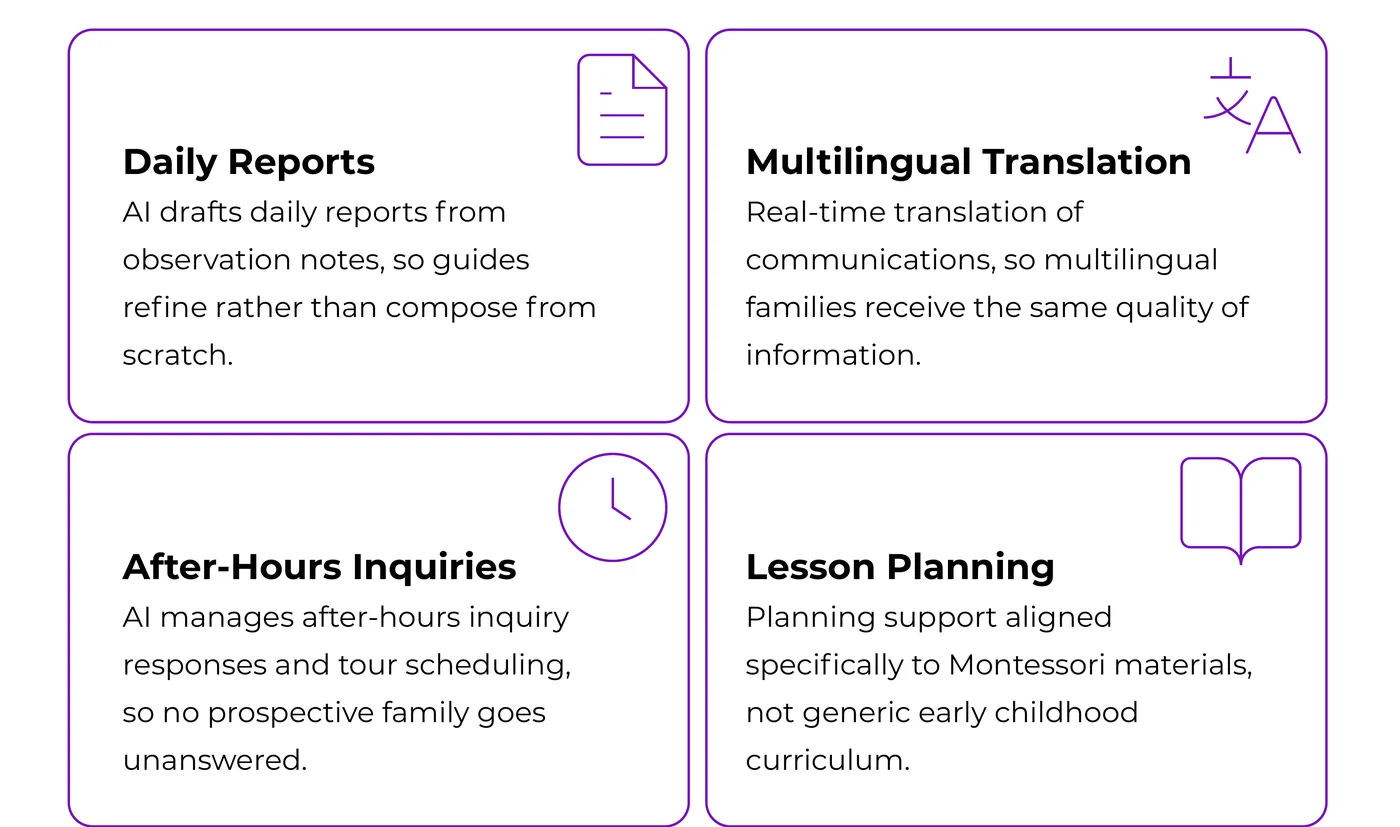
This matters especially to Montessori leaders. illumine is not a generic childcare platform with a Montessori add-on. It includes specific support for Montessori curriculum frameworks, three-year-cycle record-keeping, mixed-age classroom management, and the individualized observation and documentation at the heart of authentic Montessori practice. The AI tools are designed to support the guide's observation rather than replace it, handling the administrative work around it so that the observing itself gets more time and attention, not less. The mission, as CEO Navneet Rastogi describes it, is to remove operational friction so that educators can focus on what matters most: supporting children and their development.
User trust and ease of use
illumine is highly rated by users on Capterra, Software Advice and GetApp, with 2026 recognition across all three (see the badges). The consistent themes in reviews are ease of use, the quality of parent communication it enables, and the responsiveness of the illumine team.
One of the things I most appreciate about what illumine has built is its genuine user-friendliness. Most school software is anything but. There is often a steep learning curve, and once staff have climbed it, they are understandably reluctant to change. But in schools, change happens constantly, with new teachers, new office managers, new administrators. Every time a key staff member leaves, someone new has to learn the system. In my experience, this learning curve is a real and underappreciated operational risk.
Where do Montessori school operations stand today?
Before we look forward, we have to look honestly at where Montessori operations stand today: not at the classroom, which is the strongest part of our work, but at the system behind it.
The decade is changing under our feet
The world you stepped into as a Montessori leader in 2016 is gone. Parents communicated through email and the school newsletter. Inquiries came in by phone. Tuition was billed once a quarter. Enrollment moved at the pace of word of mouth. A handful of forms, a billing service, and a competent administrator could run most of the operations of most schools.
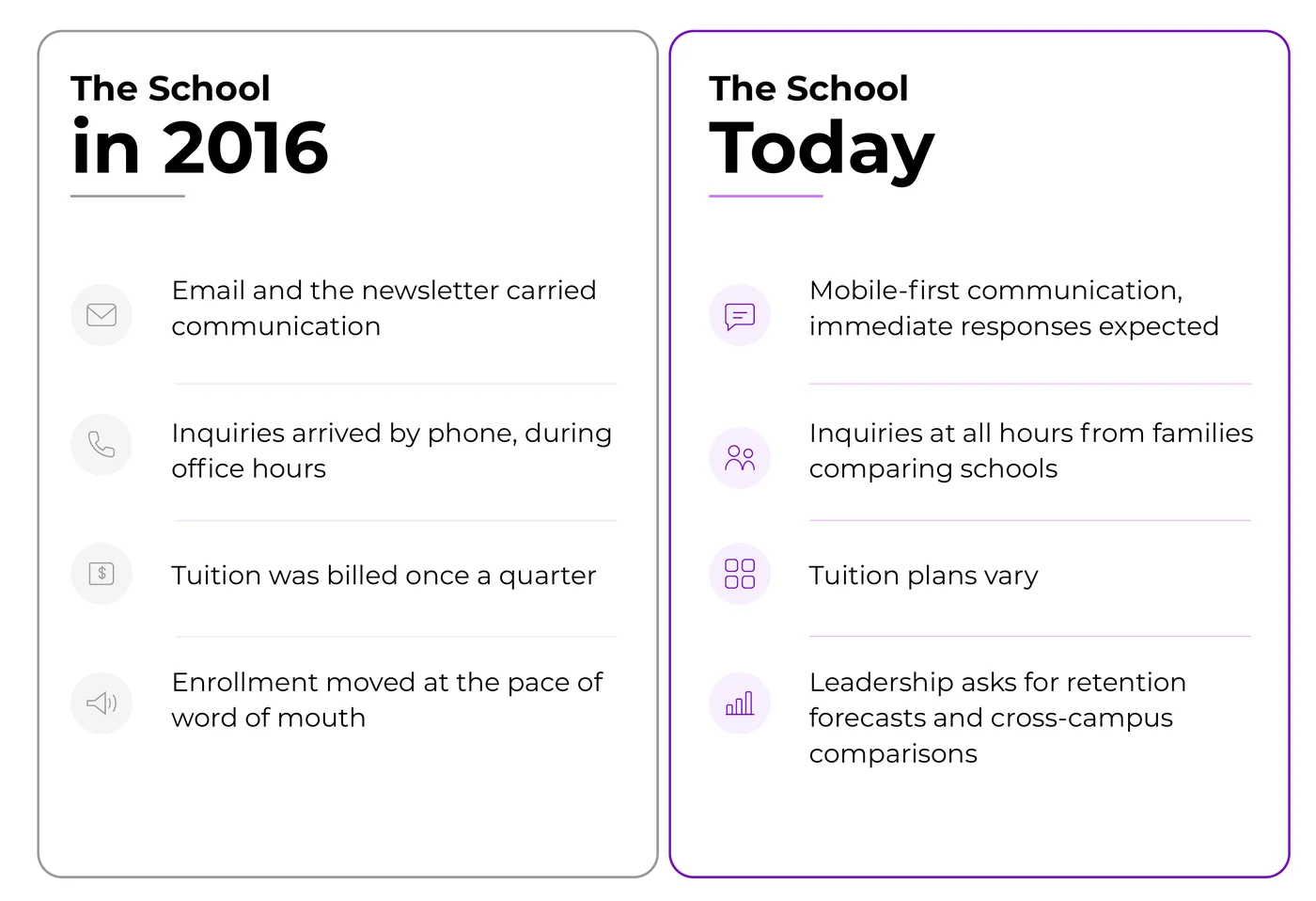
The gap between schools that thrive and schools that struggle is not talent or intent. It is infrastructure. The schools that pull ahead will be the ones that stop patching and start building: one connected system where an inquiry, a family's decision, and a leader's forecast all live on the same thread. That work does not get easier by waiting. It only gets more expensive.
The fragmentation tax
Most Montessori schools did not set out to build fragmented operations. Billing was added, then a parent app, then a classroom records system, with enrollment living in spreadsheets and a CRM added later. Each tool solves a departmental need. Together, they create a fragmented way of running the school, one that works only because dedicated people hold it together. The cost is not in the tools. It is in the seams between them, where every gap means manual reconciliation, duplicate entry, and delayed answers.
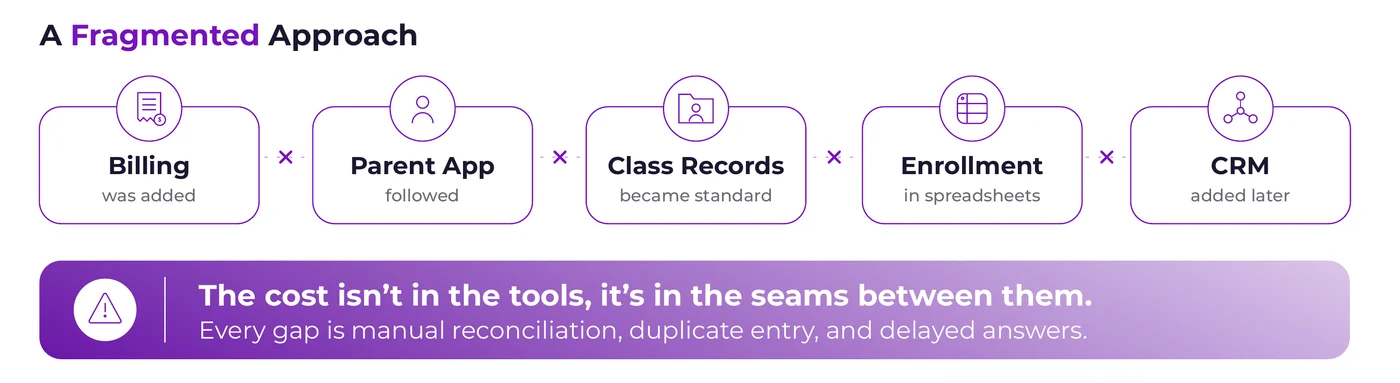
illumine estimates that fragmented tools cost each guide 3 to 5 hours every week, hours that belong in the classroom. The broader school technology picture points the same way: in a 2025 survey of teachers, parents and curriculum leaders by Cornerstone Communications and Edsby, 54% of respondents said their schools run 10 to 15 officially sanctioned apps, and 42% of parents rated their multi-app experience 5 out of 10 or lower. That survey covered K-12 schools, but the pattern is familiar to anyone running an early childhood program.
The human cost runs deeper than any data point. Administrators become the integration layer, reconciling information across systems never designed to speak to one another. Duplicate data entry creates errors. Delayed reporting means leadership is always looking at yesterday. A parent enrolled but was never invoiced. A child is marked absent in one system and present in another. When something breaks across tools, no one fully owns the problem.
Operational debt accumulates quietly
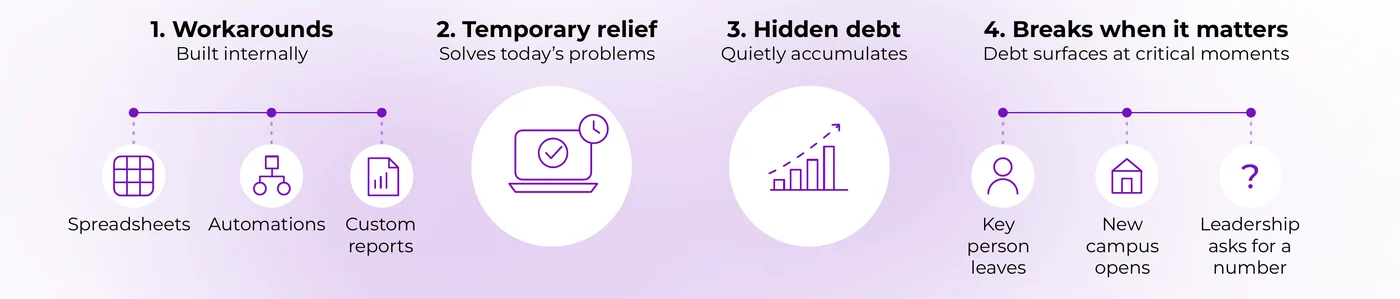
Some schools respond by building internal workarounds, spreadsheets, automations and custom reports, that temporarily solve the problem while quietly adding maintenance burden. That operational debt does not announce itself. It accumulates until a key person leaves, a new campus opens, or leadership asks for a number that no one can produce in under an hour.
I experienced this directly at the Montessori Foundation when we attempted to build our own custom app using an off-the-shelf platform. It never worked correctly. The cost of building something truly functional turned out to be far beyond what a nonprofit educational organization could reasonably sustain. The lesson was not that Montessori organizations should avoid technology. It was that building and maintaining serious operational software is rarely a side project, and that expecting informal systems to hold a growing school together is a strategy that eventually fails.
What is changing around Montessori schools?
Three forces are reshaping Montessori operations: a new kind of parent, a harder enrollment market, and higher expectations for responsiveness.
1. A new kind of parent
Twenty years ago, many Montessori families arrived already philosophically prepared. They had read Dr. Montessori's books, visited classrooms, or been introduced to the method. Schools served close-knit communities, and expectations around communication, documentation and responsiveness were far simpler. That world has largely passed.
Today's families arrive shaped by intense competition, rising anxiety about their children's futures, economic pressure, and digital communication habits. Parents now expect immediate responses, transparent communication, regular updates, easy access to information, and ongoing reassurance at every stage of their relationship with a school. And Montessori remains misunderstood by many families. Parents may love the warmth of a Montessori classroom while feeling uncertain about mixed-age groupings, the absence of grades, long work periods, or why adults are not constantly directing children. Even families deeply attracted to Montessori carry hidden questions: will my child be prepared academically? What happens in middle school?
This means the parent journey is no longer separate from school operations. It has become central to enrollment, retention, community stability and financial sustainability. The schools that thrive in the coming decade will be the ones that intentionally design systems that help families understand, trust, and stay connected to the Montessori journey.
2. A harder enrollment market
Birth rates are declining across much of the United States and internationally, which means fewer children to enroll over time. The CDC recorded 3,606,400 US births in 2025, down 1% from 2024. At the same time, publicly funded early childhood options are expanding in a growing number of states and can compete directly with independent Montessori schools, particularly when families weigh private tuition against free or heavily subsidized options for four-year-olds and, in some markets, three-year-olds. NAEYC's January 2026 survey found close to half of early childhood programs are enrolled below their preferred capacity, with family affordability and staffing the top causes.
Early childhood programs have traditionally provided the enrollment foundation that supports long-term Montessori sustainability. When schools lose four- and five-year-olds to free public programs, the financial model becomes much harder to sustain, because younger children require smaller adult-child ratios, more staffing, more specialized environments, and more intensive parent communication. Every family retained is worth far more than the tuition it represents.
3. The attention economy has changed expectations
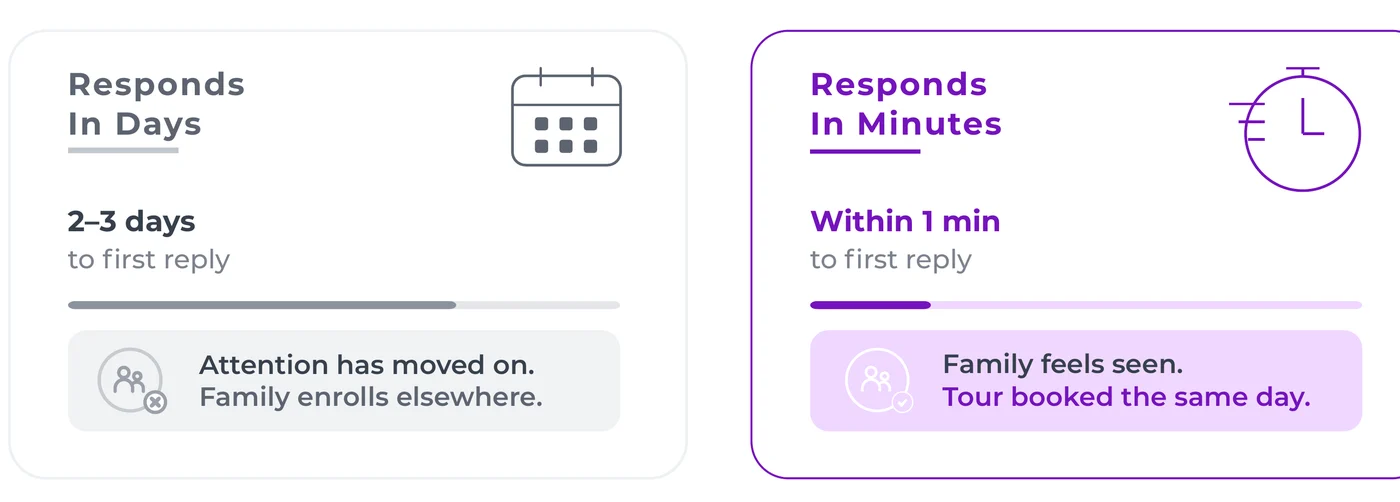
Families today are used to instant replies, real-time notifications, personalized communication, frictionless scheduling and mobile-first experiences. When one school responds to an inquiry within minutes while another takes days, parents often read the faster response as a sign of better organization and professionalism.
This does not mean Montessori schools should become transactional or automated in ways that strip warmth from relationships. It means communication delays, inconsistent follow-up and fragmented parent experiences now carry far higher operational risk. Schools that build thoughtful, responsive communication systems are better positioned to convert inquiries into enrollments.
The same standard applies internally. Teachers who must navigate four apps to complete a daily report lose time and attention. Administrators without real-time data make decisions on impressions, not information. Leaders who spot problems only in a crisis have outgrown their systems. All three forces press on the same point: the system behind the school.
What should Montessori schools build?
If the classroom is prepared for the child, the system must be prepared for the school. That means rethinking five things: the platform itself, the parent journey, teacher sustainability, leadership visibility, and the role of AI.
1. From many tools to one platform
Leading Montessori networks are rethinking how work gets done through three operational shifts:
- From parent communication to parent experience. Instead of communication, billing, forms and classroom updates each living in a separate app, one connected journey runs from inquiry through enrollment to ongoing family engagement: fewer touchpoints, more consistent communication, stronger trust.
- From siloed teams to one shared view. Instead of admissions, finance and the classroom each owning a slice while administrators stitch everything together, every team works from the same place. Handoffs become visible and measurable, and accountability is clear when something goes wrong.
- From local fixes to network-wide ways of working. Instead of each campus building its own process and reporting through manual exports, one dashboard covers every campus, performance becomes comparable across locations, and problems become visible early enough to address.
The decision to move from departmental tools to a connected platform is a leadership decision about how the organization will run. In practice, illumine brings parent communication, tuition and billing, enrollment and admissions, attendance, compliance reporting, learning records and leadership dashboards into one place, with AI built into the workflows where it genuinely reduces adult workload.
2. The parent journey, redesigned
Many schools still treat admissions as a transactional sequence: inquiry, tour, application, enrollment. But Montessori schools increasingly find that enrollment is not the end of the admissions process. In many ways, it is the beginning. Parents rarely make a clear decision to reject a school. More often, they hesitate, lose confidence, and quietly drift away. The same happens after enrollment, when normal developmental challenges turn early excitement into uncertainty. Without intentional systems for communication, orientation and relationship-building, schools lose families not because Montessori failed, but because uncertainty went unmanaged.
In Montessori education we speak often about the prepared environment. The same principle applies to families. New family onboarding should be a prepared environment for parents, designed with the same intentionality and respect for the conditions under which trust grows. The New Parent Onboarding Playbook, developed through the Montessori Family Alliance, organizes the first ninety days into three phases: Welcome and Prepare, Settle and Understand, and Deepen and Partner. Each phase carries a sequenced rhythm of communication and education, from warm reassurance right after enrollment to guidance on how Montessori classrooms work, how to prepare children for the transition, how to support independence at home, and how to read the language and rhythms of Montessori school life. Information offered when parents are actually experiencing the question lands very differently than information offered weeks in advance.
Parent education is a core operational strategy, not an enrichment activity. Schools that fail to educate parents consistently see higher attrition, more family anxiety, and pressure to compromise Montessori practice. Schools with consistent parent education see stronger trust, higher retention, more referrals and healthier long-term enrollment. Regular community gatherings help new families hear the shared language of the school and build relationships with veteran parents, and Parent Ambassador programs, in which experienced parents personally reach out to new families, offer something newsletters and email sequences cannot.
When inquiries, tours, applications, sibling tracking, follow-up, enrollment, a family's first weeks and the ongoing parent education sequence all live in one operational system, the parent journey stops being a series of disconnected handoffs. It becomes a single relationship the school can see and support, and lead conversion becomes a leadership metric. Schools that have made this shift report stronger conversion, fewer families lost in the vulnerable first ninety days, and higher retention into Elementary.
3. The prepared environment for guides
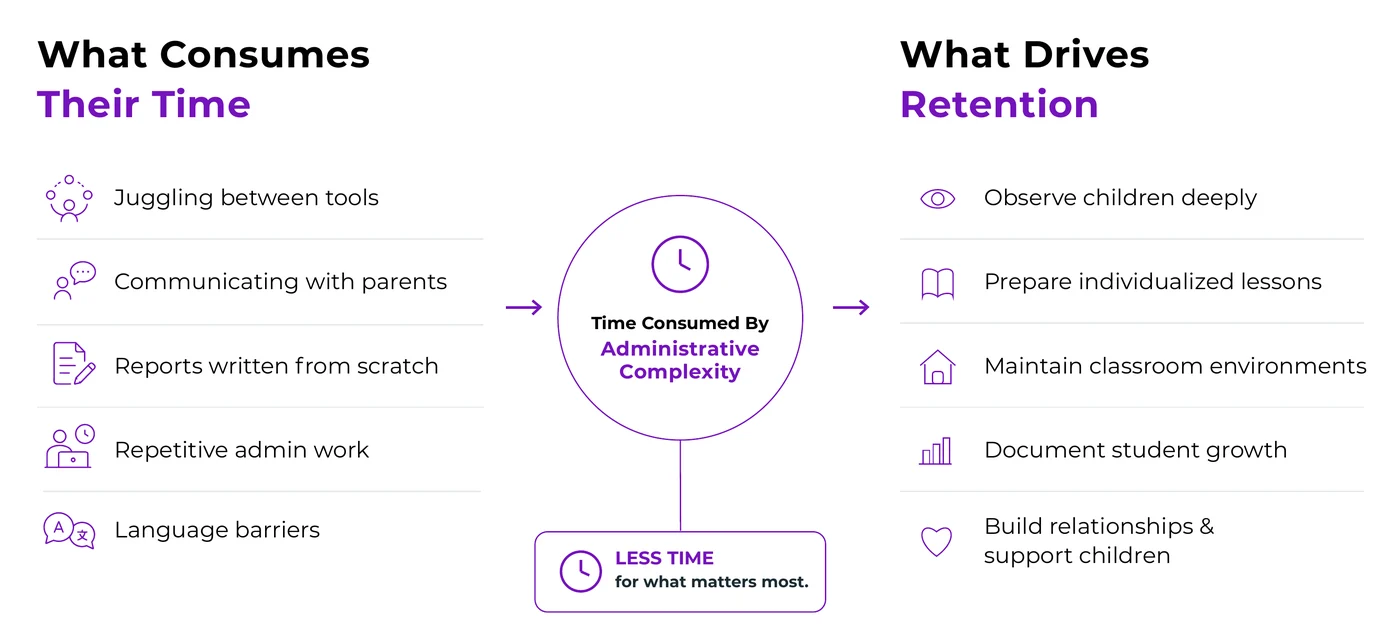
Today's guides are asked to observe children deeply, prepare individualized lessons, maintain classroom environments, document growth, complete compliance reporting, communicate constantly with parents, support behavioral and emotional challenges, and contribute to admissions and community-building. Yet more and more of their time is consumed by administrative complexity unrelated to the work they came to do. With 22% of early childhood educators considering leaving the field within a year (NAEYC, January 2026), this is a retention issue, not just a workflow issue. The goal of strong operational systems is not efficiency in itself. It is sustainability.
When observation notes, daily reports, parent communication, lesson planning and attendance live in one connected system, the guide stops being the integration layer between apps. AI drafts the daily report from the morning's observation notes, so the guide refines rather than composes from scratch. Translation happens automatically, so multilingual families receive the same warmth and consistency as everyone else. Lesson planning support is aligned to Montessori materials. The result is hours returned to the classroom each week, deeper observations, and guides who feel supported rather than buried.
4. What leadership can finally see
One of the greatest challenges in multi-campus organizations is that information becomes trapped in separate systems: enrollment in spreadsheets, billing in another tool, communication in apps, records in a classroom system. Leadership cannot see across the silos, so problems surface only after they have become serious.
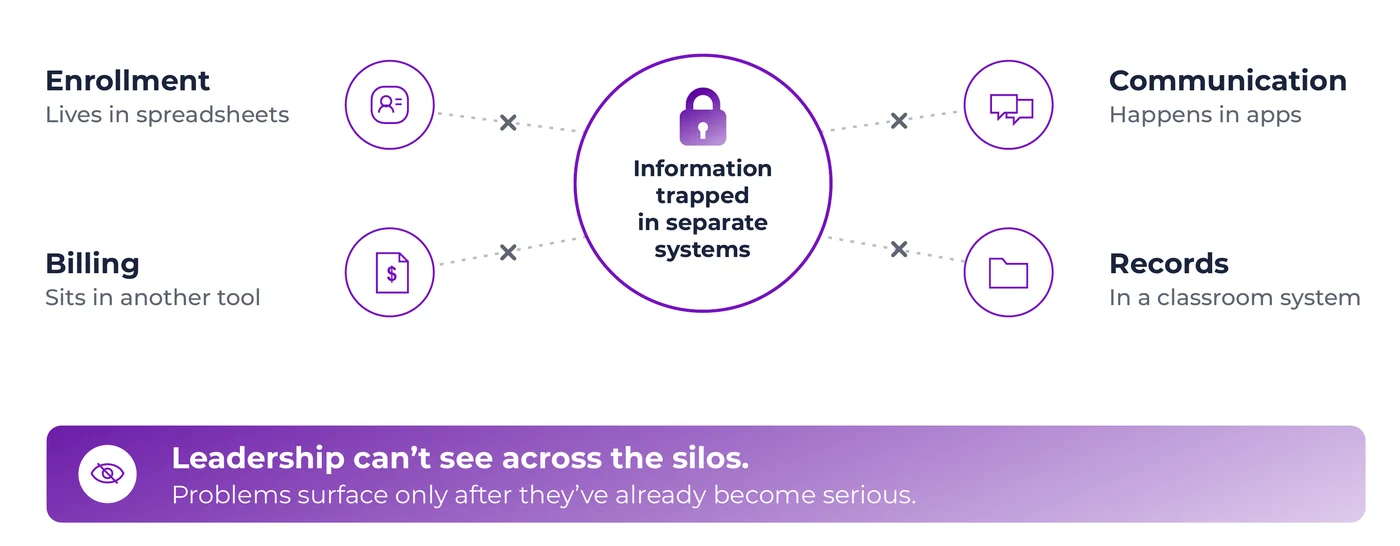
What leadership cannot see cannot be improved. By the time a problem becomes a crisis, the cost of correction in trust, retention and faculty stability is far higher than it needed to be. In many multi-campus organizations, different campuses describe the same processes differently. One campus defines an inquiry one way, another differently. Admissions stages vary and reporting drifts apart. Healthy organizations create common definitions, and those definitions, enforced through shared systems, let leadership focus on strategy.
A connected platform makes enrollment, billing, staffing, attendance and compliance visible at every level. School leaders can check classroom ratios in real time. Regional directors can monitor billing and enrollment trends across campuses. Executive directors can review network-wide performance as it happens. The network feels like a single, coherent organization to families and guides, without erasing what makes each campus its own community.
5. AI where it matters
Artificial intelligence is entering nearly every part of education, and many Montessori leaders feel both curiosity and apprehension. Both responses are appropriate. Montessori education is rooted in observation, human development, relationships and respect for individuality. AI should never replace those elements. It should not replace teacher judgment, standardize children's learning, or substitute for the human act of seeing a child clearly.
The key principle for Montessori applications of AI is this: it should protect human attention, not replace it. If AI lets guides spend less time on repetitive administrative work and more time observing children, mentoring families and supporting development, technology is serving Montessori rather than working against it. The question to ask of any AI application is not whether it is sophisticated, but whether it restores time and clarity to the people who most need both.
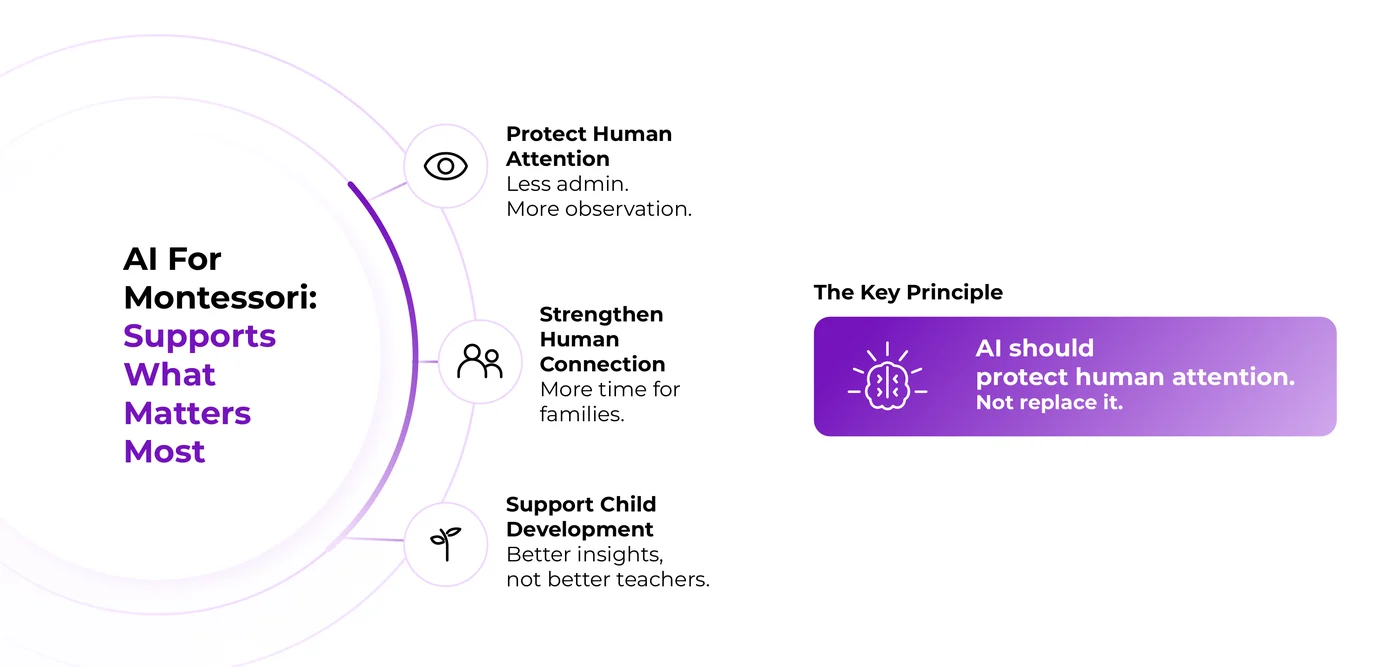
- For educators: AI takes on the documentation that quietly consumes a teacher's day, drafting daily reports from observation notes, pulling summaries, supporting lesson planning aligned to Montessori materials, and communicating with families in their own language. Observation remains the guide's work.
- For parent experience: AI supports structured daily summaries, a consistent tone across classrooms, and translation so no family is left out because of language, with no extra load on guides.
- For admissions and enrollment: An AI enrollment agent can answer calls, handle missed and after-hours contacts, qualify leads, schedule tours and send follow-up reminders so no opportunity slips through the cracks. The admissions team still shapes the voice and the relationship. AI handles triage and timing.
- For leadership and operations: AI brings enrollment, billing, staffing, attendance and compliance into a single view with early warnings and live dashboards, so leaders act on clear signals rather than spreadsheets that are already days old.
"Investors want to know what your AI strategy is and how it will create value. For us, AI is about removing administrative friction and improving execution across the organization. It gives leaders better visibility into data, automates back-office processes, simplifies compliance, and ultimately creates better experiences for teachers and families. In areas like marketing, AI hasn't changed the fundamentals of how we drive growth, it has changed the speed and sophistication with which we can execute, test, optimize, and make decisions." Steve Xu, Founder and Global CEO, Guidepost Montessori
How does a connected platform change each Montessori operational function?
Every Montessori school runs across five connected functions. Here is how each one looks fragmented and connected, with questions to take to your leadership team.
1. The enrollment journey
The enrollment journey runs from first inquiry through tour, application, waitlist, offer and acceptance, and continues through re-enrollment and sibling pipelines. In fragmented operations, inquiries sit unanswered, tours are scheduled in one tool, applications in another, and waitlists in spreadsheets. With lead-to-enrollment data scattered across systems, it is impossible to understand what drives enrollments or where families are lost.
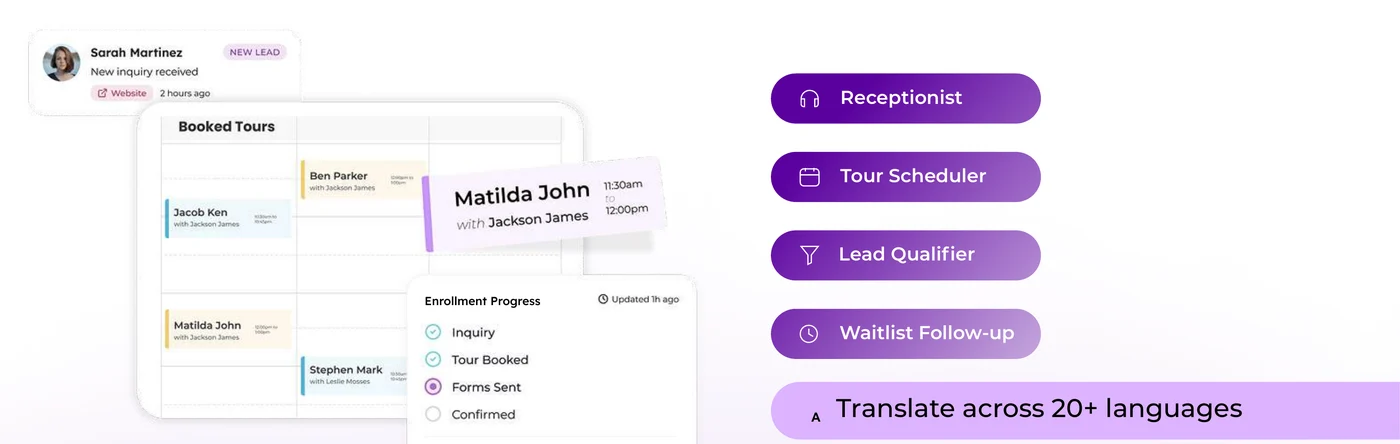
With a connected enrollment and admissions system, inquiries, tour scheduling, application management, waitlist tracking and sibling re-enrollment all run from the same record. AI agents act as receptionist, tour scheduler, lead qualifier and waitlist follow-up, translating across more than 20 languages, and the team gets real-time visibility into response times and pipeline health across every center.
Questions for your leadership team:
- How fast does your team respond to inquiries, and how do you know?
- What share of inquiries become tours, and tours become enrollments?
- How is your waitlist managed, and who has real-time visibility?
- How many sibling re-enrollments are confirmed, not assumed?
2. Registration, billing and center management
Once a seat is accepted, schools shift from winning families to serving them. Registration, billing and center management become the operational foundation of the family experience, and the source of a disproportionate share of administrative burden.
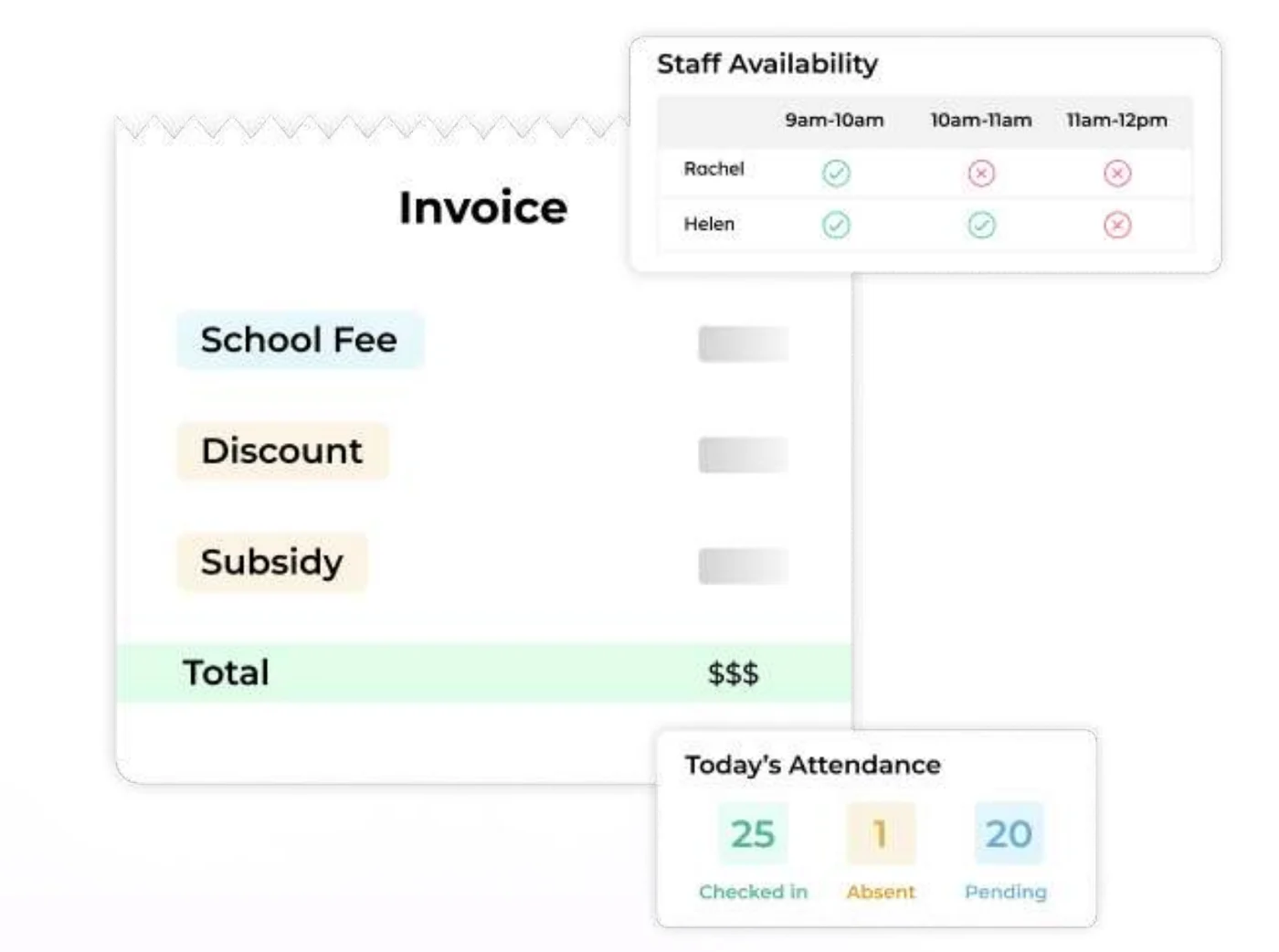
With a connected system and Montessori school accounting, the enrollment record a family completes becomes the billing, communication and compliance record without re-entry. A billing adjustment is reflected immediately across the organization. Capacity across classrooms and campuses is visible in real time, so leadership can make informed decisions about waitlists, staffing and program planning.
Questions for your leadership team:
- How many hours a week do you lose to data reconciliation?
- How often do billing discrepancies happen, and how long do they take to fix?
- Can you see capacity across every center in real time?
- When a family switches campuses, how many systems update separately?
3. Parent engagement and communication
Parent engagement runs from day one: daily updates, photos, weekly notes, teacher-parent messaging, announcements, permission slips, RSVPs and conferences. In a fragmented school, these are scattered across tools, with updates in one app, newsletters in another, conferences in a third. Each works alone, but together they create a disconnected experience for families and leave guides keeping everything in sync.
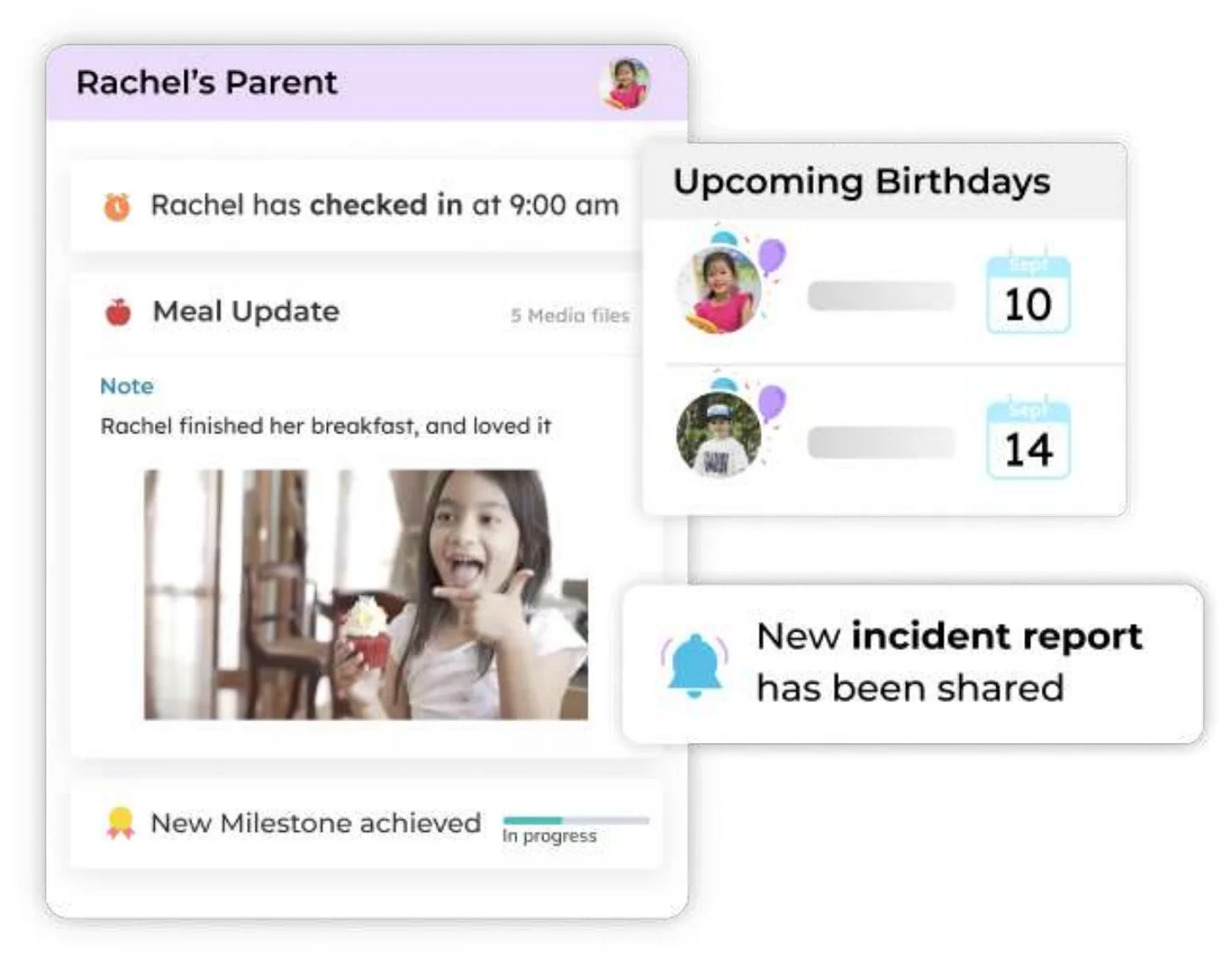
With a connected parent communication system, daily reports, weekly notes, messages, photos, RSVPs and announcements all flow through the channel families already check. Guides write once and families receive consistently. AI handles translation automatically. Leadership can see which families are opening communications, which classrooms communicate most consistently, and where engagement is weakening before it becomes a retention problem.
Questions for your leadership team:
- How many apps do parents need to stay informed?
- Is communication consistent across classrooms and centers?
- Do multilingual families receive the same communication experience?
- Can leadership see family engagement in one view?
4. Observations, lesson planning and records
Observation, individualized lesson planning and long-term record-keeping are at the heart of Montessori practice. In fragmented operations, they are spread across notebooks, spreadsheets and disconnected tools, forcing guides to hold the system together themselves.
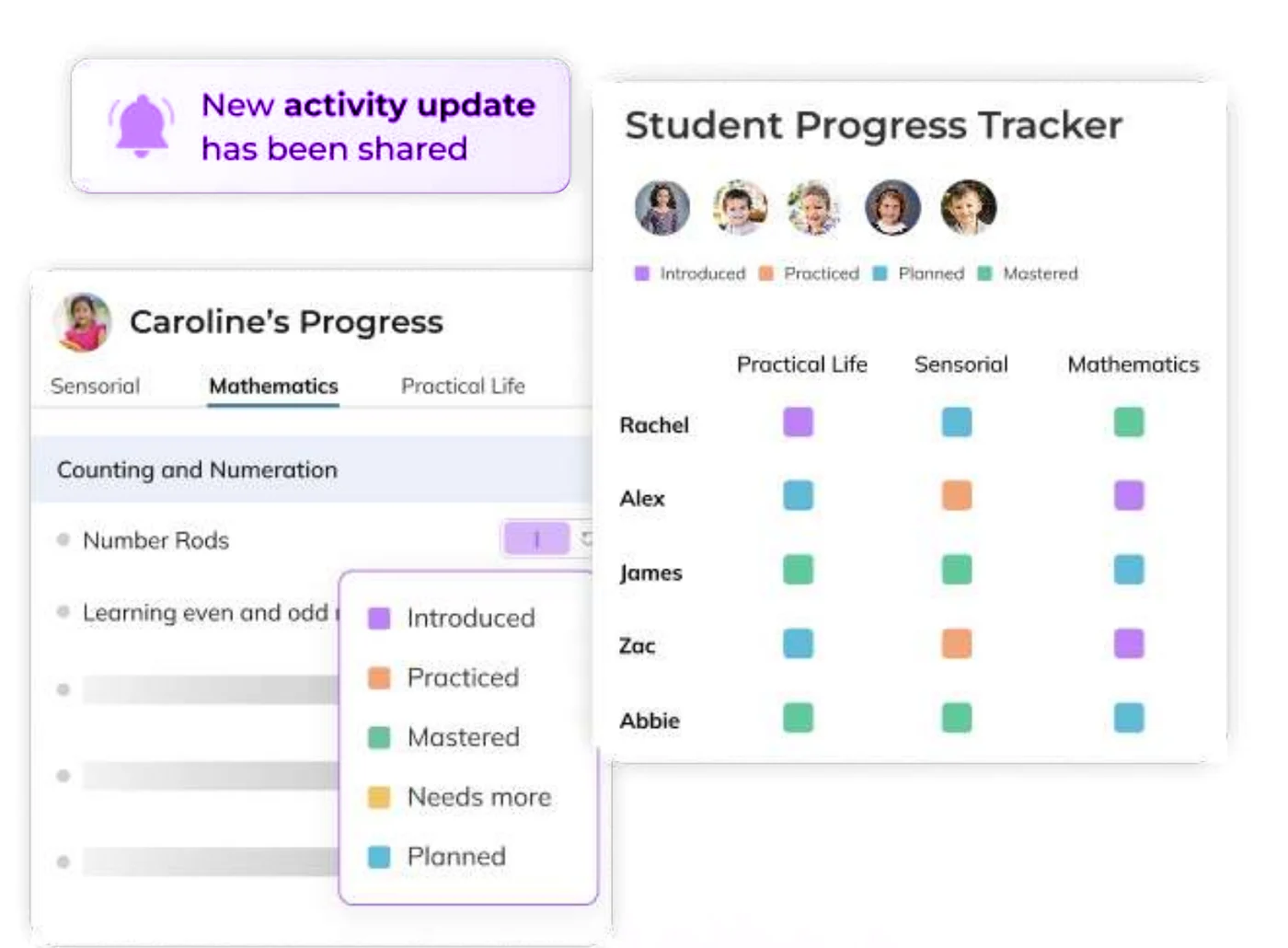
With connected Montessori record keeping, a single observation flows into daily reports, lesson plans and long-term student records without re-entry. AI can draft daily summaries from observation notes, suggest lessons aligned to the Montessori scope, and keep records following each child across the three-year cycle, giving every guide a complete picture of the child's journey.
Questions for your leadership team:
- How much time do guides spend documenting across systems?
- Is observation depth being supported by the system?
- Do child records follow the three-year cycle, or reset each year?
- Where should AI save time, and where should humans stay in charge?
5. Compliance, reporting and visibility across centers
Enrollment, registration, parent engagement and classroom practice all generate information. In a fragmented school, enrollment data sits in a spreadsheet, tuition in one system, attendance in another, compliance in another. Cross-campus comparisons are assembled manually, reporting is retrospective, and compliance preparation becomes a recurring fire drill. By the time leadership sees the data, the moment to act has often passed.
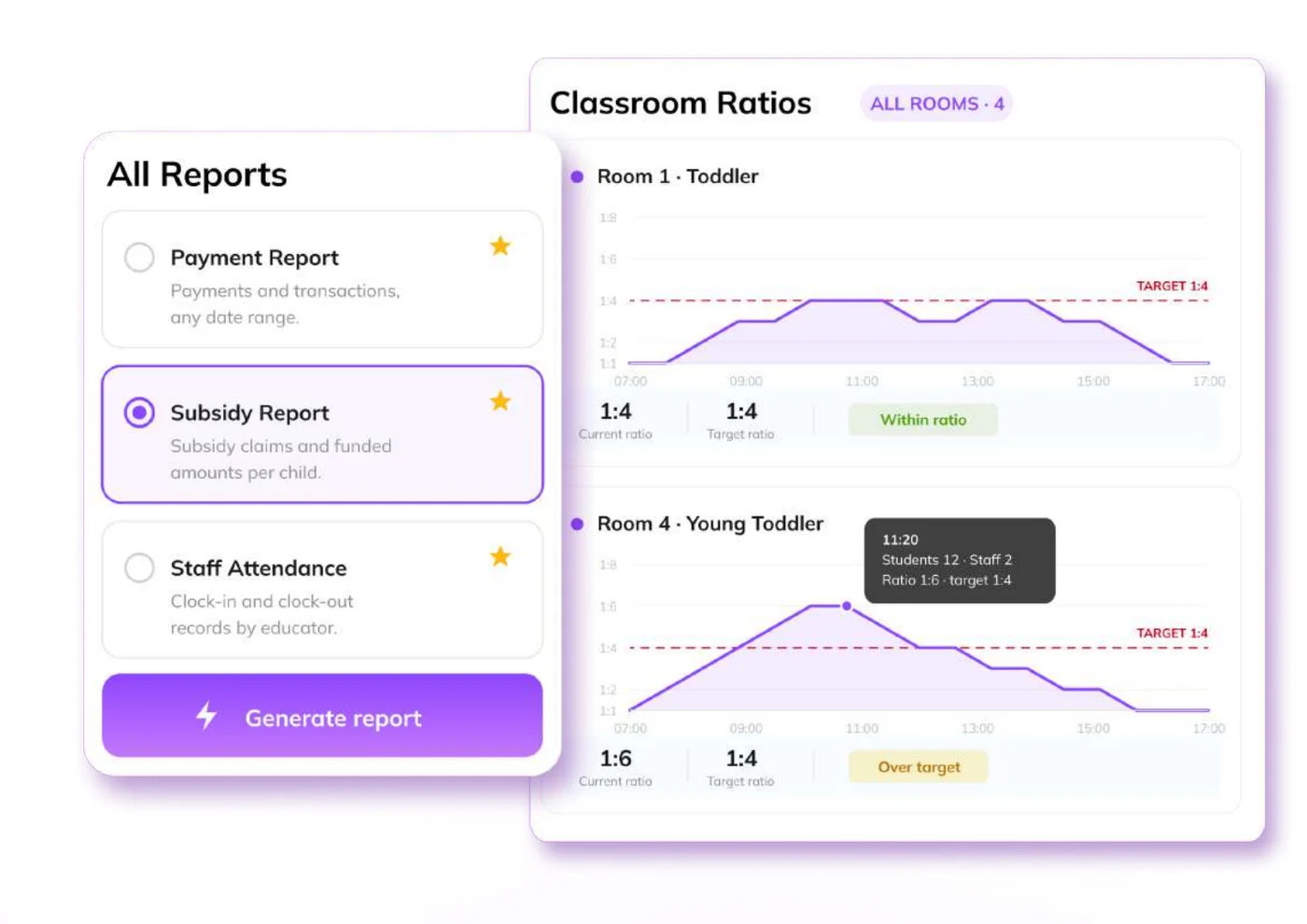
When enrollment, billing, attendance, staffing and compliance data are visible in one place in real time, the nature of leadership changes. Leaders review daily operational health in one view. Regional directors compare campus performance without waiting for manual reports. Executive directors and boards receive accurate, current information. When a licensing inspection requires documentation, it is available immediately.
Questions for your leadership team:
- Can you see every center's key operations in one unified view?
- How quickly can you produce a board-ready operational report?
- Where does compliance documentation create organizational risk?
- What decisions would change if you had real-time visibility?
Six questions to take into your next leadership meeting
- Count your systems. How many platforms touch the family journey? How many tools does your team use daily? Can you view the entire family experience in one place?
- Map duplicate entry. Where is data entered more than once? Which workflows rely on exports or copy-paste? What happens when your people stop connecting your systems?
- Audit the parent experience. How many apps do parents need to use? Is the experience consistent across every center? Does it reflect the classroom experience?
- Review support complexity. How many vendors support your operations? Who owns cross-system issues? When problems span systems, who is accountable?
- Test network scalability. Can you see all key metrics in one view? Can you compare performance across centers? Can you double in size without doubling headcount?
- Define where AI belongs. Which workflows can be simplified without losing human judgment? Where can admissions move faster without losing the human touch? Is AI reducing workload or creating more of it?
How did Guidepost Montessori move to one platform?
Guidepost Montessori, which operates more than 90 preschools across more than 20 US states, offers a concrete example of what this transition looks like at scale. Matthew Sears, Senior Vice President of Technology, Global, at Guidepost Global Education, describes the decision:
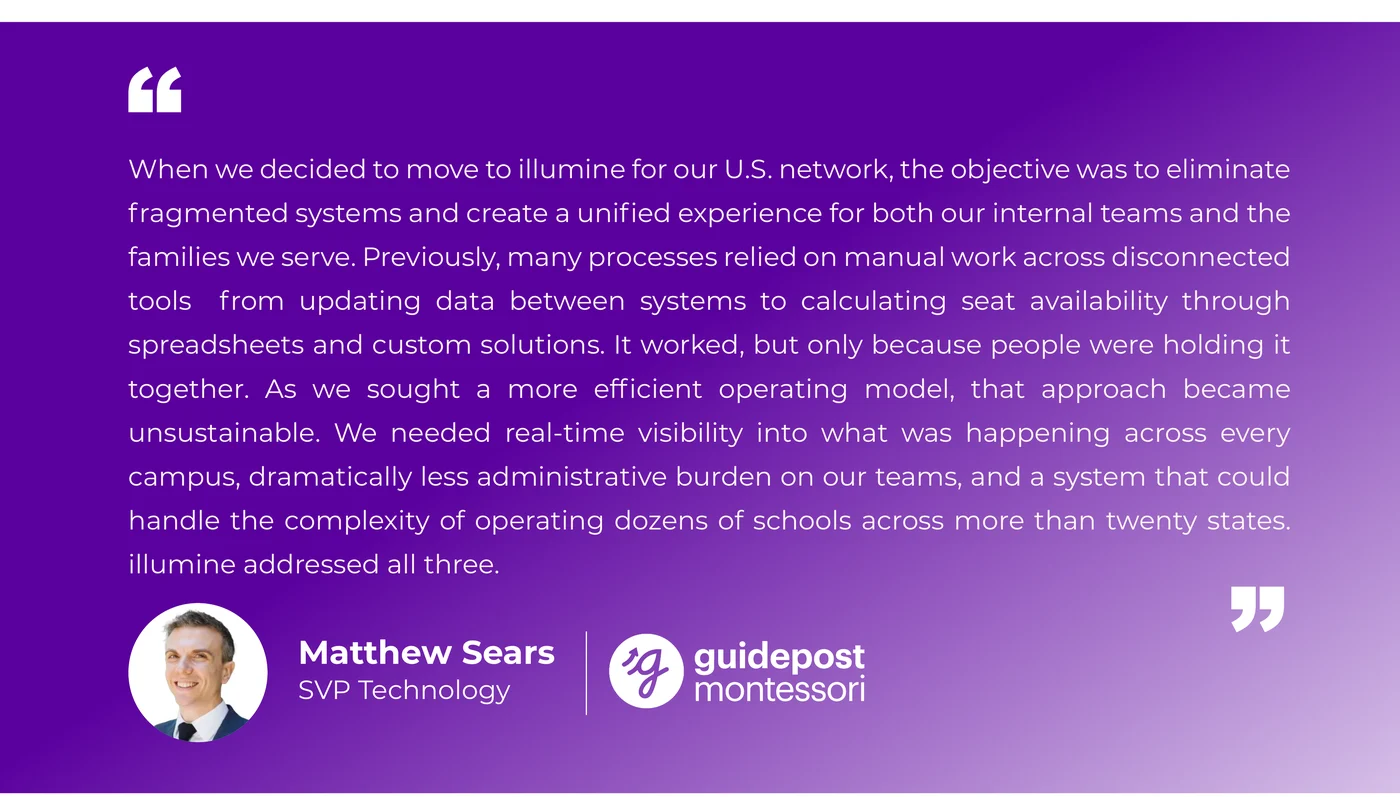
"When we decided to move to illumine for our U.S. network, the objective was to eliminate fragmented systems and create a unified experience for both our internal teams and the families we serve. Previously, many processes relied on manual work across disconnected tools, from updating data between systems to calculating seat availability through spreadsheets and custom solutions. It worked, but only because people were holding it together. As we sought a more efficient operating model, that approach became unsustainable. We needed real-time visibility into what was happening across every campus, dramatically less administrative burden on our teams, and a system that could handle the complexity of operating dozens of schools across more than twenty states. illumine addressed all three." Matthew Sears, SVP Technology, Guidepost Montessori
For the parent-facing side of Guidepost's rollout, see how illumine AI powers connected parent experiences across Guidepost campuses. Other networks making this transition include MMI International Group, with more than 150 centers across Europe and Southeast Asia, and Illuminate Montessori, with more than 15 centers across the United States. The pattern is consistent: leaders are moving away from fragmented departmental tools toward one place where parent experience, day-to-day operations, classroom records and leadership visibility live together. For a closer look at the multi-site side of this shift, see illumine's report Scaling Smart: How Multicenter Childcare Networks Scale Without Breaking.
Final reflection
For a modern Montessori network, the system behind the school shapes the experience of everyone in it: whether parents receive timely communication, whether guides have time to observe children, whether leadership sees what is actually happening across locations. The schools that thrive in the coming decade will pair strong Montessori practice with operational excellence, parent communication, teacher sustainability and scalable systems.
Maria Montessori reminded us that education is not simply about what adults do to children. It is about creating conditions in which development can unfold naturally. The same principle applies to organizations. Leadership is not simply about managing people. It is about creating conditions in which teachers can teach, families can trust, administrators can lead, and children can thrive. The prepared system is not about software, dashboards or workflows. It is about creating organizational conditions that allow human potential to flourish. That goal is as Montessori today as it was more than a century ago.
If the questions in this guide surfaced challenges you recognize, illumine offers an operational walkthrough for Montessori schools and networks: a structured conversation about your current tools, the gaps in your parent experience, where duplicate work is consuming your team's time, and where a connected platform would make the most difference. Book a walkthrough.
Frequently asked questions
What is Rethinking Montessori Operations?
A 2026 leadership guide by Tim Seldin, President of the Montessori Foundation, published with illumine. It is written for heads of school, directors and network leaders who want to modernize how their school runs without losing what makes Montessori worth protecting.
How much time do fragmented tools cost Montessori guides?
illumine estimates that fragmented tools cost each Montessori guide 3 to 5 hours every week, time that belongs in the classroom.
What forces are reshaping Montessori school operations?
Three forces: a new kind of parent who expects immediate, transparent communication; a harder enrollment market, with US births down 1% in 2025 and publicly funded early childhood options expanding; and higher expectations for responsiveness shaped by the attention economy.
How should Montessori schools use AI?
AI should protect human attention, not replace it. Use it for documentation, translation, admissions triage and leadership dashboards, while observation, teacher judgment and relationships with families remain human.
What operational functions does every Montessori school run?
Five: the enrollment journey; registration, billing and center management; parent engagement and communication; observations, lesson planning and records; and compliance, reporting and visibility across centers.
Contributors
- Tim Seldin, President, Montessori Foundation, and Chair, International Montessori Council. More than fifty years in Montessori education, including twenty-two years as head of the Barrie School. (LinkedIn, Montessori Foundation profile, Circle Time with Tim articles)
- Steve Xu, Founder and Global CEO, Guidepost Global Education (LinkedIn, Guidepost Montessori)
- Matthew Sears, Senior Vice President of Technology, Global, Guidepost Global Education (LinkedIn)
Methodology
Rethinking Montessori Operations was published by illumine in collaboration with Tim Seldin, President of the Montessori Foundation. illumine supports the Montessori Foundation's work with schools, a relationship disclosed in the foreword. The guide draws on the author's fifty-plus years of work with Montessori schools across many countries, published third-party research from NAEYC, the CDC's National Center for Health Statistics, Child Care Aware of America, and Cornerstone Communications and Edsby, and first-hand input from Guidepost Montessori leadership, an illumine customer. The estimate of time lost to fragmented tools reflects illumine's own analysis.
Sources
- PR Newswire, illumine partners with Guidepost Montessori to transform preschool operations with AI (April 8, 2026)
- Guidepost Montessori, announcement on Montessori school operations
- Guidepost Montessori, A new era for Montessori
- THE Journal, Survey finds majority of schools using 10 to 15 educational apps (Cornerstone Communications and Edsby, 2025)
- NAEYC, January 2026 child care affordability survey
- CDC National Center for Health Statistics, Births in the United States, 2025
- Child Care Aware of America, Child Care in America: 2025 Price and Supply
- Montessori Foundation, Parent Ambassador programs
- Capterra, illumine reviews
Related reports: Scaling Smart: How Multicenter Childcare Networks Scale Without Breaking, Childcare Enrollment Report 2026, What Will Montessori Leadership Look Like in 2030? and The Costs Draining Childcare Centers: USA Cost Benchmark Report.
Related webinar: The Montessori Leadership Series: Rethinking Montessori.