



The Montessori Leadership Benchmark: Priorities for 2027 is illumine's benchmark for Montessori heads of school, academic heads, guides and multi-campus leadership teams.
It draws on illumine's conversations with 244 Montessori schools across 28 US states to show the hidden cost of disconnected systems, where admissions, tuition, Montessori records and family communication break down, and what leaders should prioritize in 2027.
It includes perspectives from Tim Seldin, President of The Montessori Foundation, and Matthew Sears, SVP Technology at Guidepost Montessori.
Key findings
- 63% of the 244 Montessori schools illumine spoke with use two or more tools to run daily operations, which adds administrative work and limits leadership visibility.
- 33% reported difficulties managing tuition plans, payments and billing, the most commonly raised of the five core school functions.
- 30% reported challenges managing observations, lesson progress and student records, yet 35% named Montessori records and curriculum among what they value most.
- 28% reported difficulties keeping communication consistent across classroom updates, school administration and family interactions.
- Among 85 Heads of School, progress records and observations were the most raised operational challenge (21%), followed by tuition plans and fees, inquiries and enrollment, and parent communication (18% each).
- Transparent Classroom (26%), paper and manual processes (23%) and general preschool apps (23%) were the tools schools mentioned most often.
What is the Montessori Leadership Benchmark based on?
Montessori schools carefully prepare the learning environment for children. This report examines whether the systems supporting their guides, administrators and leadership teams receive the same attention.
illumine spoke with 244 Montessori schools to understand the challenges they face in managing day-to-day operations, including admissions, tuition, record keeping and family communication.
The conversations covered technology adoption, key operational challenges across school functions, the capabilities schools value most, and the factors shaping their technology purchasing decisions.
The research is observational: it comes from prospective schools and existing customers in conversation with illumine. Schools are counted once per theme, and every figure names the group it is calculated from. Schools could select multiple responses, so totals may exceed 100%.

The leadership priority for 2027: bring classroom and administrative operations together, giving Heads of School greater oversight, guides easier access to student records, and families a more connected experience while preserving Montessori educational practices.
Why do Montessori schools need purpose-built systems?
For Montessori leadership teams, the cost of multiple systems extends beyond software spending. Disconnected information creates inefficiencies, limits visibility across campuses, and complicates academic and administrative coordination. Without a unified view, leaders struggle to identify revenue risks, forecast enrollment and anticipate challenges.
These gaps ultimately affect financial sustainability, leadership capacity, and the ability to maintain consistent standards as schools grow.
Montessori leaders face decisions that directly shape the future of their schools: where to invest resources, how to retain experienced guides, and how to maintain educational quality amid rising operating costs.
The challenge is balancing the financial realities of running a school with the long-term commitment to Montessori education. These responsibilities are connected. The systems supporting them often are not.
"School leaders today face pressure from multiple directions at once, declining birth rates, intensifying competition, rising staffing costs, growing parent expectations, teacher fatigue, multi-campus complexity, and the demand for measurable leadership outcomes. At the same time, we are working to preserve something deeply human: environments built around concentration, relationships, observation, and authentic child development." Tim Seldin, President, The Montessori Foundation
The objective is not to change Montessori education. It is to make the operations supporting it more effective.
What tools do Montessori schools use today?
Montessori schools rely on a mix of specialized and general-purpose tools. They have often adopted technology one need at a time: one platform supports classroom observations, while another system manages tuition, enrollment or family communication.
Each tool may serve its purpose, but school leadership is left connecting information between them.
Of the 244 schools, 63% run two or more of the tools below. The figures represent individual tools or process types that schools use for their daily operations, and schools could name more than one.
- Transparent Classroom: 26%
- Paper and manual processes: 23%
- General preschool app: 23%
- Preschool management suite: 22%
- Spreadsheets: 16%
- Montessori Compass: 12%
- Accounting software: 8%
- Private-school tuition platform: 6%
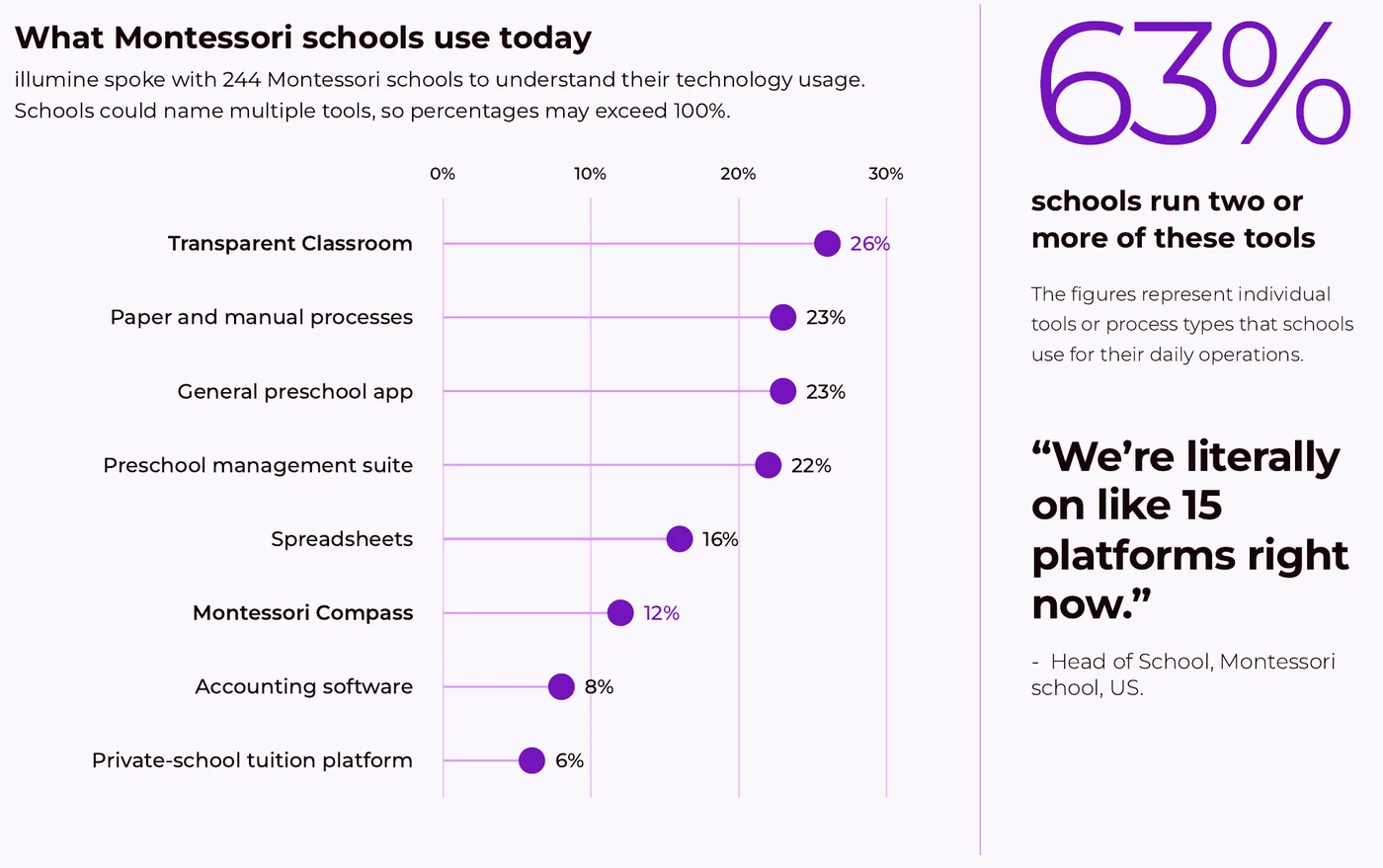
"We're literally on like 15 platforms right now." Head of School, Montessori school, US
Montessori-specific and general school management tools serve different purposes, but connecting them remains a challenge. The burden falls on school teams to keep information aligned, creating inefficiencies that extend beyond administration and affect overall school performance.
For a side-by-side look at one of these tools, see Montessori Compass vs illumine.
Where do Montessori school operations disconnect?
Montessori leaders are responsible for maintaining educational quality while protecting the financial and operational health of their schools. Yet critical information about enrollment, tuition, classroom progress and family relationships often sits in separate systems.
Without a complete view of these functions, leaders may struggle to identify emerging risks, evaluate school performance and make timely decisions.
- Classroom records. Guides document observations, lessons and individual progress in Montessori-specific platforms, often separate from the school's administrative records.
- School administration. Enrollment, tuition, attendance and compliance are managed through different systems, requiring teams to manually update and reconcile information.
- Family communication. Classroom updates, administrative notices and financial information are shared through separate channels, leaving families and school teams navigating multiple platforms.
- Leadership visibility. Heads of school and multi-campus leaders must bring information together from different sources to understand enrollment, finances, classroom operations and emerging challenges.
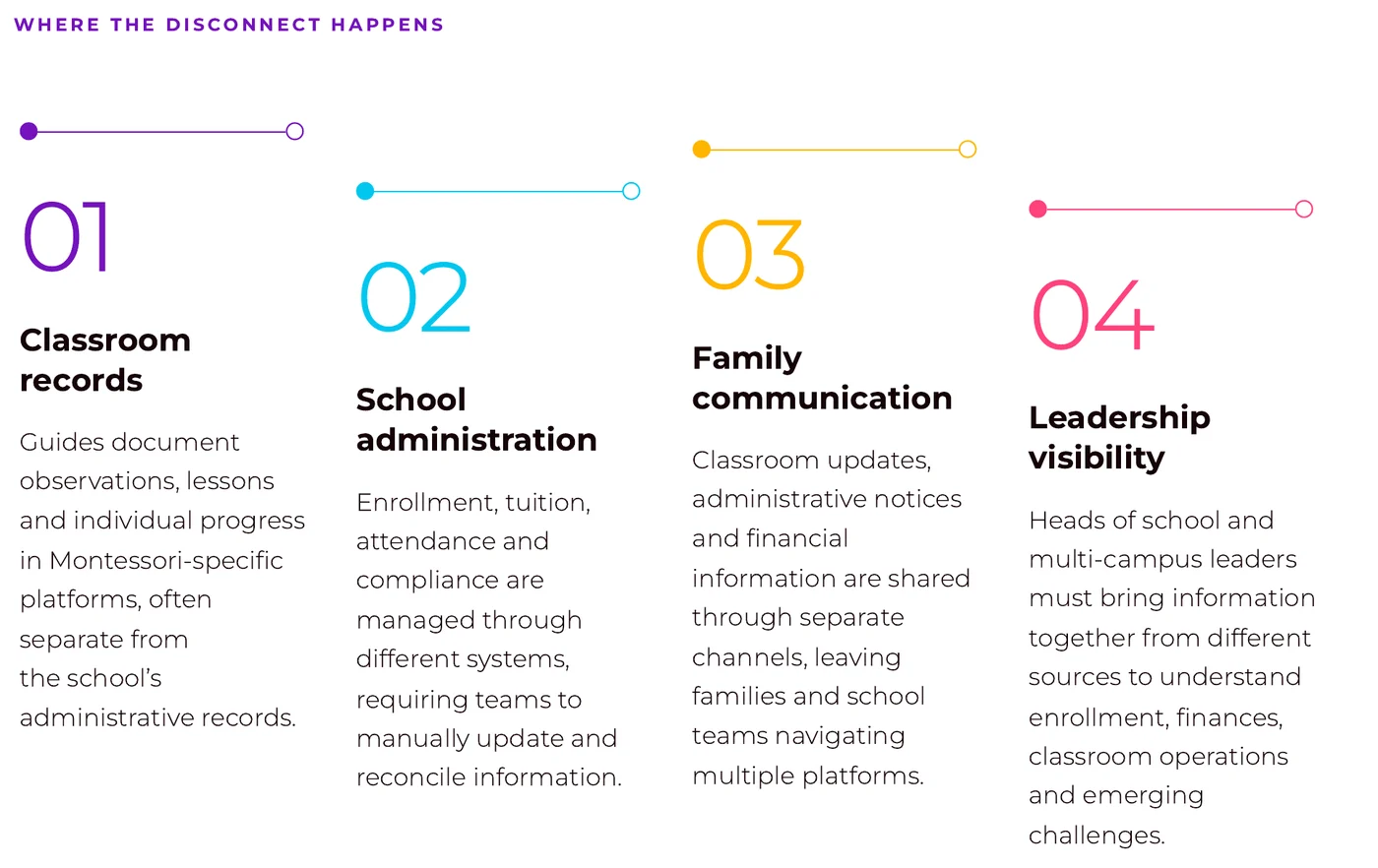
The real challenge is not the number of tools. It is the lack of connection between the functions that keep a Montessori school running.
What does operational inefficiency cost a Montessori school?
The disconnect between school functions carries a cost that rarely appears in technology budgets. Software subscriptions represent only one part of a school's technology expenditure.
The larger financial question is how much staff time is spent maintaining those systems, correcting discrepancies, training new team members and preparing information for routine decisions. These recurring activities are rarely measured or included in technology purchasing decisions.
- Duplicate data entry. A single change to a student's enrollment or family details requires updates across multiple systems, increasing the risk of missed updates and inconsistent records.
- Tuition reconciliation. Discrepancies between enrollment records, tuition plans and payments force administrators to manually investigate billing errors, missed charges and outstanding balances.
- Repeated staff training. Every new guide or administrator must learn several platforms, prolonging onboarding and creating dependence on experienced staff for routine tasks.
- Delayed reporting. By the time leadership teams consolidate data from different systems, enrollment shifts, revenue gaps and emerging operational issues may already require urgent attention.

The question is not simply what a school pays for its systems, but whether those systems are helping the school operate efficiently, use resources effectively and support long-term financial sustainability.
What operational challenges do Montessori Heads of School raise most?
A Montessori Head of School must balance educational leadership with financial and operational accountability. Beyond guiding classroom practices and supporting guide development, they oversee student transitions, parent conferences, enrollment, tuition collection, regulatory requirements, and the resources needed to maintain well-prepared learning environments.
In schools with limited administrative support, coordinating technology and correcting information across systems becomes another responsibility on an already demanding list.
"Most preschools, and especially most Montessori schools, are like me. There's one person doing everything." Owner, Montessori school
In illumine's conversations with 85 Heads of School, the operational challenges raised most often were:
- Progress records and observations: 21%
- Tuition plans and fees: 18%
- Inquiries and enrollment: 18%
- Parent communication: 18%
- Compliance and health records: 15%
- Training and onboarding: 15%

"She did 80 hours, two weeks of sick time. And I was like, no, the state requirement is 40 hours." Director, single-site school, on tracking staff records manually
"The people in my company who use Excel don't know how to use it. Even more dangerous." Operator, four-campus group in Florida
What leaders should ask: if the person who understands your setup left tomorrow, what would break?
Why is Montessori record keeping so hard to get right?
In Montessori education, observation is central to understanding each child's development, planning lessons and adapting the prepared environment. Guides track which lessons each child has been introduced to, practiced and mastered, alongside observations of their development.
When these records are scattered across notebooks, spreadsheets and separate platforms, guides spend more time compiling progress histories and preparing conference reports, and less time using that information to support individualized learning.
Of the 244 schools that described a need, 30% raised Montessori records and curriculum as a problem, while 35% named Montessori records and curriculum among what they value most.
That gap shows how much importance schools place on documenting each child's learning journey, and how far the systems available to them fall short.
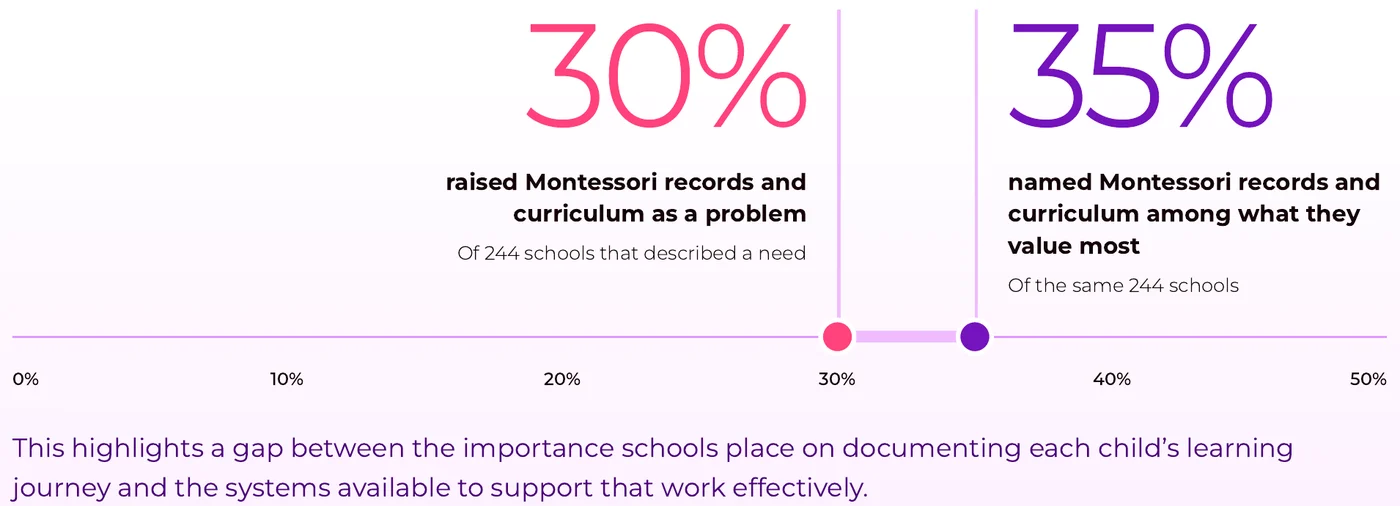
Disconnected documentation makes it harder to maintain consistent learning records, review progress across classrooms, prepare for conferences and support continuity as children move from Toddler to Children's House and Elementary.
A Montessori record should help guides understand the child, not require them to reconstruct the child's journey. One conference report can mean pulling hundreds of records for a single child. Connected Montessori record keeping keeps that history in one place.
What leaders should ask:
- Can guides follow a child's complete lesson and observation history without compiling records from separate places?
- Which classroom information do guides enter more than once, and do a child's records follow them from Toddler to Children's House to Elementary?
How do disconnected systems affect Montessori families?
Montessori education places significant importance on the partnership between school and family. That relationship depends on consistent communication, accurate information and a shared understanding of each child's progress.
Yet families may encounter disconnected processes throughout their school journey, from enrollment forms and tuition payments to classroom updates and re-enrollment. Of the 244 schools that described a need, 28% raised parent communication as a problem.
Schools told illumine that families encounter friction in three places:
- A fragmented enrollment experience. Families are often asked to provide the same information multiple times during enrollment and re-enrollment.
- An inconsistent communication experience. Classroom updates, school announcements and billing information spread across multiple channels make it harder for families to stay informed and engaged.
- Limited visibility into a child's progress. When classroom observations and family communication are managed separately, schools struggle to present a clear, continuous picture of the child's learning journey.
These experiences shape how families perceive the school, and they create additional work for administrative teams responding to inquiries and resolving confusion.
A connected family experience should reflect the continuity Montessori schools work to provide in the classroom, which is what a single Montessori parent communication system is for.
What leaders should ask: how many separate systems must a family use to complete routine tasks and stay informed about their child?
Which functions do Montessori schools value most, and where do they struggle?
Schools recognize the importance of classroom documentation, enrollment, family communication and billing, yet these same functions generate the most operational challenges. Of the 244 schools that described a need:
- Montessori records and curriculum: 35% value it, 30% raised it as a problem.
- Enrollment, tours and waitlists: 30% value it, 25% raised it as a problem.
- Parent communication: 27% value it, 28% raised it as a problem.
- Tuition and billing: 26% value it, 33% raised it as a problem.
- Compliance and forms: 15% value it, 17% raised it as a problem.
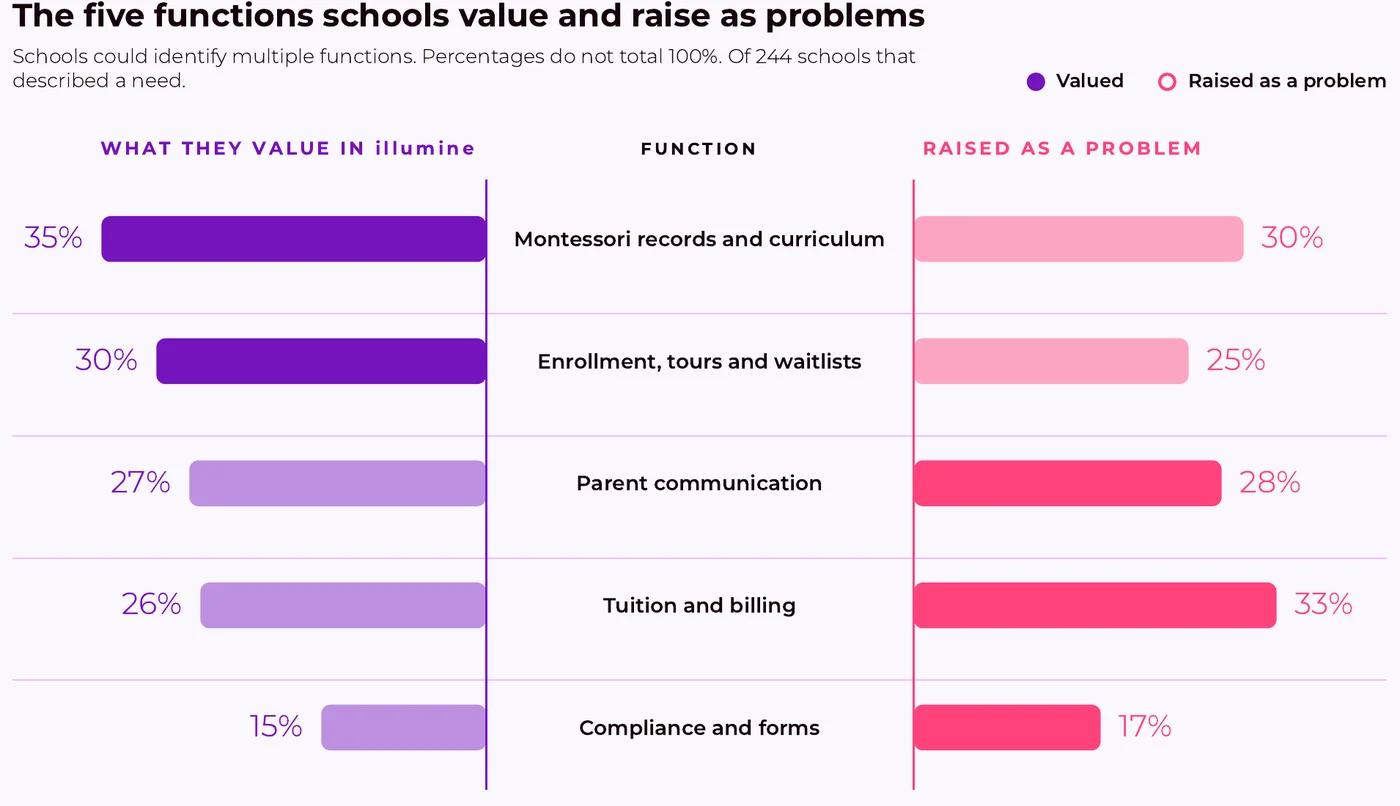
For Montessori leadership teams, these findings provide a practical starting point. Schools should prioritize the functions creating the greatest operational difficulties, particularly tuition and billing, without overlooking the Montessori records and curriculum capabilities they value most.
The goal should be to strengthen both educational documentation and financial management, rather than solving one problem while allowing another to persist.
How do disconnected systems delay leadership decisions?
Montessori leaders managing multiple campuses need to know which schools are struggling with enrollment, tuition collection or staffing, so they can provide the right support at the right time.
- Revenue visibility. Separate enrollment and billing systems make it harder to identify overdue payments, billing errors and outstanding balances. Leaders need a reliable view of tuition billed, collected, outstanding and requiring attention.
- Enrollment and classroom planning. Disconnected admissions records make it hard to connect inquiries, enrollments, upcoming transitions and available classroom places. Leaders need visibility into the enrollment pipeline alongside classroom capacity and staffing.
- Academic continuity. Scattered lesson records and observations make it harder to track progress and ensure continuity in Montessori learning. Leaders need consistent records that follow each child across classrooms and program levels.
- Team capacity. Repeated data entry, reconciliation and manual reporting take time away from supporting guides and families. Leaders need fewer administrative handoffs and clear ownership of recurring processes.
- Multi-campus oversight. Different records and reporting methods across campuses make it harder to identify trends and compare performance. Leaders need comparable reporting that supports both network standards and campus-level decisions.
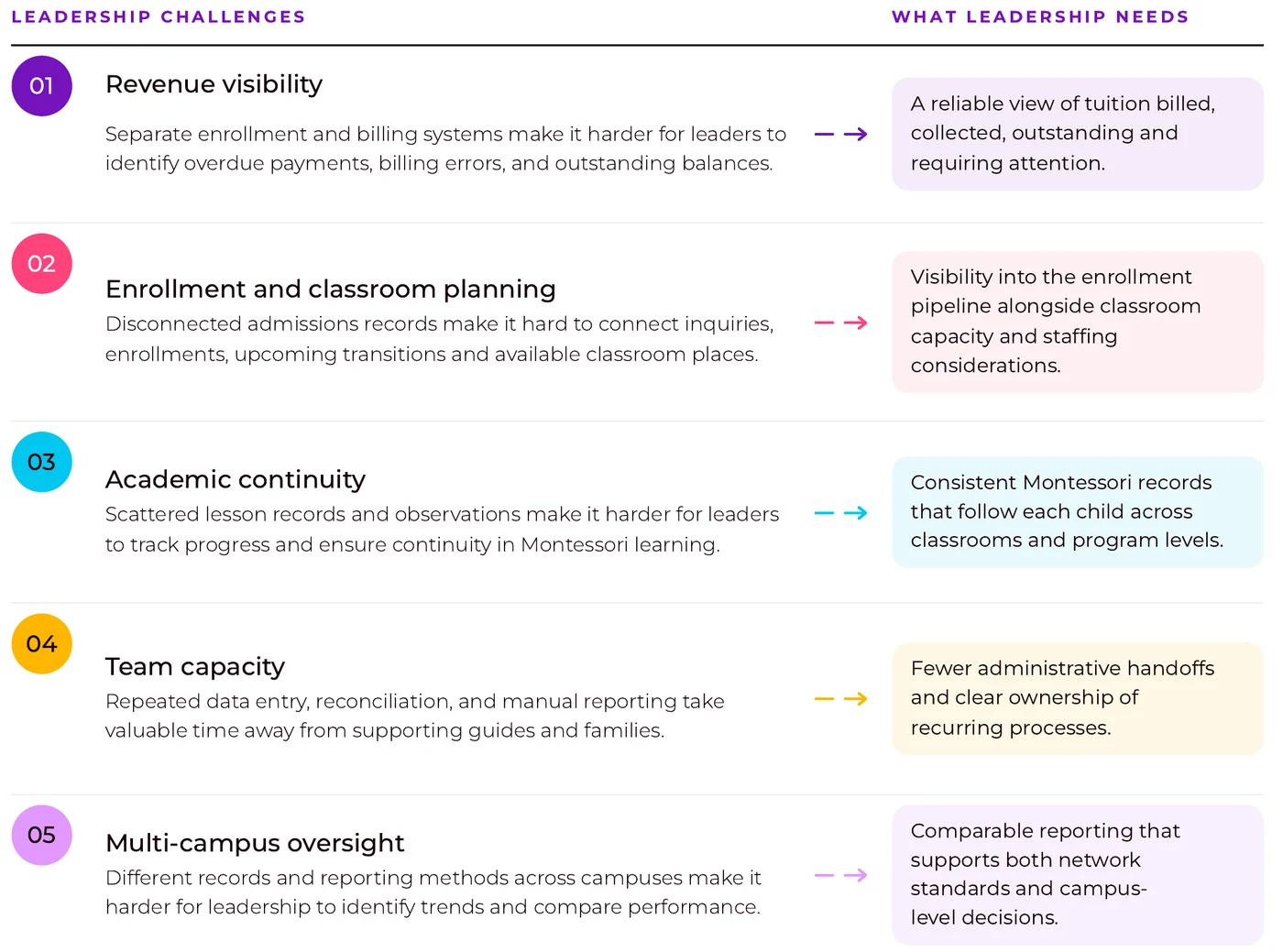
The true cost of fragmentation is not just the work being repeated. It is the decisions being delayed and the leadership attention being diverted.
What should connected Montessori school operations enable?
A unified Montessori operating model is not simply one platform containing more features. Its value lies in keeping information connected across the child's learning journey and the processes supporting the school.
- For multi-campus leadership: common definitions and shared processes support reporting across schools while allowing appropriate differences in programs, tuition and local operations.
- For academic leadership: Montessori scope and sequence, lesson records and progress information remain accessible to authorized team members, supporting continuity across classrooms.
- For families: school information, routine forms, payments and approved classroom updates are available through a more consistent experience.
- For heads of school: enrollment, tuition, attendance, administrative records and family communication can be reviewed without reconstructing information from unrelated systems.
- For guides: individual observations, lesson presentations, progress records and conference reports remain connected, reducing the need to compile information repeatedly.
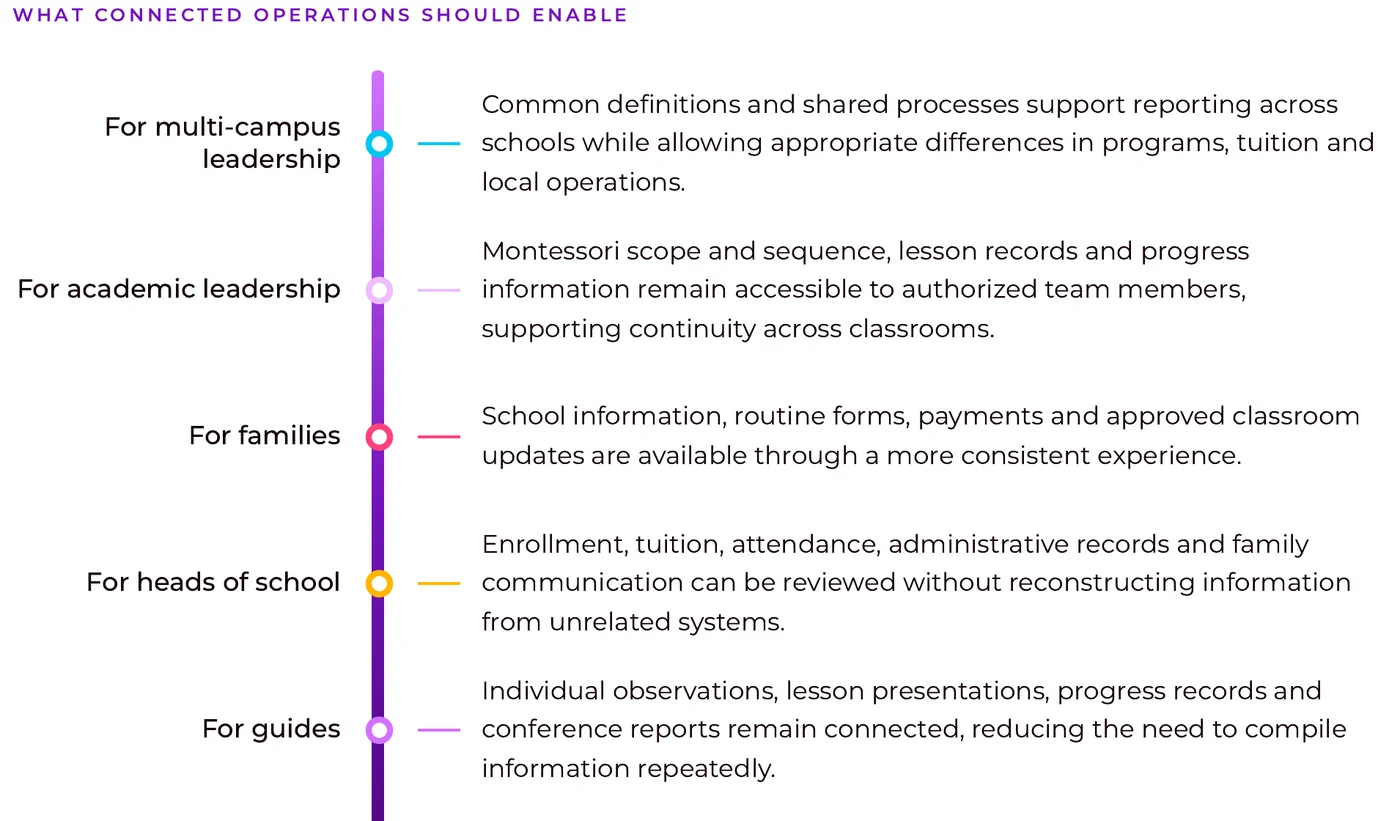
A connected system allows schools to track each child's journey from enrollment through classroom progression, so important information remains accessible at every stage. As schools grow, this shared foundation helps leadership teams scale operations while protecting the individualized approach that defines Montessori education.
How should Montessori schools use AI?
Montessori education is built on observation, independence and the relationship between the guide and the child. AI should strengthen these foundations by reducing administrative demands, improving access to information, and giving guides more time to focus on individualized learning.
For Montessori leadership teams, the priority is to identify where AI can improve operational efficiency, support better decision-making and deliver measurable value, while keeping educators in control of educational decisions.
Schools told illumine what they want AI for, and on what condition:
- Drafting daily notes and progress reports, as long as a guide reviews and approves them before anything is sent.
- Translating messages for families, as long as the school decides what goes out, and when.
- Turning a guide's rough notes into something parents can read, as long as the guide's judgment stays in the record.
illumine's AI works across the whole school rather than one feature: an AI writing assistant for newsletters and parent updates, AI translation in more than 20 languages for multilingual Montessori families, AI daily reports that tag students and generate observation summaries, and AI lesson generation aligned to each child's Montessori level.
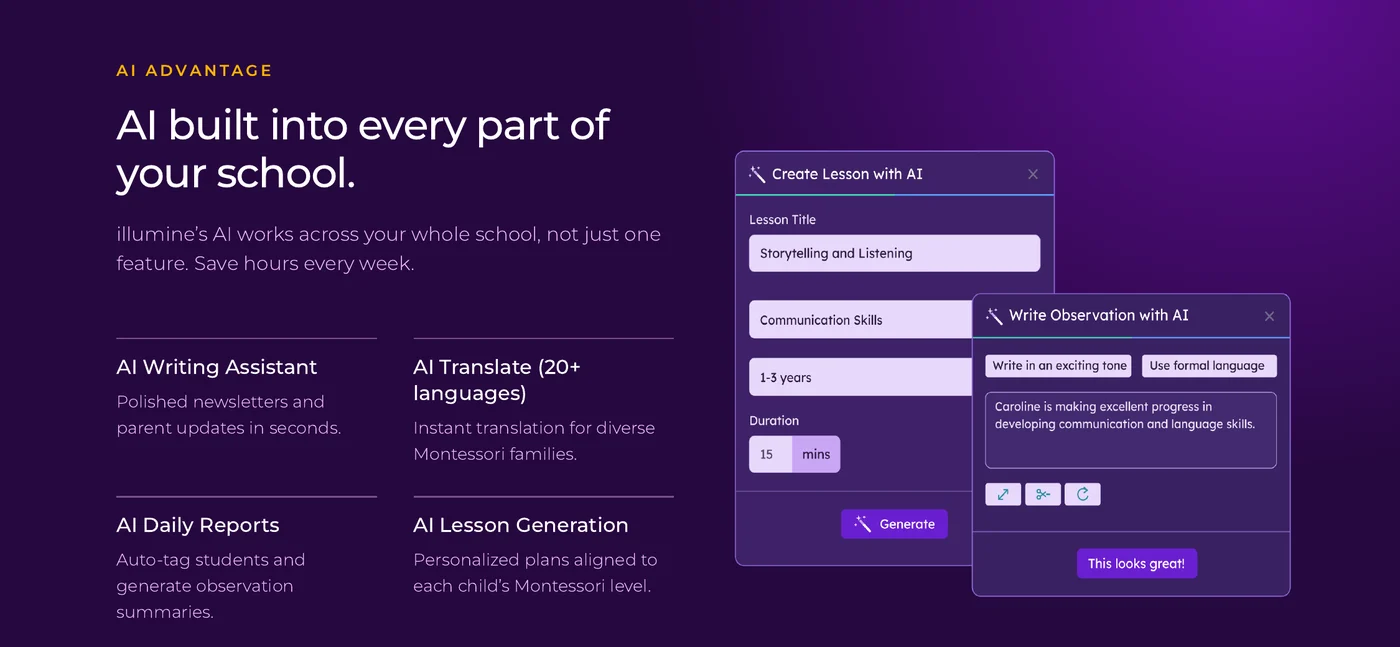
The promise of AI becomes meaningful when it supports the everyday work of Montessori educators.
With AI built into the school management platform, teams get assistance inside their existing workflows instead of switching between separate tools, and human review and approval remain central at every stage, so AI-generated content is verified by guides and school leaders before it is used or shared.
"The AI tools have been amazing for our team. Our teachers love using them for journals and photos, and whenever we have a question, we can ask the AI assistant directly. If we need more help, customer support is always there. Parents adapted quickly, and having everything connected in one place has made such a positive difference for our school." Solare Outdoor, an illumine Montessori school
How does illumine support Montessori Heads of School?
illumine is an AI-native Montessori school management platform that brings Montessori classroom records, enrollment, billing and family communication into one place, helping school leaders manage finances and operations while giving guides more time to focus on children.
In place of a spreadsheet or CRM for leads, a records-only Montessori tool, a separate form builder, a tuition platform and a messaging app, schools get one connected platform: CRM and leads with automatic follow-ups, student records linked to the CRM, smart forms that flow into enrollment, automated tuition with no separate login, and parent communication across SMS, email and app.
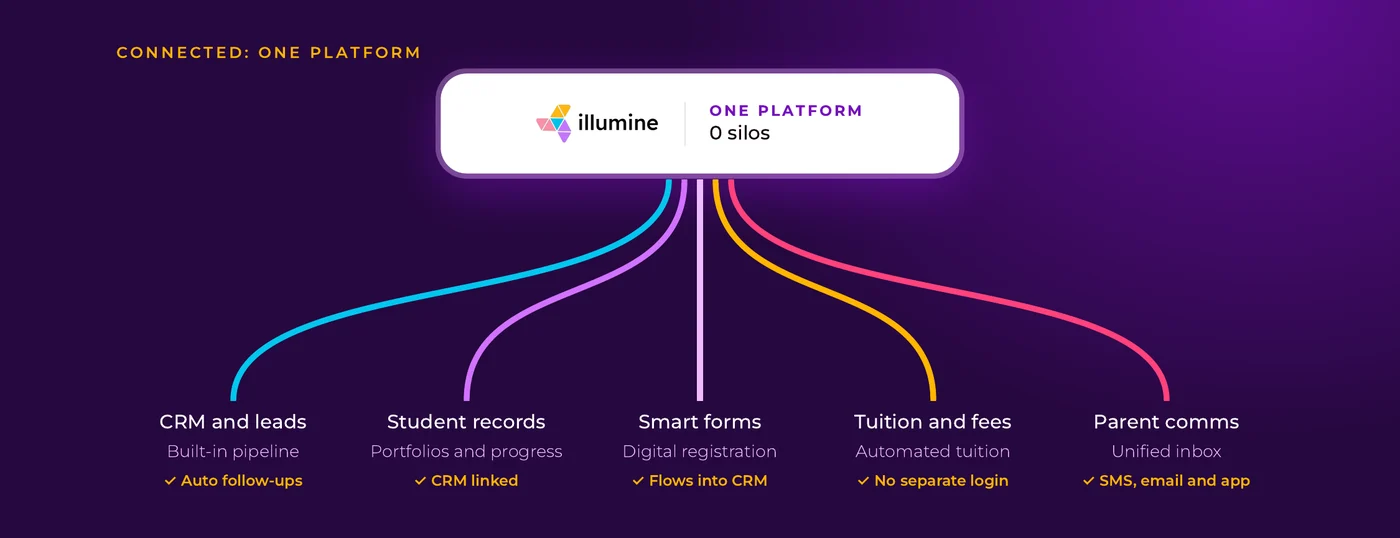
In most Montessori schools, the head of school is also the admissions office, the biller and the trainer. illumine takes the repeated work off that desk, so time goes back to guides and families.
- Montessori record keeping. Lessons aligned to AMS and AMI scope and sequence, and conference reports created in seconds with templates.
- Tuition and financials. Tuition, payment plans and supported financial administration.
- Inquiry to enrollment in one place. An admissions CRM covering inquiries, tours, registration and enrollment workflows.
- Multi-campus visibility. Visibility and oversight across multiple school locations.

Montessori leaders need more than visibility into daily operations. They need to identify opportunities, anticipate challenges and act before those challenges affect school performance. By connecting enrollment, tuition, staffing-related information and classroom operations, illumine helps leaders:
- Forecast enrollment and optimize capacity by tracking inquiries, applications, waitlists, upcoming enrollments and classroom availability.
- Protect tuition revenue by monitoring invoices, payments and outstanding balances in one place.
- Plan resources more effectively by bringing enrollment projections, classroom attendance and operational information together for staffing and planning discussions.
- Strengthen multi-campus performance with centralized reporting that shows differences across campuses and the locations that need additional attention.
"illumine brings together enrollment, communication, billing, and operational workflows into one platform while providing visibility at every level of the organization." Matthew Sears, SVP Technology, Guidepost Montessori
For more on how Guidepost uses illumine with families, see how illumine AI powers connected parent experiences across Guidepost campuses.
How does illumine support academic heads and guides?
Records, progress, attendance, conference reports and family updates sit in one Montessori school operations platform, so guides spend their time with children and academic heads see every classroom the same way. illumine connects lesson plans, observations, progress tracking and conference reports.
Guides document each child's progress directly from the classroom, while academic leaders maintain oversight of AMI- or AMS-aligned lesson sequences, keep classrooms consistent, and review updates before they reach families.
With AI-assisted documentation and a shared lesson library, schools can reduce repetitive work, support new guides and dedicate more time to individualized Montessori learning.
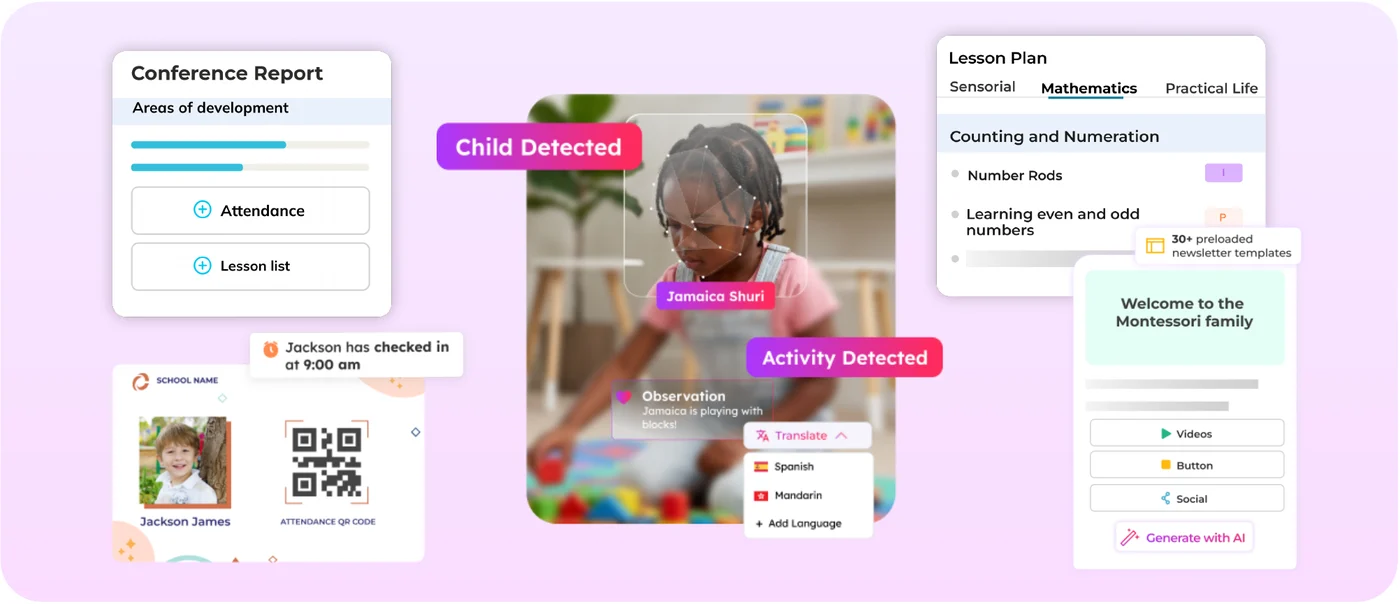
- Attendance and ratios. Access to attendance and relevant ratio information.
- Real Montessori record keeping. Montessori lesson and learning records, including conference reports.
- Observations made easy. Capture observations and follow each child's progress.
- Conference reports and newsletters. Share classroom updates and relevant information with families.
What AI governance should Montessori schools put in place?
AI adoption brings new responsibilities for Montessori leadership teams. Protecting sensitive student records, controlling access to information and ensuring human oversight of AI-generated content are essential to maintaining family trust and safeguarding Montessori educational practices.
That includes the information families trust schools with most: a child's health notes, custody arrangements, pickup authorizations, and observations and progress records.
Five governance commitments for a connected, AI-enabled school:
- Role-based access. Every person sees only what their role requires. A head of school sees the school, a guide sees their classroom, and families see their child.
- Approvals and audit trails. Tuition overrides, discounts and write-offs follow defined approval paths, and every change to a child's record is logged.
- Privacy controls. Family and classroom data is not used to train general-purpose models without explicit consent.
- Human review at defined points. AI drafts, summarizes and flags. Guides and school leaders decide on anything involving a child's development, safety or a sensitive family conversation.
- Independent assurance. Security controls are audited by a third party, not only described by the vendor.
illumine brings these principles into Montessori school operations through role-based access controls, defined approval workflows, audit trails and human oversight of AI-assisted processes, with SOC 2 Type II audited security controls. See illumine's security policy.
How can a Montessori school move to a new platform?
For Montessori leadership teams, switching technology is a significant decision, particularly when it involves years of student records, established classroom practices and family relationships. illumine simplifies the transition through guided data migration and a phased rollout, so schools can move enrollment, tuition, observations and lesson records into one platform at a manageable pace.
That helps Heads of School introduce change confidently, support guides through the transition, and maintain educational continuity without disrupting daily Montessori operations.
- Week 1, white-glove migration. illumine handles data transfer, system configuration and account setup.
- Week 2, role-based training. Live training sessions tailored for directors, teachers and admin staff.
- Ongoing, dedicated support. A success manager provides regular check-ins, strategic guidance and responsive support as the school grows.
"Being able to transition to illumine in stages has made a real difference. We can get comfortable with each part of the platform without feeling overwhelmed, and parents have been happy with how easy it is to use." Peace Pod, an illumine Montessori school
About illumine
illumine is an AI-native platform for Montessori schools and networks, unifying enrollment, billing, attendance, family communication, and Montessori-specific lesson tracking, observations and student progress.
Developed with insights from Montessori educators, school leaders and experts, it reduces paperwork for guides, strengthens financial and operational oversight for Heads of School, and supports consistent Montessori practices across campuses.
For multi-campus Montessori networks, illumine provides centralized visibility into enrollment, finances and school performance while allowing each campus to keep its own programs and operational needs.
More than 500 Montessori schools use illumine globally, and it supports more than 4,000 centers across more than 60 countries. illumine is AMI and AMS aligned, has SOC 2 Type II audited security controls, and describes itself as America's #1 Montessori platform.
"illumine understands what Montessori educators truly need: a tool that respects the method while modernizing the operations." Tim Seldin, President, The Montessori Foundation
Book a demo to see illumine for Montessori.
Frequently asked questions
What is the Montessori Leadership Benchmark?
The Montessori Leadership Benchmark: Priorities for 2027 is illumine's report on Montessori school operations, based on conversations with 244 Montessori schools across 28 US states.
It covers the hidden cost of disconnected systems, challenges in admissions, tuition, Montessori records and family communication, and leadership priorities for 2027.
How many tools do Montessori schools use to run operations?
63% of the 244 Montessori schools illumine spoke with run two or more tools for daily operations. The tools mentioned most often were Transparent Classroom (26%), paper and manual processes (23%), general preschool apps (23%) and preschool management suites (22%).
What is the biggest operational challenge for Montessori schools?
Tuition and billing. 33% of the 244 schools reported difficulties managing tuition plans, payments and billing, followed by Montessori records and curriculum (30%) and parent communication (28%). Among 85 Heads of School, progress records and observations were raised most often (21%).
Why is Montessori record keeping difficult?
When lesson records, observations and conference reports are spread across notebooks, spreadsheets and separate platforms, guides spend more time compiling a child's history and less time using it.
30% of schools raised Montessori records and curriculum as a problem, while 35% named it among what they value most.
How should Montessori schools govern AI?
The report sets out five commitments: role-based access, approvals and audit trails, privacy controls so family and classroom data is not used to train general-purpose models without explicit consent, human review at defined points, and independent third-party assurance of security controls.
Contributors
- Tim Seldin, President, The Montessori Foundation, and Chair, International Montessori Council (LinkedIn, articles on illumine)
- Matthew Sears, Senior Vice President of Technology, Global, Guidepost Global Education (LinkedIn)
Methodology
The Montessori Leadership Benchmark: Priorities for 2027 is part of illumine's Montessori Leadership Series. It is based on illumine's conversations with 244 Montessori schools across 28 US states, including prospective schools and existing customers. The research is observational, not a randomized survey.
Schools are counted once per theme, schools could give multiple responses so percentages may total more than 100%, and every figure names the group it is calculated from: all 244 schools, or the 85 Heads of School for the operational challenges chart.
Quotes from schools are anonymized or credited to the school only. Product capabilities described reflect illumine's platform, and product screens show sample data. Views quoted by contributors are their own.
Related reports: Scaling Smart: How Multicenter Childcare Networks Scale Without Breaking, Rethinking Montessori Operations, Childcare Enrollment Report 2026, What Will Montessori Leadership Look Like in 2030? and The Costs Draining Childcare Centers: USA Cost Benchmark Report.