
.webp)


Pick any two childcare directors using these three platforms, and they'll disagree on which one is best. They're probably both right.
Each platform has a module it has genuinely aced, and not by accident.
Lillio's curriculum and lesson planning are the strongest of the three because the platform was built by early-childhood educators, and it shows:
- Learning stories tag every observation to a developmental domain
- Those observations build into a real portfolio over the year
- Plans align to frameworks like NAEYC, EYLF, and ELECT
- Ready-to-use monthly curriculum kits and IACET-approved professional development come baked in Brightwheel's social-media-style approach to parent communication has made it the most natural fit for how parents and teachers actually behave. The activity feed works like the apps families already live in, photos and videos post without friction, messaging runs in every direction, and adoption is the highest in the category because using it doesn't feel like a chore.
Procare has the most complete enrollment pipeline. Custom lead and registration forms, a customizable stage pipeline, in-app payment collection, automatic student-profile creation on enrollment, and funnel insights like conversion rate and time-in-stage.
So, depending on what a center needs most, three childcare directors will hand you three different answers, and each will have a good reason. That's the trap. The right way to choose isn't to match your single loudest priority to whichever platform leads on it. It's to look at the bigger picture: solve the problem that's on fire today, yes, but also weigh how the software will carry all five functions as you add children, classrooms, and locations. The module that wins the demo isn't always the one that survives the growth.
All three cover the same five functions every center runs on: parent communication, enrollment, billing, classroom management, and lesson planning. Here's how they stack up before we go module by module.
| Module | Brightwheel | Lillio | Procare |
|---|---|---|---|
| Parent communication | Category leader. Social-style activity feed, frictionless media, messaging in every direction | Pedagogically framed. Updates are learning stories tied to development domains | Full channel set. Feed, messaging, SMS, newsletters; capable, not the centerpiece |
| Enrollment | Pipeline statuses are advanced by hand | Online registration + waitlist; not a lead-nurture CRM | Custom tools. Forms, pipeline, funnel insights; nurture is manual |
| Billing & invoicing | Strong automation. In-app payroll via Gusto | Tuition plans, autopay, subsidy tracking, and attendance-linked | Deepest financial tooling. One due-date reminder, manual late fees |
| Classroom management | Real-time ratios, digital forms, check-in | Rich records and check-in; shows ratios, but no proactive alert | Real-time ratios with configurable alerts; deep compliance reports |
| Lesson planning & curriculum | Strong, especially Montessori-first | Category leader. Learning stories, portfolios, framework-aligned kits | Deep integrations. Via content partners (Learning Beyond Paper, Vine Assessment) |
1. Parent Communication
This is the most genuinely competitive module of the five, and the three are separated by philosophy rather than feature count.
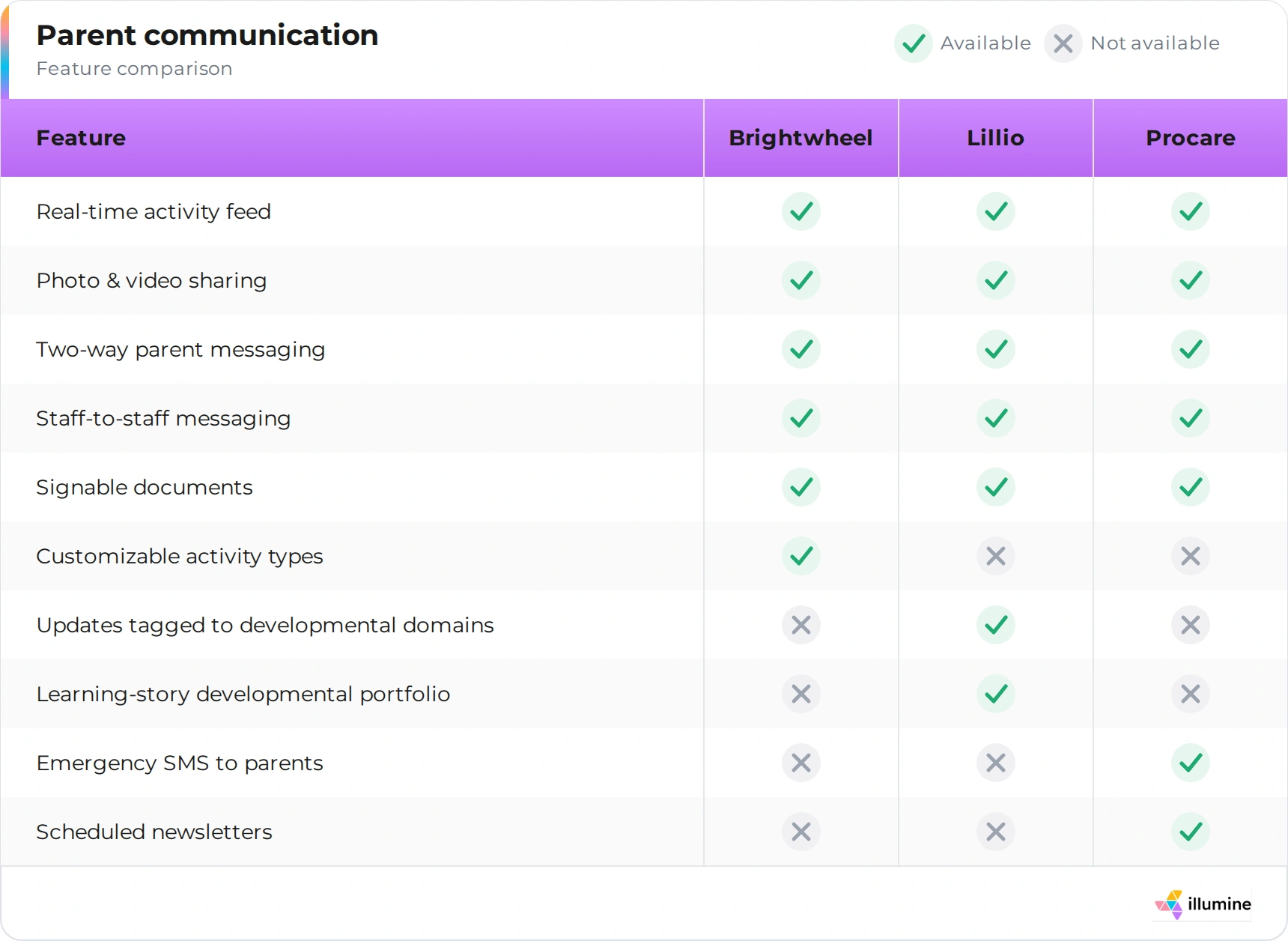
Brightwheel is the one to beat. Its activity feed behaves like a social feed: you define your own activity types so the categories match how your program thinks, and teachers attach photos and videos without fighting the interface. Messaging runs in every direction a center needs (admin to parents, admin to staff, staff to parents), with meal assignments in the same place. For a family whose biggest want is to feel close to their kids' day, this is the experience that keeps them subscribed. It's a real reason centers stay.
Lillio takes the opposite approach and turns communication into a teaching artifact. Instead of "ate lunch, napped well," a Lillio update is a learning story: a photo, a written observation, and tags that connect the moment to developmental domains like cognitive, physical, social-emotional, and language. Those updates accumulate into a developmental portfolio that the parent can open any time. It's newer digital incident reporting lets a parent read and sign an incident form inside the app instead of waiting for a paper copy at pickup. If your center sells educational quality, Lillio communicates that quality better than anyone.
Procare carries the full toolkit, including a real-time feed, two-way and staff-to-staff messaging, emergency SMS, scheduled newsletters, and signable documents. It does the job. Communication just isn't where Procare spends its best energy, and you can feel that next to the other two.
One thing is identical across all three: a human writes every word, every time.
Parent communication at a glance
2. Enrollment
Here the three split sharply, and it's the clearest example of strength-by-origin.
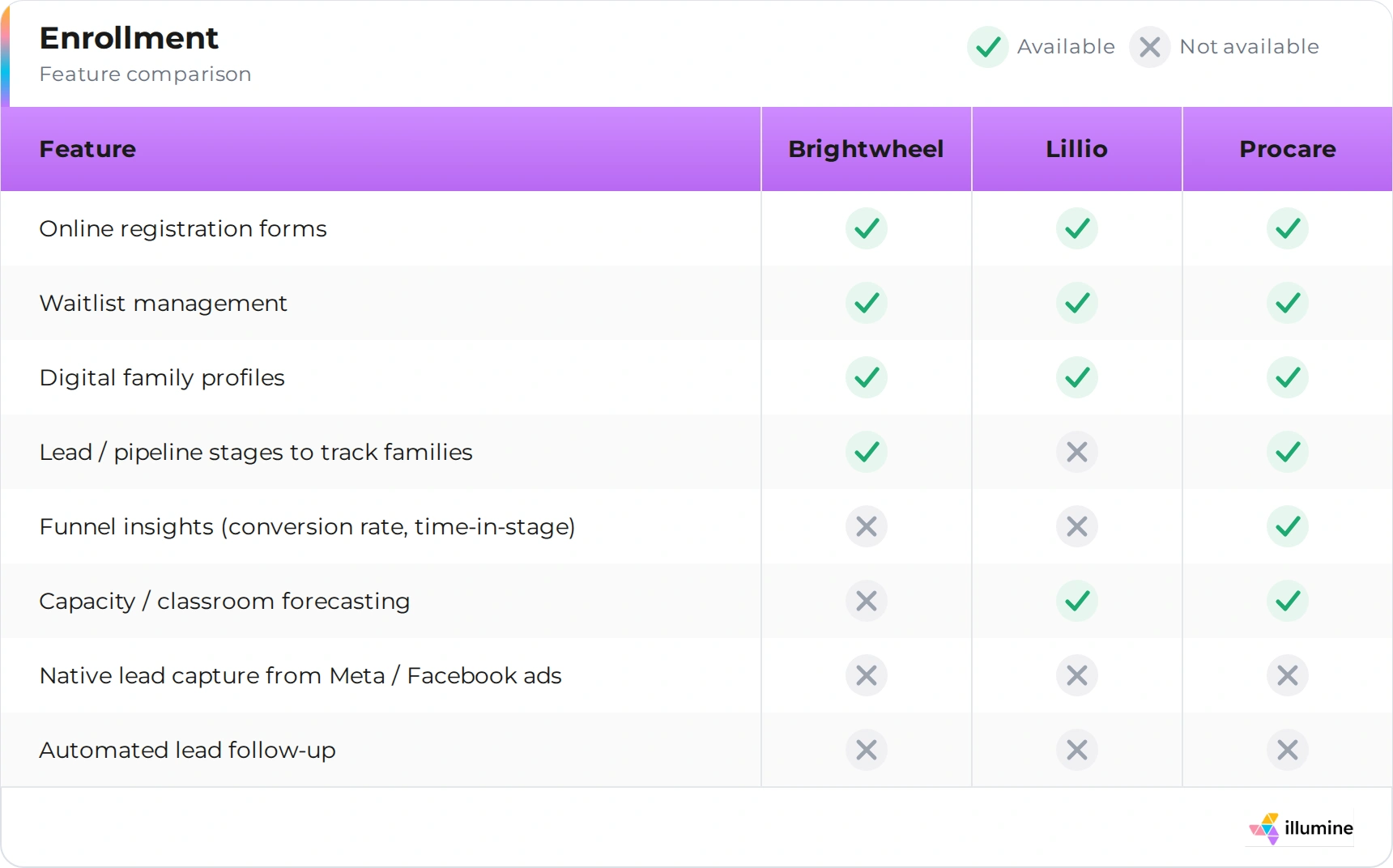
Procare is the most complete pipeline of the group. You build custom lead and registration forms per program, and collect family information and the registration fee in the same form. When a family enrolls, the system creates a student profile automatically, carrying mapped fields across. Stages are customizable (toured, interested, waitlisted, enrolled, etc.), and you get funnel insights like conversion rate and time-in-stage. The catch is what the pipeline doesn't do on its own. Leads from a Meta or Facebook ad don't flow in natively; they sit in a separate ad dashboard until someone copies them over. Every nurture action is manual, whether you compose each email and text or drop a reminder in a task list and hope a staff member acts on it. And by Procare's own documentation, the lead-to-student handoff is a one-time copy, so edits made to a lead profile after enrollment don't update the student record.
Brightwheel treats enrollment as a set of statuses you push families through by hand, one at a time or in bulk by exporting a roster, editing a column, and re-uploading it. The statuses are there to filter and count, not to act. Nothing nudges a lead that's gone quiet, and nothing fires a next step when a tour wraps.
Lillio is the lightest of the three on this axis. It handles online registration and waitlists and stores prospective and enrolled families in digital profiles, with basic forecasting to project classroom capacity. What it isn't is a lead-nurturing CRM. There's no nurture pipeline and no marketing automation, which is why operators with real inquiry volume usually end up looking at dedicated enrollment tools. For an education-first center with a steady waitlist, that's fine. For a center trying to grow, it's a ceiling.
The shared trait: none of the three follows up on its own.
Enrollment at a glance
3. Billing and Invoicing
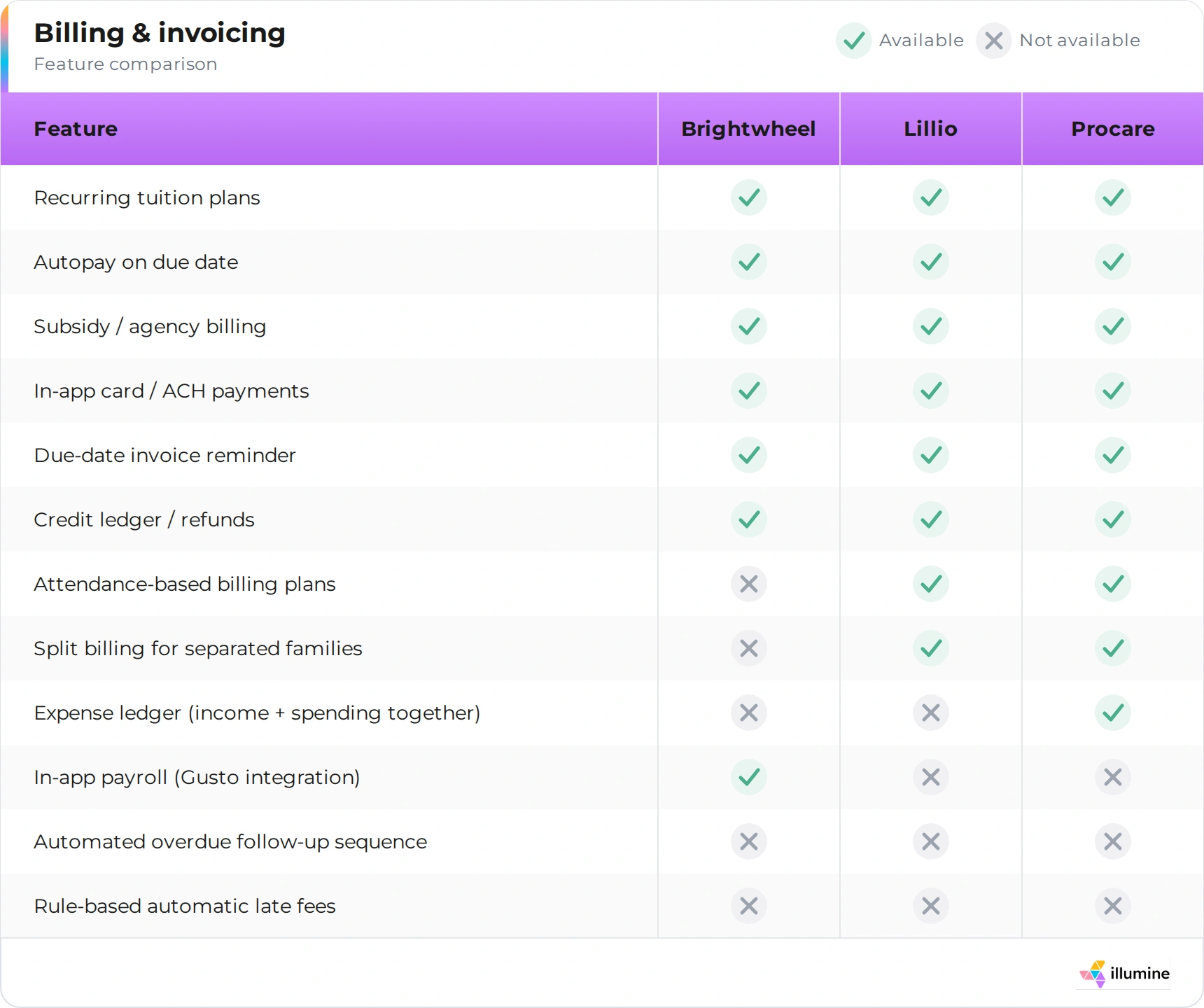
If parent comms is Brightwheel's home and curriculum is Lillio's, billing is Procare's. It carries the deepest financial machinery of the three:
- Multifamily and split billing for separated parents
- Subsidy and agency billing, viewable per child or per line item
- Recurring tuition-based and attendance-based plans
- In-app refunds and credits
- Autopay on the due date
- An expense ledger, so money collected and money spent sit together
The gap is automation past the due date. Procare's cloud product sends a single reminder on the due date itself; its only other billing emails are a new-invoice notice, a payment receipt, and a card-failure notice. Once a payment is actually late, chasing it is manual, family by family, and a late fee is a charge you add by hand. There's no automated late fee applied on a rule.
Brightwheel is arguably the most automated day-to-day biller of the three. It takes card, debit, check, and online payments, runs automated payment follow-ups, supports per-program fee structures, and handles one-time charges, subsidy billing, and discounts. It also does something neither of the others does: payroll, through a built-in Gusto integration. Staff hours, pay, and labor cost sit in the same place as the rest of your finances.
Lillio sits between the two. It covers the essentials:
- Group or individual tuition plans
- Autopay that sends invoices on the due date
- Billing reminders
- Subsidy tracking, with each child's agreement and expected-versus-received amounts
- Split invoices, plus a credit ledger with ACH and card payments
Billing is also tied directly to real-time attendance, which keeps attendance-based charges accurate. The soft spots, per its public materials and third-party reviews: subsidy billing carries manual components, there's no escalating overdue sequence or rule-based late fee, and there's no payroll.
Billing at a glance
Procare was also in the news recently for acquiring Playground, another childcare management platform, bringing the two under the same corporate parent. See our Procare vs Playground comparison for how they stack up on features and pricing.
4. Classroom Management
This module is closer to even, with one meaningful split on ratios.
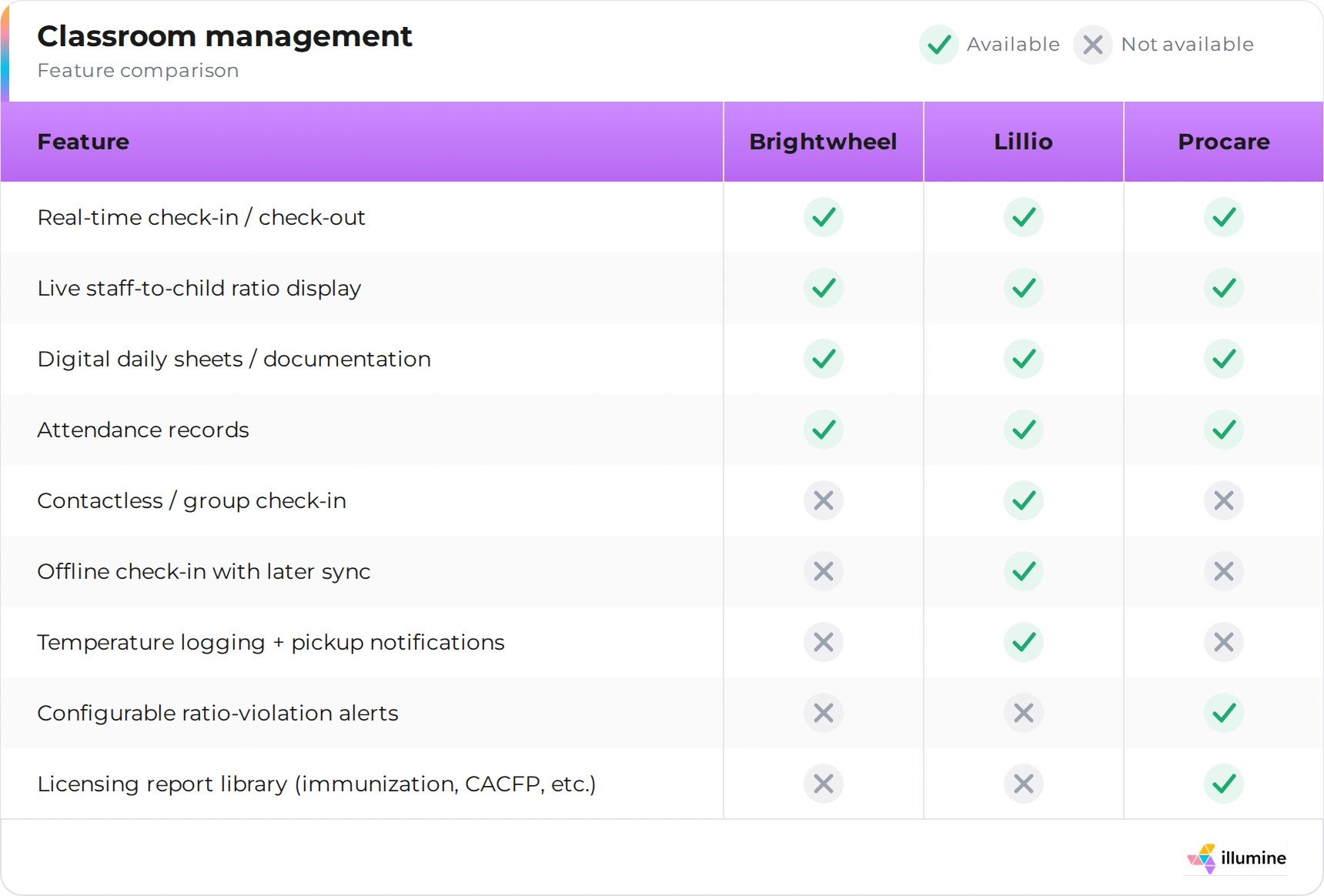
Procare brings the strongest compliance backbone. Every room shows a real-time staff-to-child ratio with configurable alerts when a ratio goes off. The reporting library is built for licensing: attendance and sign-in/out records, immunization, emergency cards, meal and CACFP, staff detail, etc. If audits keep you up at night, this is reassuring.
Lillio is rich on the day-to-day classroom record. Check-in is contactless, works for one child or a whole group at once, and even works offline by timestamping and syncing later. It captures drop-off and pickup times, absences, temperatures, pickup notifications to parents, and digital signatures. Directors see real-time attendance and a live child-per-teacher ratio, so they can react when a room is over or understaffed.
Documentation is a clear strength:
- Digital daily sheets (meals, naps, sleep checks, toileting, activities, observations, medication, etc.)
- Digital incident reports
- Immunization and health records
- Meal planning and schedule rotations
- User-level staff permissions
The one nuance worth naming: Lillio shows you the ratio but, per independent reviews, doesn't push a proactive alert before a violation the way Procare does.
Brightwheel covers the essentials cleanly: real-time ratios, check-in, and digital forms to collect what you need from families. It's solid here without trying to be the compliance powerhouse Procare is.
Classroom management at a glance
5. Lesson Planning and Curriculum
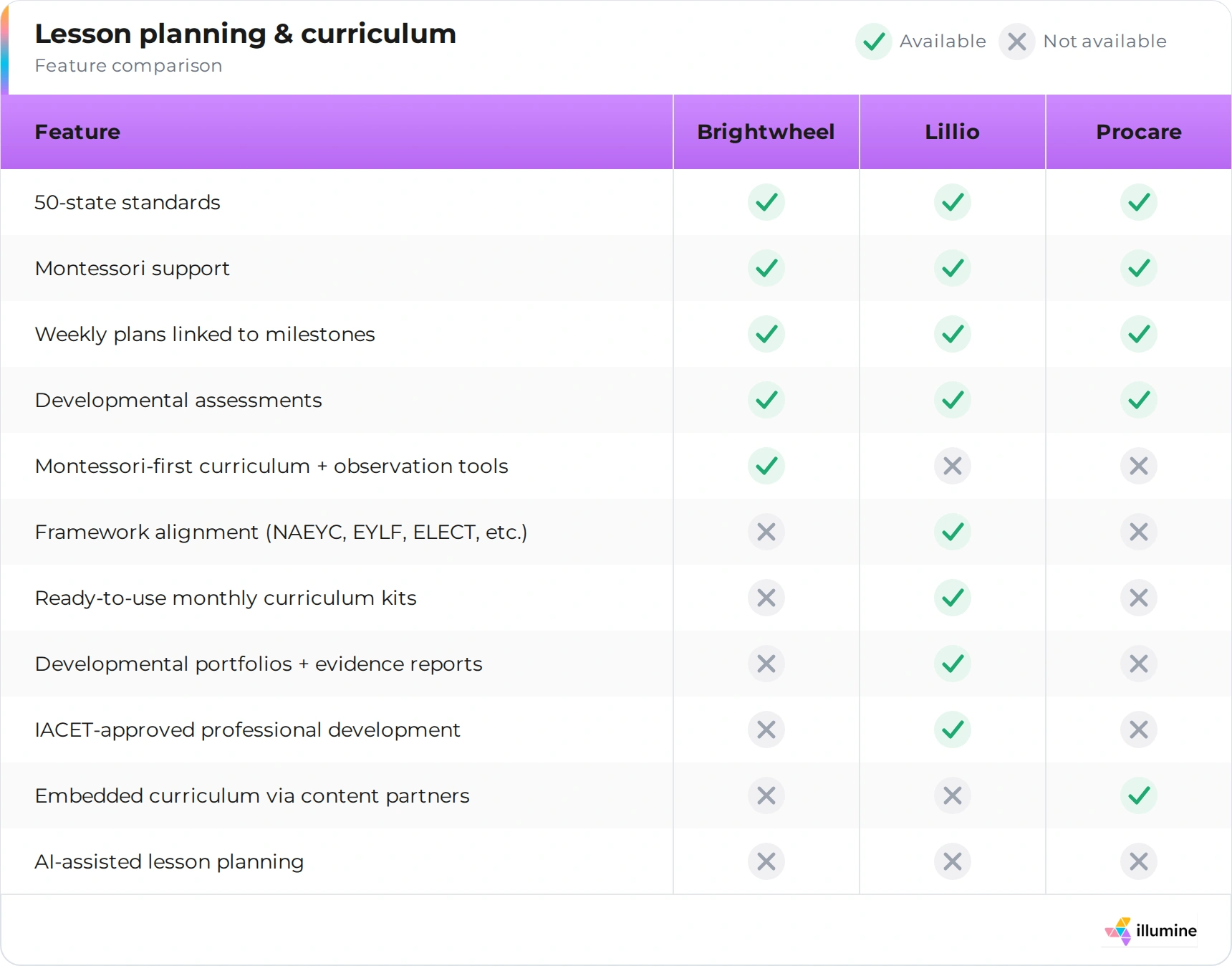
This is Lillio's territory, and its lead is real.
Lillio was built by early childhood educators, and the learning layer shows it. Teachers create learning stories that pair a photo with a written observation and tags to developmental domains. Those build into a portfolio and into child development reports that follow a child across domains, skills, and indicators. Lesson plans align to major frameworks (NAEYC, EYLF, ELECT, etc.) and to state standards, and Lillio Learning Curriculum Kits hand teachers ready-to-use themed plans every month. On top of that, Lillio Academy offers IACET-approved professional development that tracks toward state requirements. For a center whose brand is the quality of its program, this is the most complete package of the three.
Brightwheel is genuinely strong here too, especially as a Montessori-first option, with embedded curriculum, Montessori-style observation tools, and standards for all 50 states. If you run a serious Montessori program, it was clearly built with you in mind.
Procare's curriculum layer is deep but largely assembled through content partners: the Learning Beyond Paper embedded curriculum, attachable MarcoPolo materials, the Vine Assessment, and so on. It pairs these with 50-state standards, Montessori support, and weekly plans you link to milestones.
Across all three, the teacher still does the assembly. Someone builds each weekly plan, maps it to standards, and adapts it by hand for a mixed-age room or a child who needs something different. The starting point differs, but the blank page is the teacher's to fill every week. No AI lesson planning steps in to draft it first.
Lesson planning & curriculum at a glance
Compare your options:
Brightwheel vs illumine: A Childcare Director's Honest Comparison After 20 Years in ECE
The Common Pattern For All Three Childcare Solutions
Step back from the feature-by-feature scoring and the same shape shows up in all three products. It's the shape of legacy software, even when the software itself is modern and cloud-based.
They treat the center as a stack of separate modules, not one connected operation. Each function gets its own well-built, digitized box, and the boxes don't really talk to each other. Procare's own documentation describes the lead-to-student handoff breaking the link between records. Enrollment, billing, the classroom, and the parent app each hold their own slice of the truth, and stitching them together is a person's job.
They leave obvious automation on the table. Look at how much repeated, predictable work each platform still hands back to staff. A cold lead never gets nudged unless someone remembers. An overdue invoice gets re-sent by hand. A teacher's two-line note never becomes a finished parent update without retyping it. These aren't hard problems to automate. They're just outside how a module-by-module product is built to think.
Oversight is something you assemble, not something you see. All three "support" multiple locations, but in practice that means switching between center accounts and running reports you then read and interpret. None gives a director a live, side-by-side view of the numbers that actually decide whether a center is healthy: how fast each location collects, where revenue is leaking, which site converts inquiries, where occupancy is heading next quarter, etc. By the time a problem shows up in an exported report, the window to fix it has usually closed.
Where illumine Fits
This is the gap illumine was built to close, and it's worth putting on the table next to these three rather than pretending the comparison ends at Procare, Brightwheel, and Lillio.
illumine covers the same five functions, so on a feature checklist it looks similar. The difference is the three things above:
- Connected, not siloed. A lead captured from an ad stays one continuous record through enrollment, billing, and the classroom.
- Automated, not manual. Follow-ups run on triggers, AI turns a teacher's quick note into a structured parent update, and AI drafts lesson plans from your own curriculum for the teacher to adapt.
- Seen, not assembled. Multi-center performance is the default live view: collection velocity, revenue leakage by location, enrollment-funnel comparison, occupancy forecasting, period-locking with an audit trail, etc.
You don't have to switch to see the point. The point is that "best at one module" and "best at running a center" are different competitions, and they're scored differently. If your priority is the single thing one of these platforms leads on, the choice is easy. If your priority is the whole operation moving together, that's a different shortlist, and illumine belongs on it. See how these three stack up against the other top childcare platforms in our best childcare management software roundup.
Frequently Asked Questions
Brightwheel, for most centers. Its activity feed and media sharing have the widest adoption. Lillio is the better choice if you want updates framed as learning and tied to a developmental portfolio.
Procare has the deepest financial tooling, and Brightwheel adds the most day-to-day automation plus in-app payroll. Lillio handles core tuition billing and subsidies well, but isn't a financial powerhouse.
Lillio, with the most complete learning-documentation and curriculum package. Brightwheel leads specifically for Montessori programs.
No. Procare and Brightwheel give you pipeline stages you advance manually, and Lillio is closer to registration plus a waitlist than a nurturing CRM. None runs trigger-based follow-up on its own.
All three can manage multiple locations, but oversight relies on account-switching and exported reports rather than a live, side-by-side performance view across centers.