

Most of us probably understand the importance of play in early childhood years. You even see the magic of play happen in your classroom every day! However, the difficult part is knowing exactly how to support it without forcing it.
- When should you step in to help a child join a group?
- When is it better to stay back and let the play unfold?
- And how do you explain what you’re seeing to parents who might just see "chaos"?
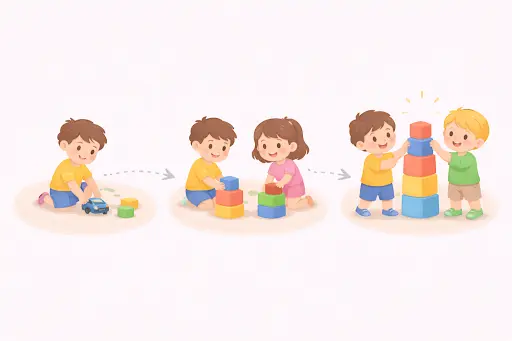
This is where Parten’s stages of play come in. This framework gives directors and educators a simple language to describe stages of play development. It explains how children generally move from playing alone to playing with others.
Please remember: It’s not a checklist to stress over. It’s a practical guide for planning play based learning, noticing growth, and supporting social skills in real classrooms.
In this guide, we’ll explore the importance of play in early childhood education, look at Parten’s classic play theory, and walk through the six stages with definitions and play-based learning examples for your classroom.
The Importance of Play in Early Childhood Education
Play isn't a "break" from learning. In the early years, it is the engine of learning. When you facilitate high-quality learning through play, you aren't just letting kids run wild; you are supporting critical developmental milestones.
Here is what is actually happening beneath the surface:
- Language development: Children practice narration and conversation. They learn to negotiate and explain their ideas.
- Social-emotional growth: Play gives children daily "reps" in sharing space, managing frustration, and reading social cues.
- Executive function: Games with rules strengthen working memory, planning, and impulse control.
- Cognitive development: Hands-on play based learning activities teach cause-and-effect, sorting, counting, and patterns.
Mildred Parten’s Stages of Play: An Overview
Before we dive into the definitions, keep a few things in mind. Stages of play are non-linear. A child might even show different stages on the same day depending on their mood or the environment.
Remember: earlier stages aren't "bad." They are necessary steps. Your goal isn't to rush a child to cooperative play, but to create the conditions where their social skills can grow naturally.
Here are the six stages, ranging from solitary observation to complex group cooperation.
1. Unoccupied Behavior
%20(2).webp)
Unoccupied behavior definition: Technically, researchers label this "behavior" rather than "play" because the child isn't using materials yet. The child isn't playing with peers or toys in a focused way. They might be looking around, moving their body, or just "being."
- Typical Age: Infants and young toddlers (0–18 months), or older children during transitions.
- What it looks like: Wandering without a goal, shifting attention quickly, or wiggling fingers and limbs.
- Your Role: Provide a calm "landing zone." Use sensory invitations like textured balls or soft lighting to help them orient themselves.
2. Solitary (Independent) Play
.webp)
Solitary Play definition: The child plays alone with materials, focused entirely on their own activity. They generally don't care what other children are doing nearby.
- Typical Age: Toddlers (1–2.5 years), but healthy for all ages during deep concentration.
- What it looks like: Building a tower alone, drawing, or protecting their toys from others.
- Your Role: Provide materials that invite individual focus, like puzzles, pegboards, or individual sensory bins. Protect their play space from interruption so they can build deep concentration without the pressure to share.
3. Onlooker Play
.webp)
Onlooker play definition: The child actively watches others play. Unlike unoccupied behavior, the child is very focused on the peers. They might ask questions or hover, but they don't jump in.
- Typical Age: Toddlers and young preschoolers (2–3.5 years).
- What it looks like: Standing close to a group, narrating what others are doing (“She is cooking!”), or laughing at a peer's joke without joining.
- Your Role: Set up play based learning activities that are easy to watch, like a centrally placed train track. Allow them to take "helper roles" (holding a sign, handing out items) to participate safely from the edge.
4. Parallel Play
.webp)
Parallel play definition: Children play side-by-side with similar materials. They might mimic each other, but they don't have a shared goal. They are playing beside rather than with.
- Typical Age: Toddlers (2–4 years).
- What it looks like: Two children building separate towers on the same rug, or driving cars on separate tracks.
- Your Role: Ensure you have enough duplicates of popular items (like two identical trains or multiple glue sticks). This lowers the barrier to entry and helps children feel safe playing near others without fighting over resources.
5. Associative Play
.webp)
Associative play definition: Children interact and share materials, but the play isn't coordinated toward a common goal yet. The focus is usually on the social interaction rather than the game itself.
- Typical Age: Preschoolers (3–4.5 years).
- What it looks like: "You can use my marker." Conversations happen, but they might not be about the activity. Everyone is doing their own thing, just together.
- Your Role: Ask open-ended questions that encourage connection ("Oh, I see you both are using blue blocks!"). Model social scripts for trading items or asking to join, as this stage is where friction often happens.
6. Cooperative Play
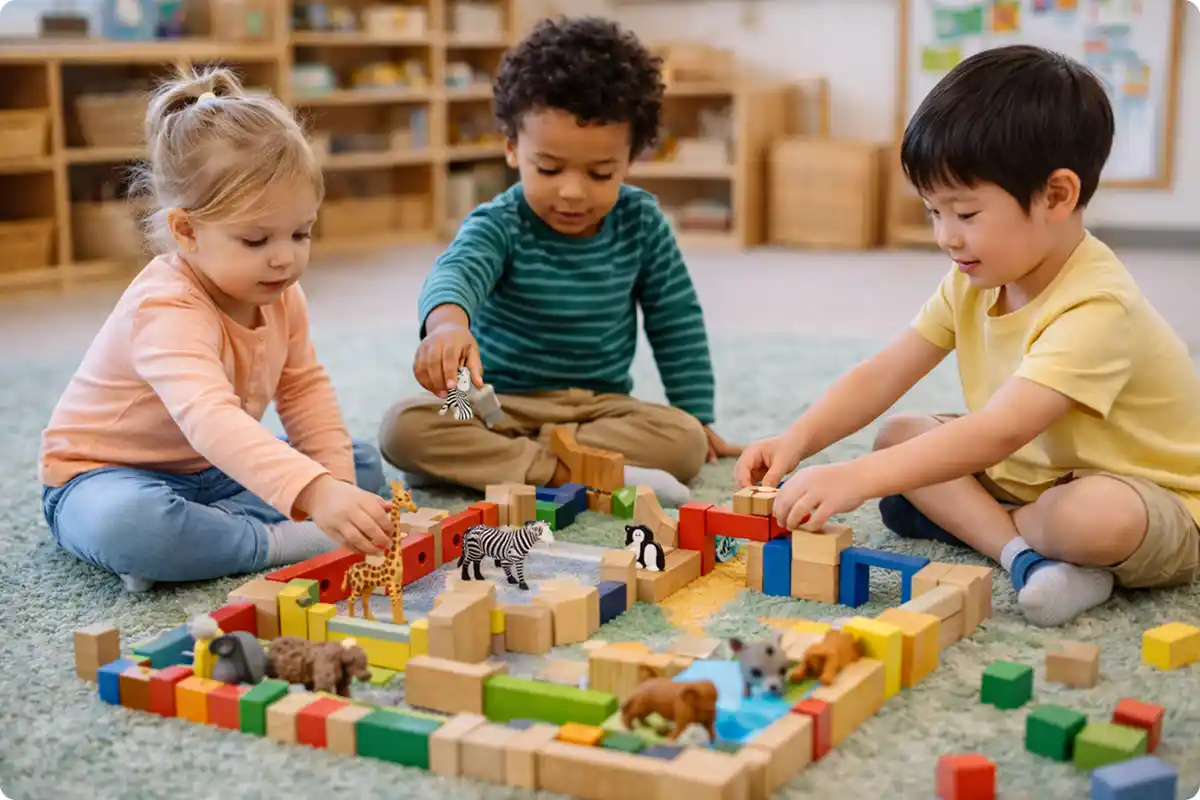
Cooperative play definition: The "gold standard" of social play. Children play together with a shared goal, assigned roles, or an organized storyline. They must negotiate to keep the game going.
- Typical Age: Older preschool and kindergarten (4.5+ years).
- What it looks like: "You be the doctor, I’ll be the patient." Building a zoo together where everyone adds a specific part. Creating rules for a game.
- Your Role: Act as a scaffold rather than a director. Help them assign roles if they get stuck ("Who is going to be the cashier?"), and support them through conflict resolution so the play doesn't break down when disagreements happen.
Capture Play Observations Faster and Accurately With illumine
Observation is what turns Parten’s stages from a theory into something you can actually use. When you watch how a child plays over time, you start to notice patterns like who prefers parallel play, who often stays in onlooker play, and who is ready for more cooperative play.
These small details help you choose the right activities, support peer connections gently, and spot social growth early, without rushing children into play they are not ready for.
illumine makes this easier for busy teachers by helping them observe and record in the moment.
Teachers can capture meaningful notes, reflections, and concerns in real time through a mobile-friendly platform, then link those observations to developmental milestones to track progress more accurately.
When it’s time to update families, illumine also helps you share real-time insights and developmental progress reports, so parents stay informed and involved in their child’s journey.
Bringing It All Together
Parten’s stages of play help you see social development more clearly. Instead of worrying that a child who plays alone is “falling behind,” you can recognize it as a normal part of learning and focus.
When you set up your classroom with these stages in mind, your expectations become more realistic. You can choose materials and groupings that match your age group and gently support children as they move toward more social play.
Over time, this turns play-based learning from a buzzword into a real strategy. Play stops feeling like “just toys” and becomes a daily way to build social skills, language, problem-solving, and confidence.