



Multi-center growth introduces structural complexity that traditional billing processes were never designed to handle.
Legacy childcare billing software function like they were originally built for single-site centers and retrofitted later for chains. They do not account for the additional operational complexity that comes with scale. Sure, they help generate invoices, collect payments, and report the revenue generated, but that does little to help multisite childcare leaders understand:
- Financial performance, including collection rates, overdue balances, and subsidy reconciliation across centers
- Policy consistency, including how late fees, discounts, waivers, and subsidies are applied from one location to another
- Business health, including revenue projections, cash flow visibility, and where revenue leakage is building across the organization
Operational Issues with Multicenter Childcare Billing
The first place this flawed model starts to break is in daily billing operations.
A common mistake in multicenter childcare is assuming scale simply means repeating the same processes across more locations. In reality, what works at one center often starts to break across ten, twenty, or fifty. Leaders usually do not see the problem immediately.
This happens mainly because:
1. Staff turnover destroys institutional billing knowledge.
Childcare has some of the highest staff turnover rates of any industry. In a large portfolio, you are constantly onboarding new people into billing roles. If your billing process depends on someone knowing how to work around limitations in your software or understanding undocumented local conventions, you will lose revenue and create errors every time someone leaves.
2. Manual processes don't scale.
What works as a workaround at one center becomes a significant liability at fifty. Manual invoice generation, spreadsheet-based subsidy tracking, and ad hoc late fee calculations are not just inefficient at scale; they're error-prone in ways that affect real revenue and real families.
3. Reconciliation consumes the finance team's capacity.
Multi-center operators with inadequate billing systems routinely report that month-end reconciliation takes days of the finance team's time. That's time not spent on analysis, forecasting, or strategic decisions.
Systemic Issues Causing Multi-Center Billing Problems
Even with the right processes in place, childcare leaders still struggle with a lot of ambiguity and lack of data. Most leaders can’t answer simple questions like:
- Which locations have collection rate problems?
- Where is revenue leakage concentrated?
- What does cash flow look like across the organization over the next 60 days?
The underlying issues are systemic:

1. Policy inconsistency
When center directors have discretion over billing decisions that should be standardized, the result is systematic inconsistency. Families at different locations pay different effective rates for the same services. Some centers enforce late fees. Others don't. The financial impact is often significant and almost always invisible without centralized reporting.
2. Subsidy and voucher complexity
Government subsidy programs involve their own billing cycles, reimbursement timelines, and compliance requirements. Managing this across 50+ centers, each potentially working with different state or county agencies, without purpose-built tools, creates compliance risk and revenue delay.
3. No audit trail for billing changes
When a tuition rate changes, a fee gets waived, or a discount gets applied outside of policy, who did it and why? In organizations without a full audit trail, these questions are unanswerable. That's a financial control problem that will show up during compliance audits.
4. Overdue balances go undetected for too long.
Without centralized visibility, overdue accounts accumulate at the location level and don't surface to leadership until they're already significant. By the time a 90-day balance shows up, the collection probability drops sharply.
Multi-Center Childcare Billing: Best Practices for Scale
There are various ways you can ensure smooth childcare payment processes. Here are some of the best practices you can follow to ensure that your operations can scale smoothly:
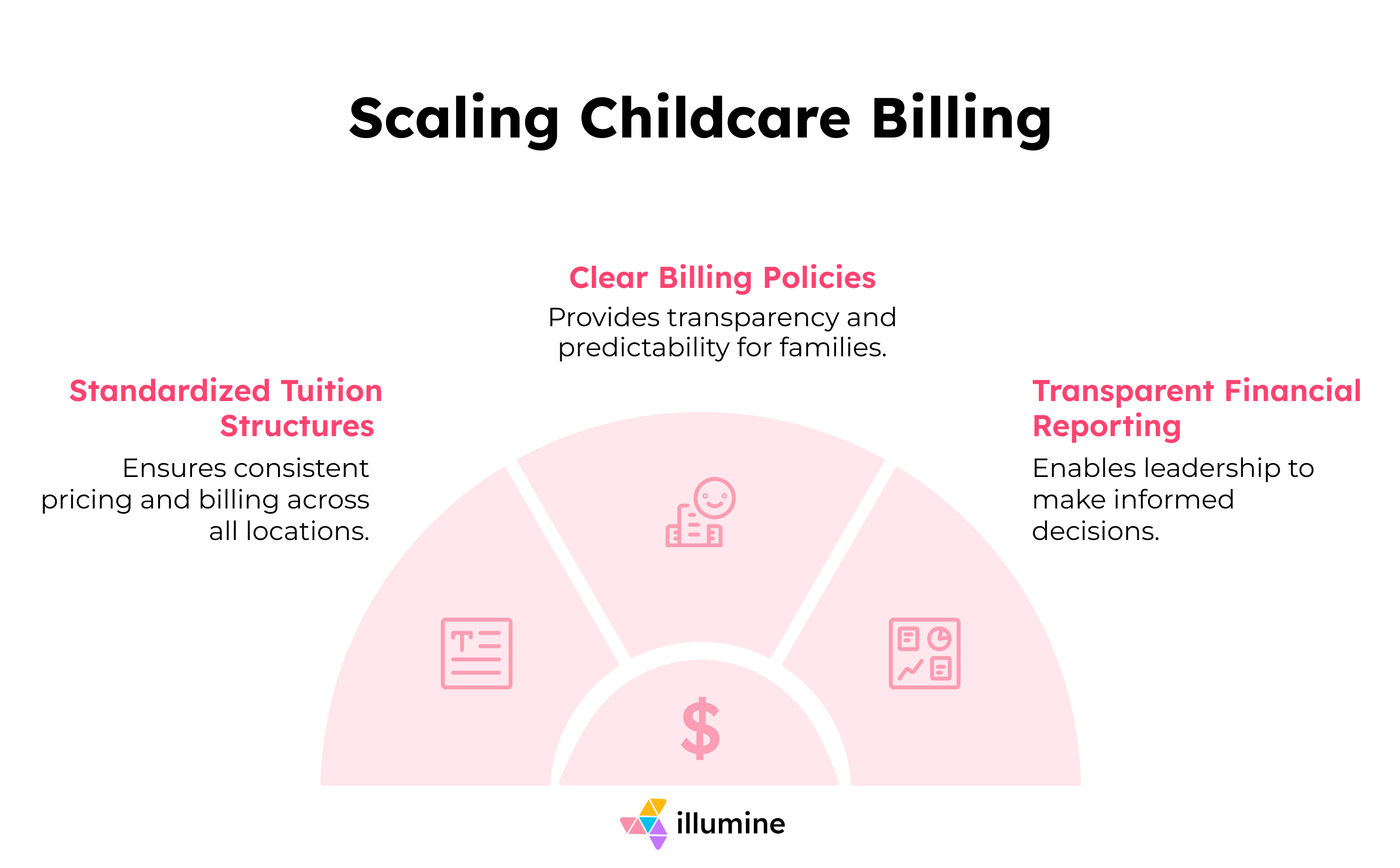
1. Standardized Tuition Structures Across Centers
One of the first sources of billing complexity in multi-center networks is inconsistent tuition configuration. While each location may have different pricing tiers or programs, the underlying billing structure should follow a standardized framework.
- Structure tuition plans using consistent naming conventions
- Clearly define program-based pricing across locations
- Standardize discount rules (sibling, staff, etc.)
- Create consistent billing cycles (weekly, biweekly, monthly)
- Clearly define fee categories (registration, late pickup, activity fees)
2. Clear Billing Policies for Families
Families expect billing to be predictable and transparent. Confusion around invoices, late fees, or adjustments can quickly impact the parent experience. Every center should follow clearly documented billing policies that families can easily understand.
- Communicate tuition schedules at enrollment
- Clearly define late payment policies
- Standardize proration rules for mid-cycle enrollments
- Document refund policies and apply them consistently
- Make billing FAQs available to families
Strong processes prevent revenue gaps and compliance risks.
3. Transparent Financial Reporting for Leadership
For executives overseeing multiple centers, billing data should feed directly into operational reporting. Financial visibility enables leaders to make informed decisions about enrollment, pricing, and expansion.
- Create revenue reports by center
- Track billing performance across locations
- Connect enrollment and revenue data
- Create leadership dashboards with a network-wide view
- Analyze financial trends periodically
Childcare Billing Features for Multi-Center Leaders
Here are some features multisite leaders should look for in a childcare billing software:
1. Automated Invoice Generation
Automation ensures that every family receives accurate invoices on time without requiring hours of administrative work. A robust childcare billing software should be able to:
- Generate invoices automatically based on enrollment data
- Apply charges according to program schedules
- Apply discounts and subsidies automatically
- Schedule when families receive invoices
2. Multiple Payment Options for Families
Families today expect flexibility when paying tuition. Offering multiple payment options improves convenience and increases on-time payment rates. Here’s what to expect from your multicenter childcare billing software
- ACH payments are supported
- Credit and debit card payments are available
- Autopay options are offered
- Families can view and manage payment methods easily
- Payment confirmations are automatically sent
The easier it is to pay, the fewer outstanding balances administrators must chase.
3. Real-Time Visibility into Accounts Receivable
In multi-center networks, leadership teams need immediate visibility into outstanding balances and revenue performance across locations. Relying on end-of-month reports often means issues are discovered too late:
- Real-time updates on accounts receivable dashboards
- Aging reports across individual centers
- Track outstanding balances by location
- Should be easy to identify overdue accounts
- Leadership can review revenue performance at the network level
4. Consistent Handling of Subsidies and Third-Party Payments
Government subsidies and third-party programs add another layer of billing complexity. Each program may have different documentation, payment timelines, and reporting requirements.
- Required documentation is tracked centrally and is easy to retrieve
- Billing teams can monitor expected vs received subsidy payments
- Adjustments are automatically applied when needed
5. Audit-Ready Billing Records
Billing processes should always be audit-ready. Whether reviewing internal financial controls or preparing for regulatory audits, documentation must be easily accessible.
- Store Invoice histories centrally
- Payment records are traceable
- Adjustments are logged with clear reasoning
- Documentation can be retrieved quickly
- Financial records are securely stored
Well-maintained records protect both the organization and its families.
6. Transparent Financial Reporting for Leadership
For executives overseeing multiple centers, billing data should feed directly into operational reporting. Financial visibility enables leaders to make informed decisions about enrollment, pricing, and expansion.
1. Cash Flow Visibility (by Center, by Week/Month)
Cash flow reporting at portfolio scale means seeing, in real time, expected revenue, actual collections, and the gap between them by center and time period. It surfaces chronic collection issues, improves cash forecasting across the network, and enables regional leaders to intervene early, before small gaps become systemic problems.
2. Accounts Receivable Aging
AR tells you not just what's owed, but how collectible it is because a balance that's 15 days overdue and a balance that's 90 days overdue represent very different situations. At portfolio scale, you need to see this broken down by center, by region, and in total, with the ability to drill down to individual accounts.
3. Revenue Leakage Indicators
Revenue leakage is the gap between billed revenue and what's actually collected—driven by write-offs, unauthorized discounts, manual adjustments, and off-policy waivers. Without dedicated reporting, it stays largely invisible. When tracked by center, staff member, and adjustment type, it quickly reveals outlier locations overusing manual edits, roles issuing disproportionate waivers, or discounts applied beyond policy. Leakage reporting replaces intuition with precise, actionable insight.
4. Forecasting: Expected Revenue vs. Collected Revenue
Expected revenue, what enrollment and rate data say you should collect, is the baseline. Collected revenue is reality. The gap between the two, tracked over time and by location, is a clear indicator of billing health and execution discipline. For finance, it anchors accurate forecasting. For regional leaders, a widening gap at the center is an early warning sign. At the portfolio level, the trend line tells you whether operations are tightening or deteriorating before it hits the balance sheet.
Why Multicenter Leaders Choose illumine for Childcare Billing
For multicenter childcare operators, billing software needs to do more than generate invoices and collect payments. It needs to give leadership better control, clearer visibility, and stronger financial discipline across every center. That is where illumine stands out.
Here’s what makes illumine a strong fit for multicenter billing:
1. A true multicenter billing dashboard
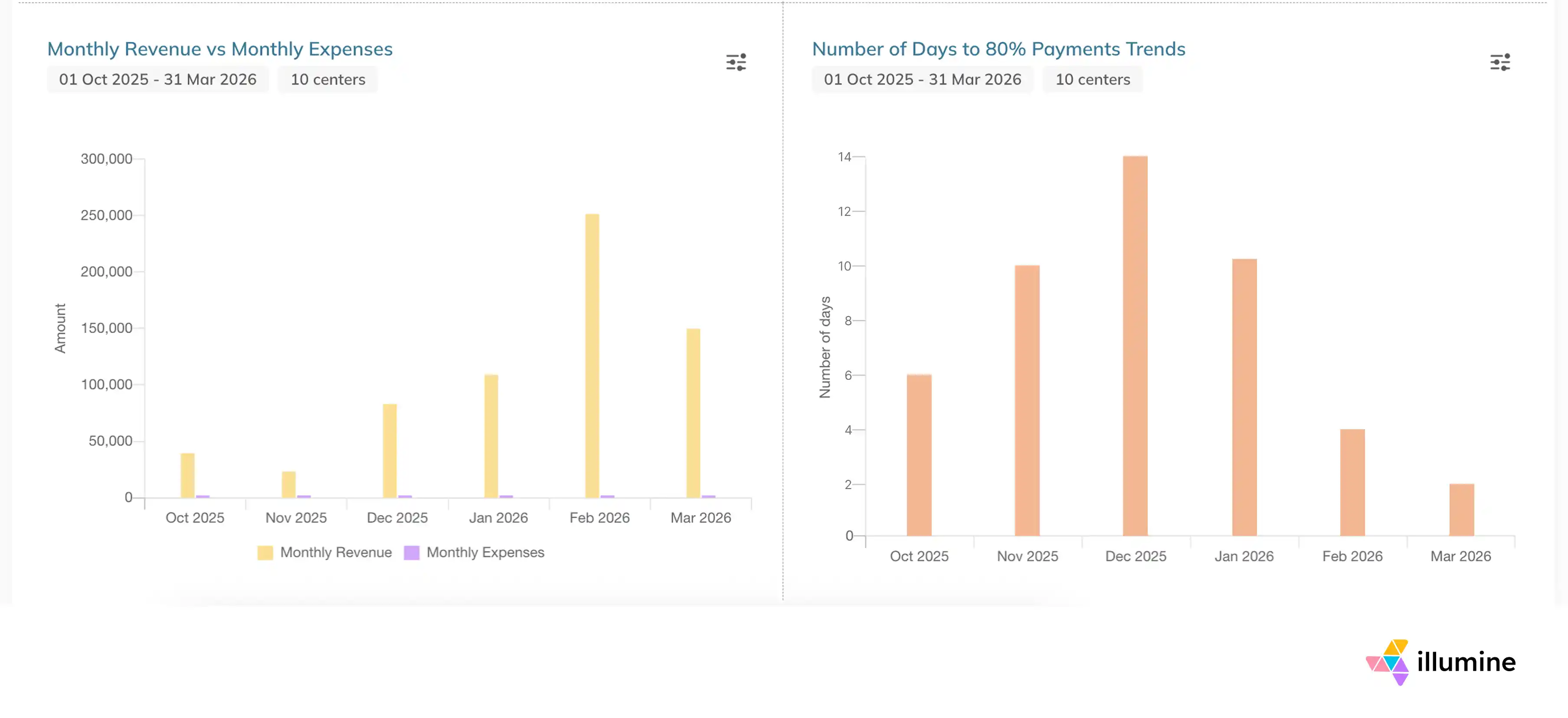
illumine gives leadership a centralized billing and accounting view across the organization, not just disconnected center-level records. Teams can track billed amounts, collections, overdue balances, outstanding amounts, and revenue trends from one place.
2. Easy visibility into financial health
The dashboard is built to make billing performance easy to understand at both the network and center levels. Leaders can quickly spot collection issues, overdue trends, invoice aging patterns, and changes in cash flow without relying on spreadsheets or manual reports.
3. Better control over period closing
Admins can lock accounts for a chosen billing period, whether weekly, monthly, or another cadence that fits their process. This prevents center-level teams from going back and changing closed numbers later, helping keep books accurate and reducing reconciliation issues.
4. Stronger financial governance across centers
When billing rules and reporting are managed centrally, leadership gets more consistency across locations. That reduces the risk of centers handling fees, adjustments, or exceptions differently and helps create a more controlled billing operation.
5. Clearer tracking of receivables and overdue balances
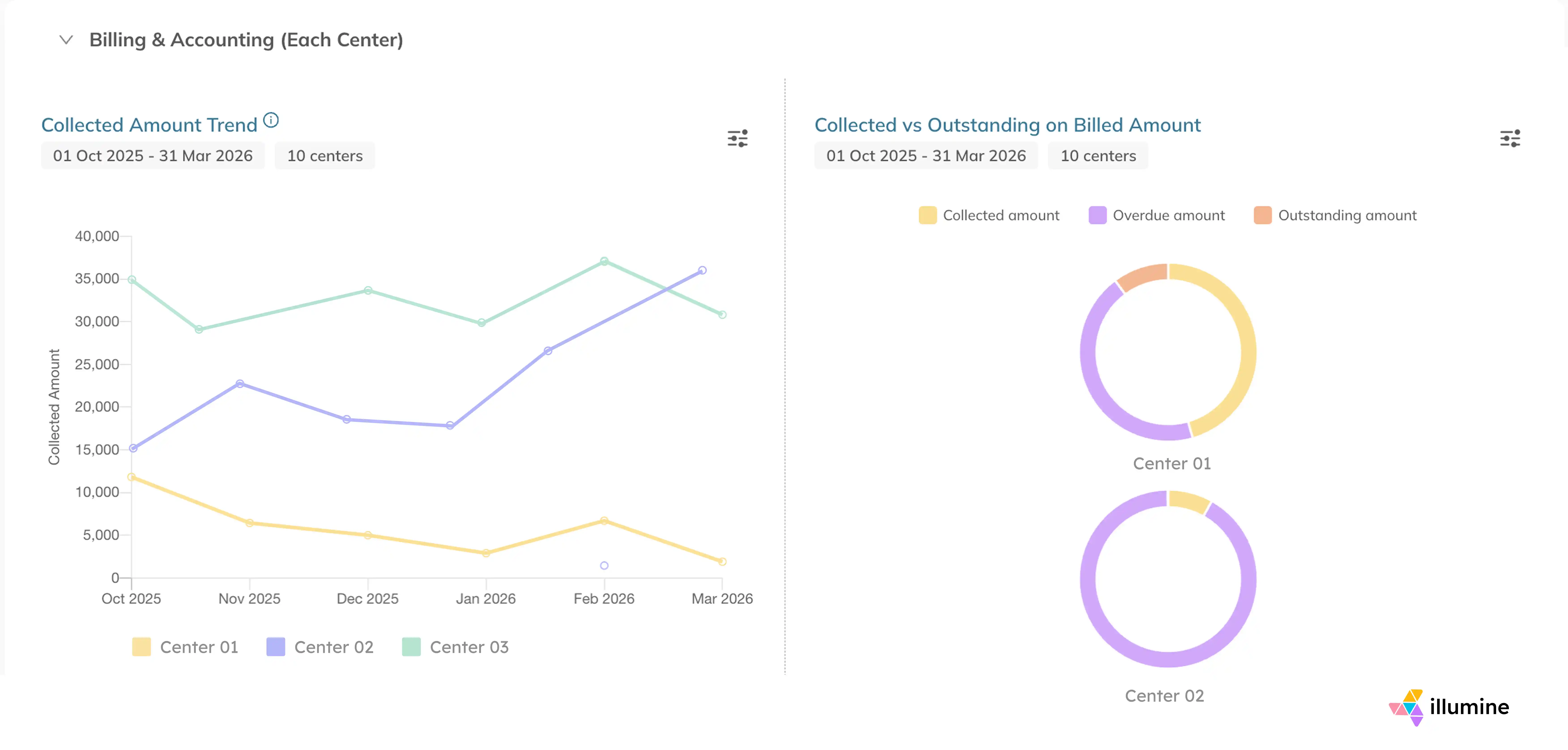
illumine helps teams monitor collections, outstanding balances, and overdue amounts in real time. That means leadership can identify which centers need intervention earlier instead of waiting until overdue balances have already grown.
6. User-friendly reporting for leadership teams
A dashboard only helps if people can actually read and use it. illumine’s visual reporting makes it easier for regional and finance leaders to review billing performance, compare centers, and understand organization-wide financial trends at a glance.
7. Better handling of subsidies and third-party billing
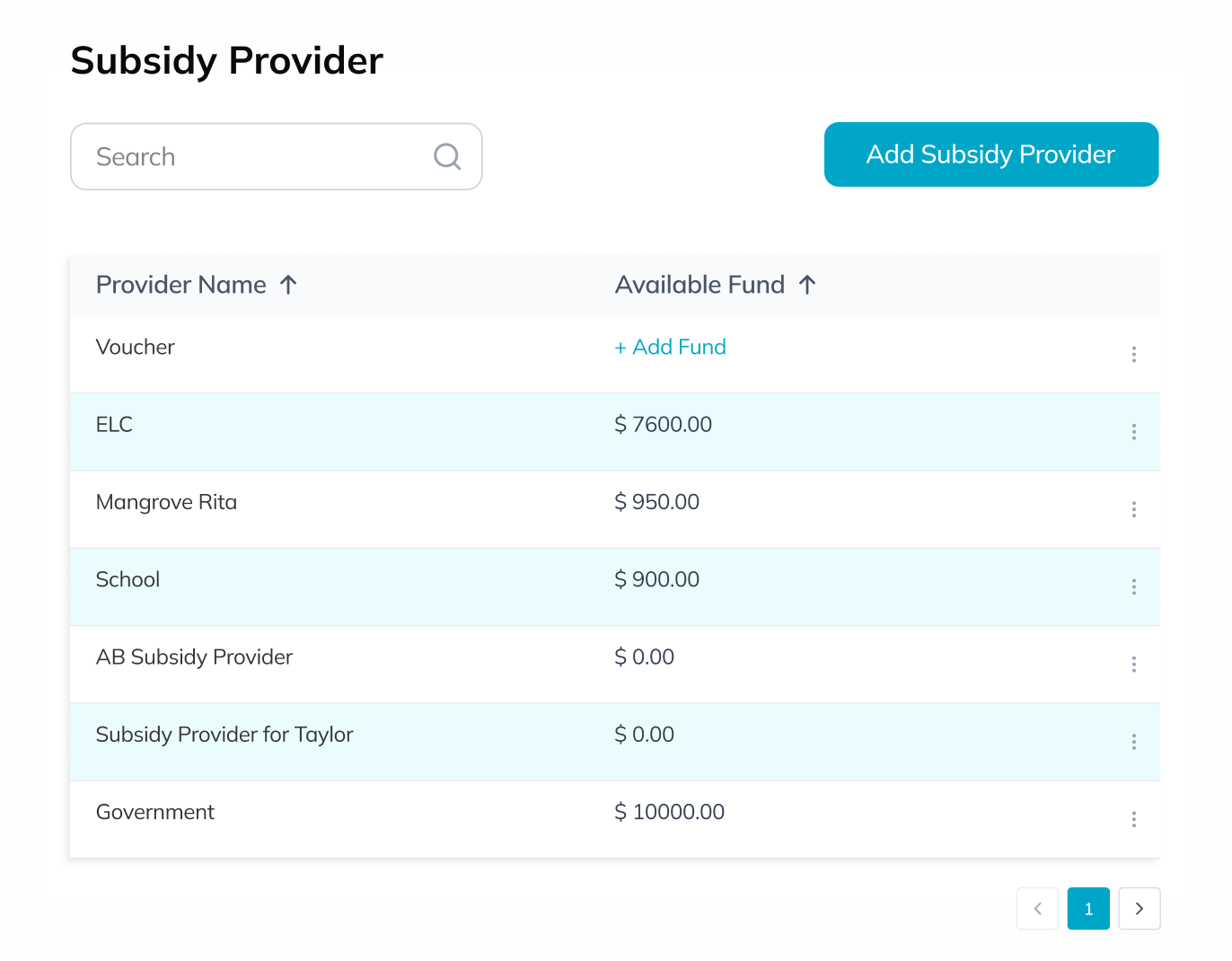
Subsidy workflows can be hard to manage at scale. illumine gives teams a more structured way to track subsidy providers, allocation, fund balances, remittances, and student-level mapping, making these workflows easier to manage and easier to review.
8. More audit-ready billing records
Billing actions need to be traceable. illumine makes it easier to maintain clean records around payments, adjustments, transfers, and subsidy activity, which supports both internal financial controls and external compliance needs.
9. Built for both leadership and center teams
Local teams still need a billing system that is simple enough to use day to day. At the same time, leadership needs portfolio-level oversight. illumine supports both, which is critical in a multicenter environment.
Closing Thoughts
Billing is a control system for margin, cash flow, compliance, and parent experience and should be treated as such. Multicenters struggle with this because systems that were “good enough” at a smaller scale become structurally misaligned with portfolio-level complexity.
Policy drift, revenue leakage, reconciliation delays, and limited visibility are signals that the infrastructure hasn't kept pace with growth.
The operators who scale successfully are the ones who standardize early, automate aggressively, and insist on real-time, portfolio-level visibility.
When metrics like expected revenue, collected revenue, leakage, AR aging, and cash flow are monitored clearly by center, by region, and across the network, decision-making changes.
Problems surface sooner. Interventions happen earlier. Forecasts become reliable.
The question is whether your billing infrastructure absorbs that complexity or amplifies it.