



The best childcare management software is the one that treats operations as interconnected tasks, not as a set of siloed operational functions running in parallel.
That distinction sounds abstract until you see what happens when software fails to make those connections. Consider a common scenario: a child is enrolled in a curriculum-aligned program. Three teachers rotate across the week. The lesson planning tool doesn't speak to the daily reporting module, so each teacher documents activities differently. The parent starts receiving inconsistent updates - detailed observations one day, a photo and nothing else the next. Over several weeks, the picture of their child's development becomes fragmented. They raise concerns at pickup, get different answers from different staff, and quietly begin looking at other centers. By the time they disenroll, no alert was ever triggered. The center's enrollment module showed one fewer child. Nothing else changed.
That scenario stems from software that stores information in separate places without surfacing the relationships between them. A disengaged parent, inconsistent communication, and uneven curriculum documentation are three data points that, when viewed together, tell a clear story.
This guide compares the leading childcare management platforms across the five operational domains that determine whether a center runs coherently or in fragments: compliance, parent communication, enrollment, billing, and curriculum. For each domain, you'll find what the category gets right, where the gaps are, and which platform is best suited for which type of center.
If Procare or Playground is on your shortlist, note that Procare acquired Playground in September 2026. Our Procare vs Playground comparison covers what that changes.
Why Does Integration Matter for a Childcare Management Software?
At its most basic, a childcare management software replaces paper - sign-in sheets become digital logs, invoices become automated, handwritten reports become app notifications.
That's the floor, not the ceiling.
The platforms that deliver genuine operational value go further: they connect the functions so that a change in one area is visible across the system, not buried in a module that no one remembers to check. When attendance data feeds directly into subsidy claims and ratio monitoring, when enrollment pipeline data connects to capacity forecasting, when parent communication history is visible on the same screen as a child's developmental record. That's the difference between software that stores information and software that runs a center.
The five domains below are where that integration either holds together or falls apart:
- Compliance
- Parent communication
- Enrollment and admissions
- Invoicing and fee collection
- Learning and assessments
Here’s how the best childcare management software fare in each of these domains, and how they integrate all daily operations in a single platform:
Childcare Tools Feature Overview: Comparing Platforms Across 5 Domains
Before the domain-by-domain comparison, this table gives you an at-a-glance picture of the feature landscape across the five platforms covered in this guide. Common features are those present in all or nearly all platforms. Differentiating features are what each platform does that others don’t:
Common features across all childcare management platforms:
Every platform in this comparison offers: digital attendance tracking and check-in/out, automated invoicing and online payment collection, parent-facing daily reports with photo sharing, digital enrollment forms and document collection, basic messaging between staff and families, and mobile apps for both staff and parents.
These features represent table stakes for the category in 2026. If a platform doesn't offer all of them, it isn't a serious contender.
Differentiating features in each childcare management software:
Swipe left to compare →
| Feature | illumine | Brightwheel | Lillio (HiMama) | Procare |
|---|---|---|---|---|
| Compliance |
|
|
|
|
| Parent Communication |
|
|
|
|
| Enrollment |
|
|
|
|
| Billing |
|
|
|
|
| Unique Edge |
|
|
|
|
| Best Suited For |
|
|
|
|
Domain 1: Compliance and safeguarding software for childcare centers
Compliance in childcare means managing real-time attendance tracking, and easily accessible documentation, inceident report alerts, etc. For multi-site networks, it also means enforcing consistent compliance standards across locations with varying staff.
What most software gets wrong
The gap in legacy platforms is that those features are reactive rather than preventive. The information is stored, but the risk is not managed.
For centers subject to licensing inspections, this distinction is consequential. An auditor doesn't want to see that you recorded what happened. They want to see that your system is designed to prevent certain things from happening in the first place.
Platform #1: Brightwheel
- Manages room ratios in real time and surfaces compliance data through licensing-ready reports.
- Its health check feature, like logging temperatures and illness symptoms, is particularly strong for centers navigating health protocols.
- CACFP meal tracking is purpose-built and widely used by US providers.
- The limitation is depth: ratio monitoring exists, but alerts are not as granular as some larger-scale operations require, and there's no multi-site compliance overview for network operators.
Platform #2: Lillio
- It introduced classroom ratio tracking and automated staff certification expiry alerts - a genuinely useful feature for directors managing a team with varying credential renewal cycles.
- Its name-to-face check capability helps centers fulfill spot-check documentation requirements for licensing.
- Like Brightwheel, the compliance depth is appropriate for single-site operations but doesn't extend to cross-site monitoring.
Platform #3: Procare
It has the deepest compliance infrastructure in the category, which reflects its 30-year history serving regulated US childcare programs.
- Ratio monitoring is configurable by room, day part, and time block. The platform's document management handles the full scope of compliance paperwork (enrollment contracts, incident reports, immunization records, staff certifications, and permission slips_ in a digital workflow with access controls.
- For Head Start programs and large publicly funded operations where compliance documentation is mission-critical, Procare's depth here is unmatched.
Platform #4: illumine
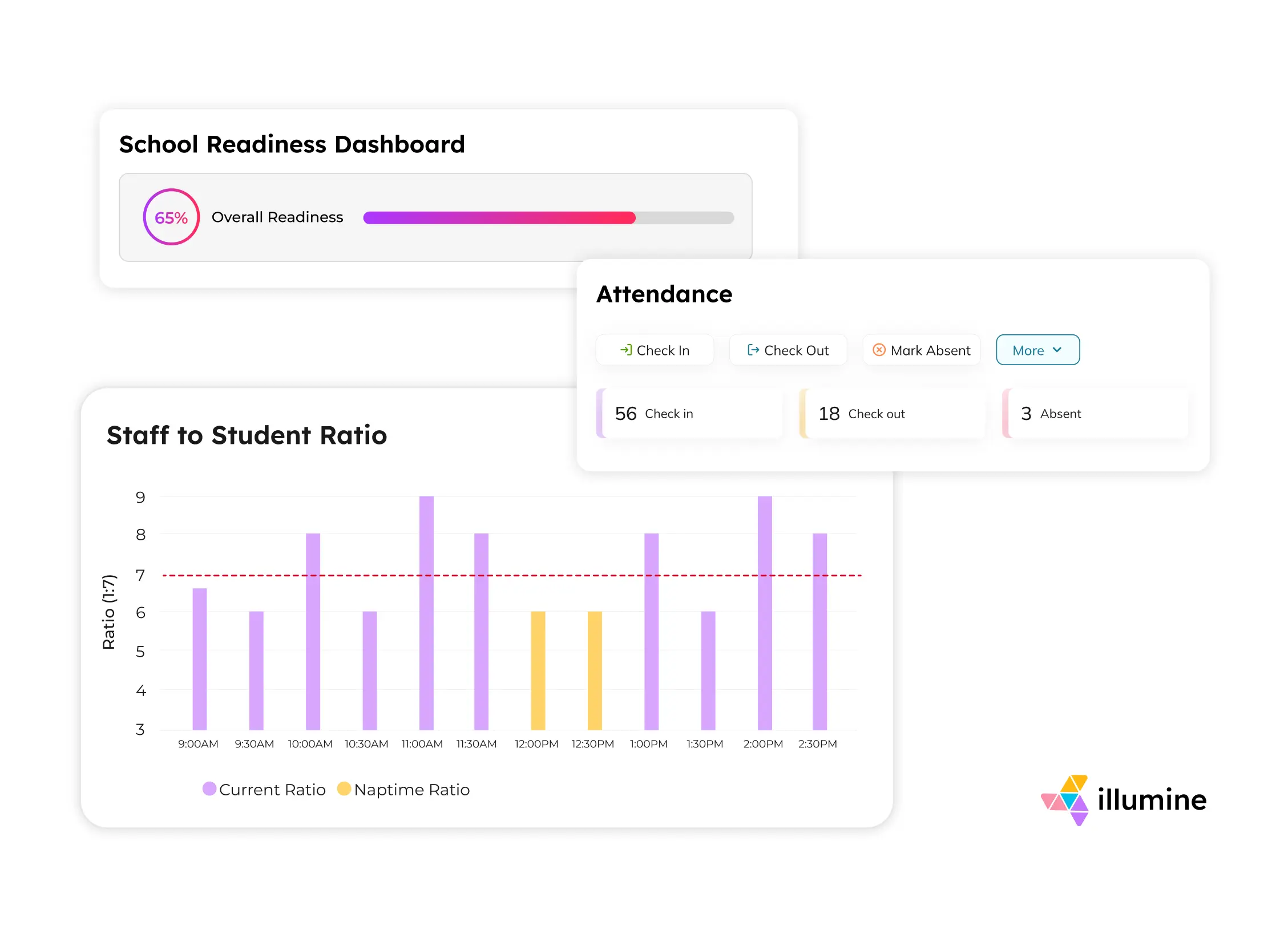
- Handles real-time ratio monitoring with alerts to both staff and directors, and its compliance visibility extends across the multi-site network dashboard - so a network director can see the compliance status of all locations simultaneously.
- The authorized pickup controls include a verification layer at check-out, and CCTV/livestream access is integrated directly into the platform, giving parents and directors visibility into the physical environment without requiring a separate monitoring system.
- Incident reporting routes automatically to the appropriate role with a resolution deadline, creating an auditable workflow rather than a static record.
Domain 2: Parent communication software for childcare centers
A communication platform built for directors, not just teachers, gives leadership oversight of communication quality across classrooms: which rooms are communicating daily, which families are opening and responding, which children haven't had an observation shared with their family in two weeks.
What most software gets wrong
The rotating staff problem is where most parent communication platforms fail quietly. What most can't do is enforce consistency in how messages are sent, surface patterns in family engagement, or alert a director when a family's communication engagement has declined.
Invisible engagement decline is an operational risk. The family that goes from engaged to quiet rarely announces they're considering alternatives.
Platform #1: Brightwheel
Brightwheel’s parent communication is the most widely adopted in the US market for good reason.
- The daily report format is clean and intuitive.
- Photo sharing is reliable. SMS alerts reduce the friction of parents needing to open a separate app.
- The extended family access feature, which allows grandparents or other caregivers to receive updates, is well-implemented.
- The gaps are in administrative oversight and multilingual support. Directors cannot see a consolidated view of communication quality across classrooms, and there is no built-in translation capability. For centers with multilingual communities, both are significant.
Platform #2: Lillio
Its communication strength is its tie to learning documentation. Updates to parents aren't just activity logs. They're connected to observations and developmental milestones. So parents receive updates with curriculum context rather than isolated daily summaries.
- Message scheduling allows teachers to plan communication, which reduces the end-of-day rush.
- The platform's professional development integration (Lillio Academy) subtly supports communication quality - better-trained educators tend to communicate more substantively.
- The limitation is the absence of real-time translation, no group messaging between classroom subsets, and no admin-level communication oversight dashboard.
Platform #3: Procare
Communication capabilities center on the parent portal and mobile app, which give families access to photos, daily updates, and billing in one place.
- The two-way messaging function works reliably. What Procare lacks in this domain is the AI-assisted and translation layer that modern, diverse communities require
PS- Recent user reviews suggest that the messaging tools, while functional, don't match the parent-facing polish of Brightwheel or the communication depth of illumine.
Platform #4: illumine
A communication platform is architecturally different from the others in one significant way: it gives directors oversight of what's being communicated and to whom, not just a log of what was sent.
- The admin dashboard surfaces read rates, response patterns, and engagement trends by classroom and by family.
- AI translation fires automatically on every message - supporting over 20 languages, including Spanish, Arabic, Mandarin, Malay, Cantonese, and French - without requiring any action from the teacher.
- The AI-assisted writing feature helps educators compose developmentally appropriate updates with the right tone, which both improves quality and reduces the time teachers spend writing.
- Voice notes allow parents and teachers to communicate without typing, which is particularly useful for mobile-first interactions.
- Every child has a consolidated communication history - so any staff member interacting with a parent can see the full context of previous exchanges, regardless of who sent them.
Domain 3: Childcare Enrollment Software
Enrollment management spans the full journey from a parent's first inquiry to a child's first day - and the ongoing relationship that determines whether that family re-enrolls and refers others. It includes lead capture from multiple channels, inquiry pipeline management, right to the handoff from prospective to enrolled family.
What most software gets wrong
A platform that digitizes registration paperwork has solved the last 20% of the enrollment problem while leaving the first 80% (inquiry, follow-up, tour conversion) entirely manual. And that 80% is where centers lose families - not because they didn't have availability, but because their follow-up was too slow, their tour booking was too complicated, or a lead sat untouched for four days while the family enrolled somewhere else.
Platform #1: Brightwheel
- Handles the post-decision enrollment experience well.
- Custom admission packets, digital forms, e-signature collection, waitlist management, and registration fee collection are all present and reasonably well implemented.
- What's absent is the pre-decision pipeline - there is no CRM, no automated follow-up for inquiries, no lead source tracking, and no tour scheduling tool.
Platform #2: Lillio
Lilio also focuses on the documentation side of enrollment - managing upcoming, currently enrolled, and graduated children, handling registration forms and waitlists, and sending enrollment-related communications through the platform.
- The enrollment experience for families is clean and digital.
- Like Brightwheel, there is no inquiry pipeline, no automated lead nurturing, and no analytics on conversion rates or lead sources.
Platform #3: Procare
- It extends further than both into the pre-enrollment funnel.
- Its online registration tools allow lead tracking and waitlist management through a that auto-populates data into billing and enrollment records when a family commits.
- Leads can be tracked through a pipeline and approved or declined, with automated confirmation emails.
- The limitation is that Procare's enrollment tools are still primarily form and documentation-oriented - the CRM depth needed for multi-touch lead nurturing and source analytics requires integration with ChildcareCRM (now LineLeader), which Procare doesn’t natively include.
Platform #4: illumine
- Approaches enrollment as the full journey.
- Every inquiry - from the website, a Facebook campaign, a WhatsApp message, a walk-in, or a QR code scanned off a brochure at an open day - enters a unified pipeline automatically without manual logging.
- Automated follow-up sequences run on a configurable cadence from the moment of inquiry.
- AI lead scoring surfaces the highest-priority families for human attention, and cold lead alerts flag inquiries that have gone quiet before they age out entirely.
- Families can self-book tours via a calendar link without a back-and-forth phone call.
- The registration process from forms, e-signatures, to fee payment is a single flow, with real-time payment status linked to the student record.
- And for network operators, the multi-site pipeline dashboard shows inquiry volume, stage-by-stage conversion rates, and lead source performance across all locations from a single view, making cross-site benchmarking possible without manual data export.
Domain 4: Childcare Billing Software
Childcare billing is one of the most operationally complex domains in the category. Centers typically manage multiple fee structures across different programs, discounts, add-on charges, subsidy payments, late fees, and split-payer arrangements. Add in the reconciliation requirement, and billing becomes the place where the most revenue is silently lost.
What most software gets wrong
Most billing modules are built around the invoice. They generate it, send it, and record payment. What they don't do is surface the connection between billing and operations. If attendance changes after a subsidy claim has been submitted, no flag appears. If a family moves from full-time to part-time mid-month, the fee adjustment depends on someone noticing and manually updating the billing plan. If a subsidy agency changes its documentation requirements, nothing in the system prompts the center to update its records.
In a sector with margins as thin as childcare, these quiet discrepancies accumulate. Revenue that was legitimately earned never gets collected. Write-offs happen not from bad debt but from software that wasn't watching.
Platform #1: Brightwheel
Brightwheel’s billing is widely regarded as the most polished parent payment experience in the category.
- Families rate it highly for ease of use, and the 90% on-time payment rate reported by centers using Brightwheel's autopay is a genuine operational outcome.
- Recurring billing plans, one-time charges, attendance-based invoicing, and flexible payment methods - bank transfer, credit card, debit card, and check deposit - are all well implemented.
- The expense management module and Gusto payroll integration add financial management depth that competitors don't match at the same price point.
- The limitation is subsidy billing complexity: Brightwheel's subsidy tools handle the basics but fall short of the deep reconciliation required by centers with significant government-funded enrollment or multiple subsidy programs.
Platform #2: Lillio
- Billing is capable and continues to improve - custom tuition plans, flexible invoice editing, CSV/XLS export for accounting integration, and basic subsidy support cover the needs of most single-site programs.
- The platform has historically been strongest in communication and curriculum, with billing added as a module, which shows in the relative depth: it works reliably for standard fee structures but is less suited to complex multi-program billing environments.
Platform #3: Procare
Carries the deepest billing and accounting capability in the category, built over three decades of serving US childcare programs with complex subsidy requirements.
- Split-payer billing is also handled natively. Subsidy billing supports multiple agency types with the documentation structure each requires. Electronic fund transfer, automated billing, and in-person point-of-sale transactions are all available. The challenge, per recent user reviews, is support quality and integration limitations: Procare's accounting system doesn't connect natively with QuickBooks or similar platforms, which creates reconciliation work for centers using external accounting software.
Platform #4: illumine
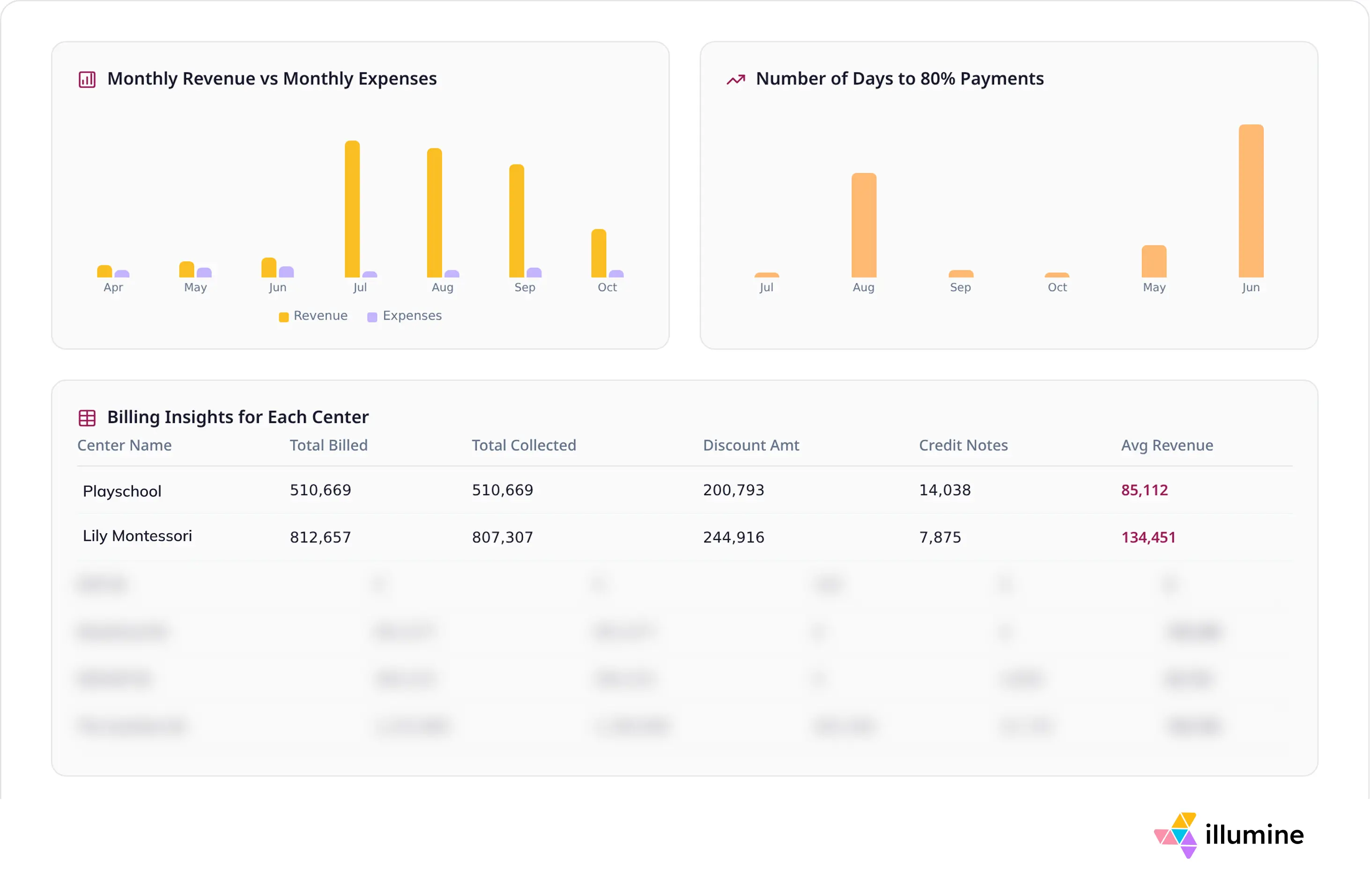
- The billing is built with the complexity of international and multi-program operations in mind. Multiple fee structures, add-on charges for meals and extracurricular activities, sibling discounts, subsidy offsets, and late fees are all configurable within the same billing workflow.
- Attendance-linked billing means subsidy claims reflect what actually happened rather than what was scheduled - discrepancies between the two surface automatically rather than silently.
- Payment integration covers over 10 processors globally (Stripe, PayPal, Razorpay, RinggitPay, and others), which matters for centers operating across different payment infrastructure markets.
- The multi-center financial dashboard gives network directors a real-time view of fee collections, outstanding balances, and subsidy revenue across all locations simultaneously - the data that a network finance function needs without requiring manual extraction from individual site reports.
Domain 5: Childcare Learning and Assessment Software
Curriculum management in childcare covers lesson planning, alignment to developmental frameworks (EYFS, Montessori, Reggio Emilia, Creative Curriculum, or custom center-defined standards), observation recording, developmental milestone tracking, individual child progress documentation, portfolio management, and the sharing of learning progress with families in a way that means something to them.
What most software gets wrong
Curriculum tools in most platforms are isolated from everything else the center does. A teacher plans lessons in one module, records observations in another, and sends parent updates through a third. None of those three actions knows about the others. The lesson plan doesn't feed the observation template. The observation doesn't link to the milestone framework. The parent update doesn't connect to the assessment report. The documentation accumulates in separate places, and someone - usually the director or a lead teacher - has to manually bridge the gaps when assessment time comes.
The result is that curriculum documentation is the domain most likely to be done inconsistently. It's also the domain where quality differentiation is most visible to parents who are evaluating centers. A parent who understands how their child is progressing developmentally - and receives regular, contextual updates that make that progress visible - is a parent who stays enrolled and refers others.
Platform #1: Brightwheel
- Their curriculum capability is built around its Experience Curriculum add-on, which provides a complete digital lesson plan system with pre-loaded state learning standards and DRDP alignment.
- Teachers can customize lesson plans, share them with families, and track progress against developmental benchmarks.
- The platform's observations feature allows teachers to tag milestones and share with parents or keep them internally.
- The limitation is that Experience Curriculum is a paid add-on to an already premium platform, and for centers with existing curriculum frameworks (Montessori, Reggio, EYFS), the pre-loaded content may not align with their pedagogy.
- Integration between the lesson plan and the parent communication is present but not automated. Teachers bridge that connection manually.
Platform #2: Lillio
- The curriculum approach is educator-first.
- Lesson plans are created and shared with families directly through the app, with curriculum-aligned developmental observations that build into individual child portfolios over time.
- The Lillio Academy professional development platform (IACET-accredited and CEU-eligible) adds a dimension that no other platform in this comparison offers: the teachers delivering the curriculum have access to structured, recognized professional development that improves their practice over time.
- For centers pursuing NAEYC accreditation or quality rating improvement system (QRIS) scores, this combination of curriculum documentation and educator development is genuinely valuable.
- The limitation is that Lillio's curriculum tools are designed primarily for centers using established state standards. Programs with heavily customized or non-US curriculum frameworks have less flexibility.
Platform #3: Procare
- The curriculum tools cover weekly lesson planning and developmental milestone tracking against state standards.
- The functionality is sufficient for centers needing structured documentation, but multiple user reviews highlight that Procare's curriculum capabilities require third-party integration for more sophisticated frameworks -Creative Curriculum being the most commonly cited example.
- Centers using Creative Curriculum or similar third-party systems find that the data doesn't flow seamlessly between platforms, creating duplication of documentation effort.
Platform #4: illumine
- illumine’s curriculum module is built around the premise that the lesson plan, the observation, the developmental assessment, and the parent update should be part of one continuous workflow rather than four separate tasks.
- Lesson plans are created in alignment with EYFS, Montessori, Reggio, or custom framework parameters.
- Observations pull from the lesson plan context, so when a teacher records an observation, the system knows what was being taught and can surface relevant developmental indicators automatically.
- AI-assisted observation generation means teachers review and approve documentation rather than writing it from scratch, which meaningfully reduces the after-hours work that contributes to burnout.
- Assessment reports are generated from the accumulated observation data and shared with families in a format that is readable by parents rather than readable by administrators.
- And the entire workflow is available in multiple languages- lesson plans, assessments, and parent-facing reports can be produced in the family's preferred language without requiring a separate translation step.
Choosing The Right Childcare Management Platform for Your Center
The five domains above each have a recommendation row, but the real decision comes from understanding which of the five is your biggest pain point right now - and which platform handles that domain within a system you can actually grow into. If you are still building your shortlist, the top 10 things to look at in preschool management software sets out the criteria that sit underneath these five domains.
If your biggest challenge is empty seats and slow inquiry conversion, the enrollment domain is where to start. The platforms that handle the full inquiry-to-enrollment pipeline (illumine, LineLeader) will have more immediate impact than platforms that only improve the registration paperwork.
If your biggest challenge is billing complexity or subsidy revenue leakage, the billing domain is where to start. Procare has the deepest subsidy depth for US-based programs. illumine offers more if your program has complex fee structures, add-on charges, or operates across multiple payment markets.
If your biggest challenge is parent retention and family engagement, the communication domain matters most. Brightwheel is the easiest to adopt and the most polished for English-speaking families. illumine adds the multilingual translation and admin oversight layer that larger or more diverse centers need.
If your biggest challenge is educator burnout and curriculum documentation, the curriculum domain is the lever. Lillio's professional development infrastructure is unique in the category. illumine's AI-assisted observation generation directly reduces the after-hours documentation load that drives burnout.
If you're a multi-site network evaluating a single platform across all locations, the question is different. You need a platform that doesn't just work for one center - it needs to give you visibility across all of them from a single dashboard, standardize processes without removing site-level flexibility, and scale with you as the network grows. Among the platforms compared here, illumine is the only one that offers consolidated multi-site visibility across all five domains natively - enrollment pipeline, compliance, communication, billing, and curriculum - without requiring third-party tools to bridge the gaps.
The right platform isn't the one with the longest feature list. It's the one whose architecture treats your operation as a system, and whose connections between domains reflect how your center actually runs.