
.webp)


Enrollment seasonality is a process problem, not a demand problem.
Most childcare directors experience the same pattern: a strong September, a quiet January, a scramble every spring to project whether summer will hold. The instinct is to treat this as a market reality: families move, siblings age out, the academic calendar creates natural churn.
And some of that is true.
But underneath the seasonal narrative is a more fixable problem- most centers are losing families not because demand dried up, but because their follow-up was too slow, their enrollment process was too cumbersome, or they had no way to see the leak until after the seat was already empty.
The best software for growing enrollment in childcare doesn't solve this by adding a waiting list feature or a digital signup form. It solves it by fixing the operational gaps that let warm leads go cold, turn interested families into frustrated ones, and leave directors making capacity decisions based on incomplete data.
Most Common Mistakes that Cause Childcare Centers to Lose Enrollment
The biggest barrier to enrollment is that the process is largely invisible and almost entirely manual.
It typically breaks down in three places:
1. Enrollment paperwork creates friction
A family has decided they want your center. They've toured, they've met the teachers, they're ready to commit. And then you send them a packet.
A physical packet, a PDF, or a series of forms that need to be printed, signed, scanned, and emailed back. Health records, emergency contacts, authorization forms, fee agreements, and payment setup- each of these is legitimate and necessary. But the experience of completing them is tedious, especially for a working parent managing two children and a full-time job.
Most childcare software has addressed this by digitizing the paperwork. Forms are now online. Signatures are electronic. Documents are stored in a portal. That's a genuine improvement, but it's the minimum - and it stops well short of actually making enrollment frictionless. The documents still need chasing. The payment setup is still separate from the enrollment workflow. The admin staff is still manually confirming that every required form has come in before a child's start date.
2. Slow or sloppy, manual follow-ups
When a family submits an inquiry, most centers track it the same way they tracked it in 2010: a spreadsheet, a sticky note, or a CRM field that someone updates when they get around to it. Stages like "contacted," "tour booked," and "application submitted" are logged manually. Follow-up for families at each stage is triggered by someone remembering to check the list. On a Tuesday morning when drop-off is chaotic, three families called in sick, and a subsidy claim is overdue - that check doesn't happen.
By the time it does, the family has toured somewhere else.
For multi-site operators, this problem multiplies. Each location has its own pipeline, managed by its own staff, with its own interpretation of what "followed up" means. There's no consolidated view across sites, no way to compare conversion rates between locations, and no system that escalates when a lead has been sitting untouched for four days.
3. Data stops at occupancy metrics
How many inquiries came from your Facebook campaign last quarter versus your Google listing? Which of your locations converts tours to enrollments at the highest rate, and what are they doing differently? Which message in your follow-up sequence gets the most responses? Which families who toured but didn't enroll gave a reason, and what was it?
Most childcare management platforms answer exactly one enrollment question: how many seats are filled and how many are empty. That's occupancy data. It tells you the outcome but nothing about the process that produced it. For a single-site center, that gap is frustrating. For a multi-site operator trying to understand why two locations with similar demographics are producing different enrollment results, it's operationally limiting in ways that directly affect revenue.
Best childcare enrollment software for growth: matched to your center's size and stage
Not every enrollment problem is the same. A family daycare with 20 children is not dealing with the same operational gaps as a network of 12 preschools trying to standardize follow-up across locations. The right software depends on where your biggest friction is. It also tends to follow a predictable pattern as centers grow.
Here's how the market currently maps to that complexity, and where each tier of solution starts to show its limits.
1. For smaller centers (under 50 children)
For a single-site center at this scale, the most immediate enrollment pain is usually paperwork. Collecting all of it before a child's start date is genuinely time-consuming, and following up on outstanding documents manually is one of those tasks that falls through the cracks on a busy morning.
Platforms like Brightwheel and Lillio address this well. They digitize the enrollment paperwork, allow families to complete forms online, capture e-signatures, and give staff a cleaner view of what's been submitted and what's still outstanding. For a small center where the director is also often the teacher and the administrator, that reduction in back-and-forth is meaningful.
The ceiling, though, is real. These platforms solve the documentation problem by digitizing it, but it's still essentially moving paper online. There's no inquiry pipeline. No automated follow-up for families who expressed interest but haven't enrolled. No visibility into which channels are bringing in inquiries or why some families tour and don't convert. If your center has empty seats, these tools won't tell you why - and they won't help you fill them faster.
For centers at this stage, that gap may be acceptable. If you're consistently full and the main frustration is administrative friction at enrollment, documentation-focused software is a reasonable fit. But if you have empty seats you can't explain, you've already outgrown this tier.
2. For growing centers (50–250 children)
This is where the enrollment problem stops being about paperwork and starts being about the pipeline. You have enough inquiry volume that manual follow-up is actively costing you enrollments. Families are falling through the gaps between "expressed interest" and "booked a tour." Tours are happening, but not converting at the rate they should. And you have no systematic way to know which families are close to deciding and which ones went cold three weeks ago.
LineLeader is the platform most commonly adopted at this stage, and for good reason. It's purpose-built for childcare enrollment management, with a proper lead pipeline, configurable stages, and automation for follow-up sequences. The step up to LineLeader is significant - you gain real pipeline visibility, consistent follow-up cadence, and a much clearer picture of where families are in the decision process.
But two gaps become increasingly visible as centers grow into and beyond this tier.
The first is post-enrollment. LineLeader's strength is the lead-to-enrollment journey. Once a family is enrolled, the platform's management capabilities, like daily reporting, parent communication, and ongoing engagement, are noticeably thinner. For a center that understands retention as part of enrollment strategy (which it is - an enrolled family who re-enrolls a sibling, refers a neighbor, and stays through their child's third year is worth multiples of any new inquiry), the drop-off in engagement tools after enrollment is a meaningful gap. The families you worked hardest to convert become the families your software pays the least attention to.
The second gap is multi-site visibility. LineLeader's dashboard is built around individual centers, not networks. For an operator running three or more locations, there's no consolidated view of pipeline performance across sites, no ability to compare conversion rates between locations, and no network-level capacity forecasting. Each site's data lives in its own context. The director who needs to understand why one location fills consistently and another struggles - that answer isn't in the platform.
3. For multi-site operators and growth-focused networks
At this level of complexity, point solutions stop working because the problem has changed.
You're no longer trying to manage one pipeline. You're trying to standardize a process across multiple teams, compare performance across locations, forecast capacity months in advance, and keep enrolled families engaged enough that retention becomes a growth engine rather than a vulnerability.
That requires software built around a different design premise: that enrollment is a continuous journey, not a series of discrete transactions, and that every stage of that journey - from the first inquiry to a family's final pickup - should live in the same system, feed the same data, and be visible in the same dashboard.
Ideally, this is how your childcare enrollment software should function:
On the inquiry side, every lead - regardless of source - enters a unified pipeline automatically. Automated follow-up sequences run on a configurable cadence without requiring staff to trigger them manually. AI-powered lead scoring surfaces the highest-priority families for human attention. Cold lead alerts flag inquiries that have aged past a set threshold, before a warm prospect becomes a lost one.
For network operators specifically, you need a consolidated pipeline visibility across all locations in a single dashboard:
- Conversion rates by site
- Inquiry sources by location
- Capacity forecasts across the network.
On the enrollment side, the experience should be frictionless for families and low-effort for staff: digital forms, e-signatures, and integrated fee payment in a single flow, with automated document reminders that chase outstanding items without anyone having to manually track them.
And on the retention side, your software should treat existing families as the highest-value pipeline a center has. The parent communication, billing transparency, and daily engagement tools aren't a separate product bolted onto the enrollment system. They're the same system, continuing the relationship that enrollment started. Engaged, informed families don't quietly disenroll. They refer. They re-enroll siblings. They stay.
The Best software for Multi-Site Childcare Enrollment and Growth System
Most platforms in this category solve for one part of the enrollment journey and treat the rest as someone else's problem. Documentation tools handle the paperwork but have no awareness of where the family came from or what it took to get them to sign. Pipeline tools track the lead journey but lose interest the moment the contract is signed. The result is a process that's better in parts but still broken as a whole - and a director who's still connecting the dots manually between systems that were never designed to talk to each other.
Illumine was built around a different premise: that enrollment isn't a transaction with a start and an end date. It's a relationship that begins the moment a family first hears about your center, and the software should manage that entire arc - not just the segment that's easiest to productize.
Here's what that looks like in practice.
1. Centralized pipeline and automated workflows
Regardless of where a family finds you, the inquiry is captured in a single system without anyone having to manually log it. There's no spreadsheet to update, no tab to check, no risk of a lead sitting in a staff member's email inbox over a long weekend. The pipeline starts the moment the family does.
From there, automated follow-up sequences run on a configurable cadence. For example- When a lead changes stage - from "new inquiry" to "tour booked," from "tour completed" to "offer made" - illumine can automatically trigger the next action. Email sequences, task assignments, document reminders, and personalized messages fire based on pipeline stage, without a staff member having to initiate them. Personalization tokens (the parent's name, the child's name, the program they expressed interest in) are embedded in those automated messages, so the communication feels considered rather than generic.
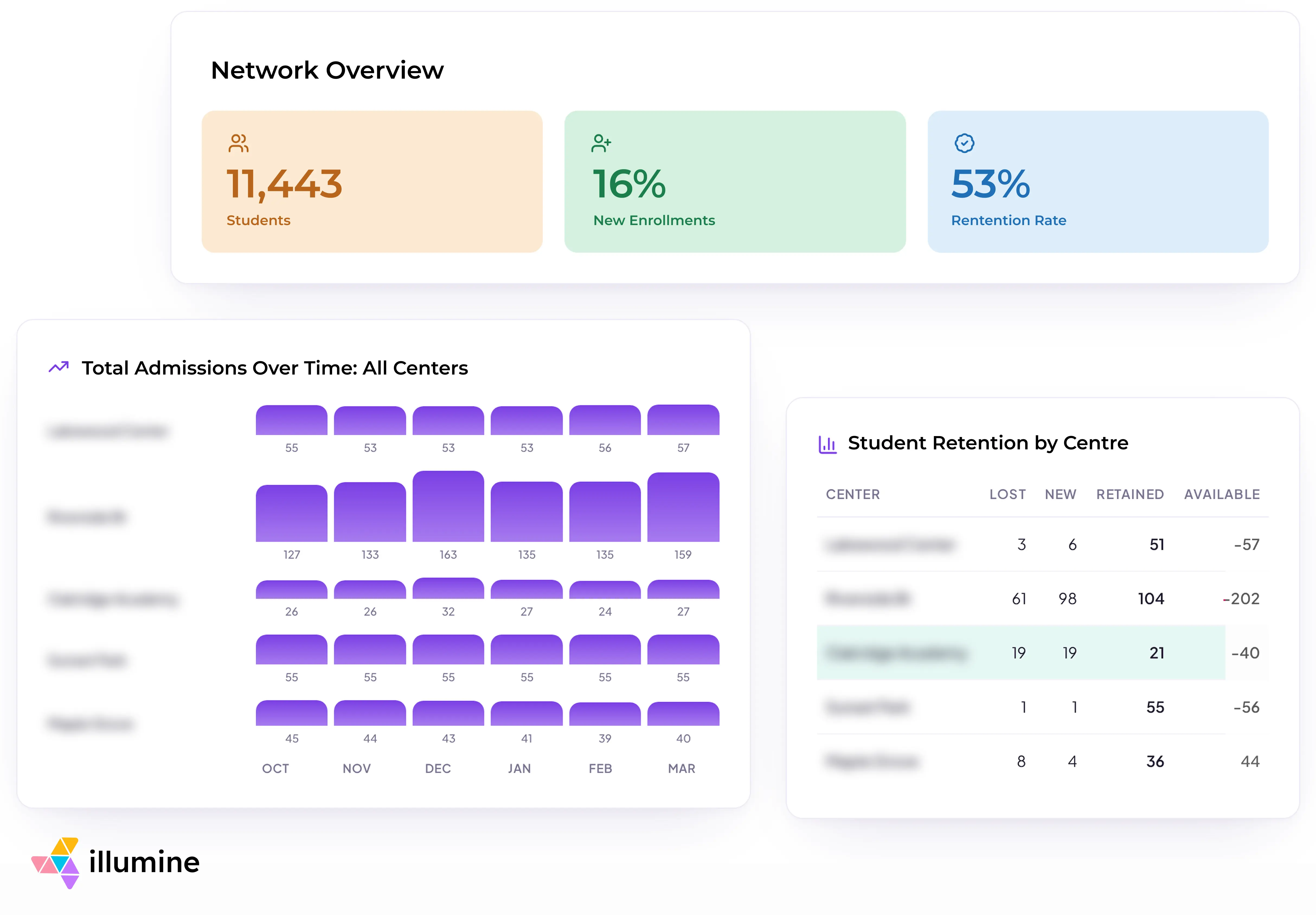
The first response goes out within minutes. Subsequent touchpoints follow a schedule because the system was set up to do it.
2. AI lead scoring
Not every inquiry in the pipeline deserves the same attention at the same moment. A family that has opened every message, clicked through to your virtual tour, and started filling out a registration form is in a fundamentally different position than one that submitted an inquiry three weeks ago and hasn't responded since. Treating them identically wastes time on the second and risks losing the first.
Illumine's AI lead scoring evaluates engagement signals like response rates, time in stage, interaction history, and inquiry source. Based on this information, it surfaces the families most likely to convert. Say a family that submitted an inquiry three weeks ago and hasn't responded to two automated follow-ups is flagged differently from one that booked a tour yesterday and opened the confirmation email twice.
Cold lead alerts surface specifically for inquiries that have gone quiet past a set threshold - giving admissions staff a prompt to re-engage before the window closes entirely, rather than discovering three months later that a warm prospect silently moved on.
Requiring a registration or inquiry fee at the form submission stage is also configurable - filtering out unqualified inquiries at the top of the funnel and ensuring that the pipeline reflects genuine interest rather than casual browsing.
For a multi-site network, this matters at a different scale. A network director is managing ten, across locations with different staff, different inquiry volumes, and different conversion histories. Illumine's consolidated dashboard surfaces that view in one place:
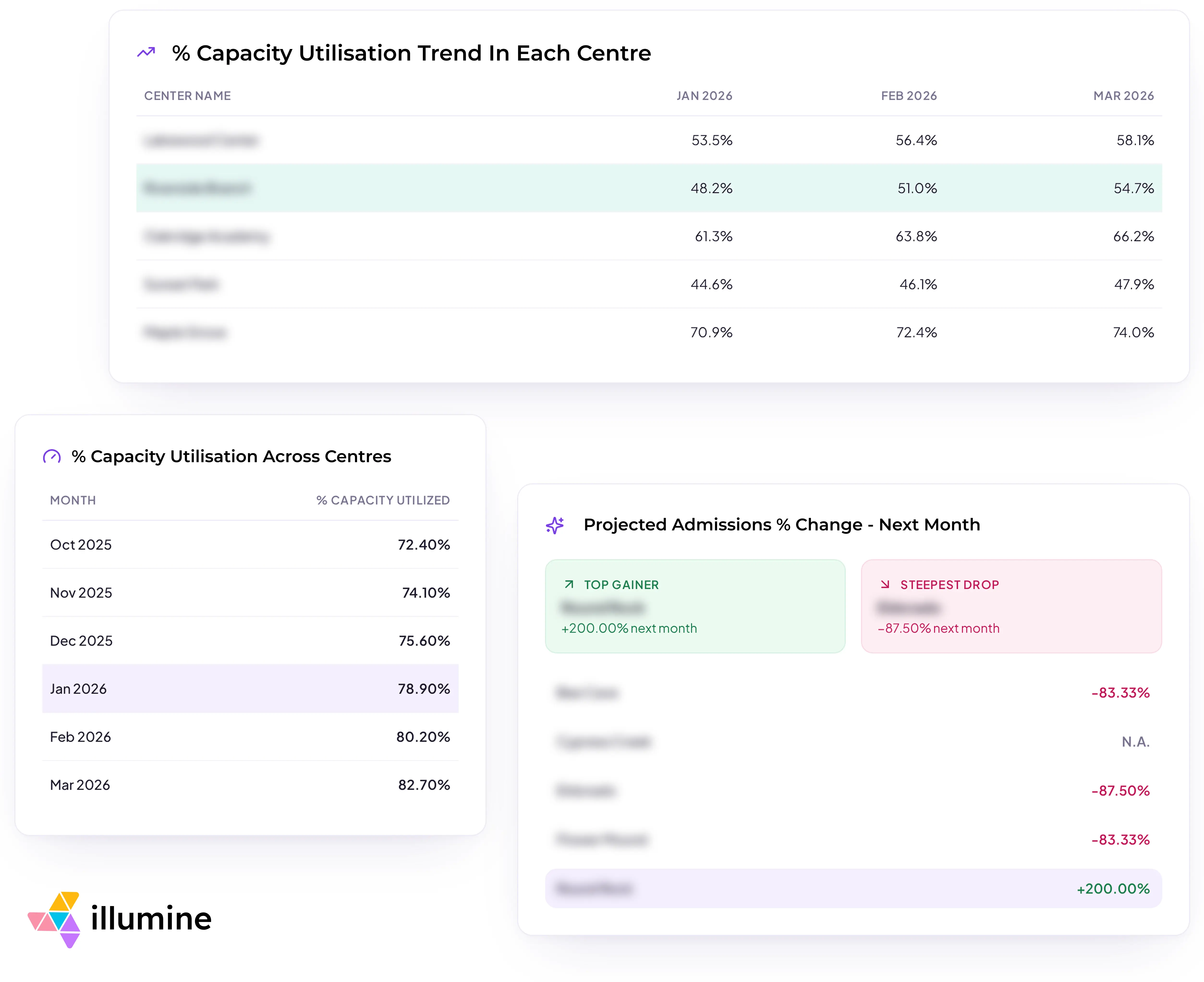
- Pipeline performance by location, with conversion rates at each stage
- Lead source reporting by site: which channels are generating inquiries, and which are generating enrollments (those are often different answers)
- Capacity forecasting across the network, based on pipeline stage and historical conversion rates, so empty seats are visible months before they happen
- Cross-site benchmarking so high-performing locations can be understood and replicated, not just admired
3. Smooth enrollment process
Once a family is ready to commit, the experience should match the impression your center has been building. Digital forms that work on any device. E-signatures that don't require a separate app or a printer. Fee payment is integrated into the same flow, not linked out to a third-party portal that loses the thread of what the family was doing. Automated reminders for outstanding documents, so the admin team isn't chasing individually, and families don't feel hounded.
Staff sees a single, real-time view of every incoming family- what's been submitted, what's outstanding, what's been paid, and what needs to happen before the child's start date. Not three systems with three logins. One.
4. Aligned retention strategy
This is the piece most enrollment software quietly ignores, and it's the piece that compounds most visibly over time. An enrolled family who stays for three years, re-enrolls a younger sibling, and refers two neighbors is worth multiples of any new inquiry your marketing generates. Treating retention as a separate problem means you're losing the thread at exactly the point where it matters most.
In illumine, the parent communication, daily reporting, billing transparency, and engagement features that keep families connected aren't a different product. They're the same platform, continuing the relationship that enrollment started. A family that feels informed and involved doesn't quietly disenroll. And when children grow, and families eventually leave, they leave as advocates.
That's the difference between software that fills seats and software that builds a program. For centers at any stage of growth, it's the distinction worth getting right before you choose a platform.
Enrollment gaps are a process problem. Which means they're a solvable one - with the right system behind them. See how illumine manages the full enrollment journey for centers of your size.