
.webp)


When a nursery hires a new teacher, the induction is thorough. The vision is explained, the curriculum is introduced, and the expectations are set. And then the classroom door closes, and the leader hopes that everything discussed in those first weeks translates into what actually happens with the children.
Sometimes it does. Often, it doesn't because teaching in a nursery is complex, fast-moving, and learned primarily through experience. A young practitioner who understood the lesson plan in the planning meeting may freeze when a child is dysregulated, default to passive supervision when the activity loses momentum, or miss the quieter children entirely while managing a vocal few. Without observation, that gap between intention and practice is invisible. With it, it becomes the starting point for the most important professional development conversations a nursery leader will have.
In the UAE, where nursery teams typically include both a teacher and an assistant, observation takes on additional dimensions. It reveals not just individual practice but how the team functions together: how responsibilities are shared, how communication happens during the session, and whether both adults are genuinely engaged with children or falling into a supervisor-and-supervised dynamic that serves neither.
This guide covers everything a nursery leader in the UAE needs to conduct meaningful staff observations: what they are, why they matter, what to look for, how to conduct them well, and how to give feedback that actually changes practice. A free observation form template, designed specifically for UAE nursery settings, is available to download at the end.
What is a Teacher Observation in a Nursery?
A teacher observation is a structured process in which a nursery leader or senior practitioner watches a teacher and their assistant at work in the classroom. The observer records what they see and uses that evidence to support professional development and maintain quality of care.
The word "structured" matters. An observation is not a drop-in visit or a casual check. It has a defined purpose (Eg, evaluating a specific aspect of practice, assessing a new team member's readiness, or maintaining baseline quality standards across the nursery). It uses a form or framework to ensure the observer is capturing consistent, objective information rather than relying on impression or memory. And it has a defined follow-up: a feedback conversation that happens while the experience is still fresh.
Observations are also part of the quality landscape that KHDA and other regulatory bodies assess. A nursery that can demonstrate a systematic, documented approach to staff observation is in a stronger position at inspection than one where observation is ad hoc or undocumented. But more fundamentally, a regular observation cycle is how a nursery leader knows what's actually happening in the rooms they're responsible for, week to week.
Why is Teacher Observation Important in Early Years Settings?
The quality of a nursery is, in the end, the quality of what happens between adults and children in the classroom. Everything else, like the environment, the resources, the curriculum planning, is a context for those interactions. Observation is the only way to know whether those interactions are what they should be.
There are four specific reasons why observation matters in nurseries, and particularly in the UAE:
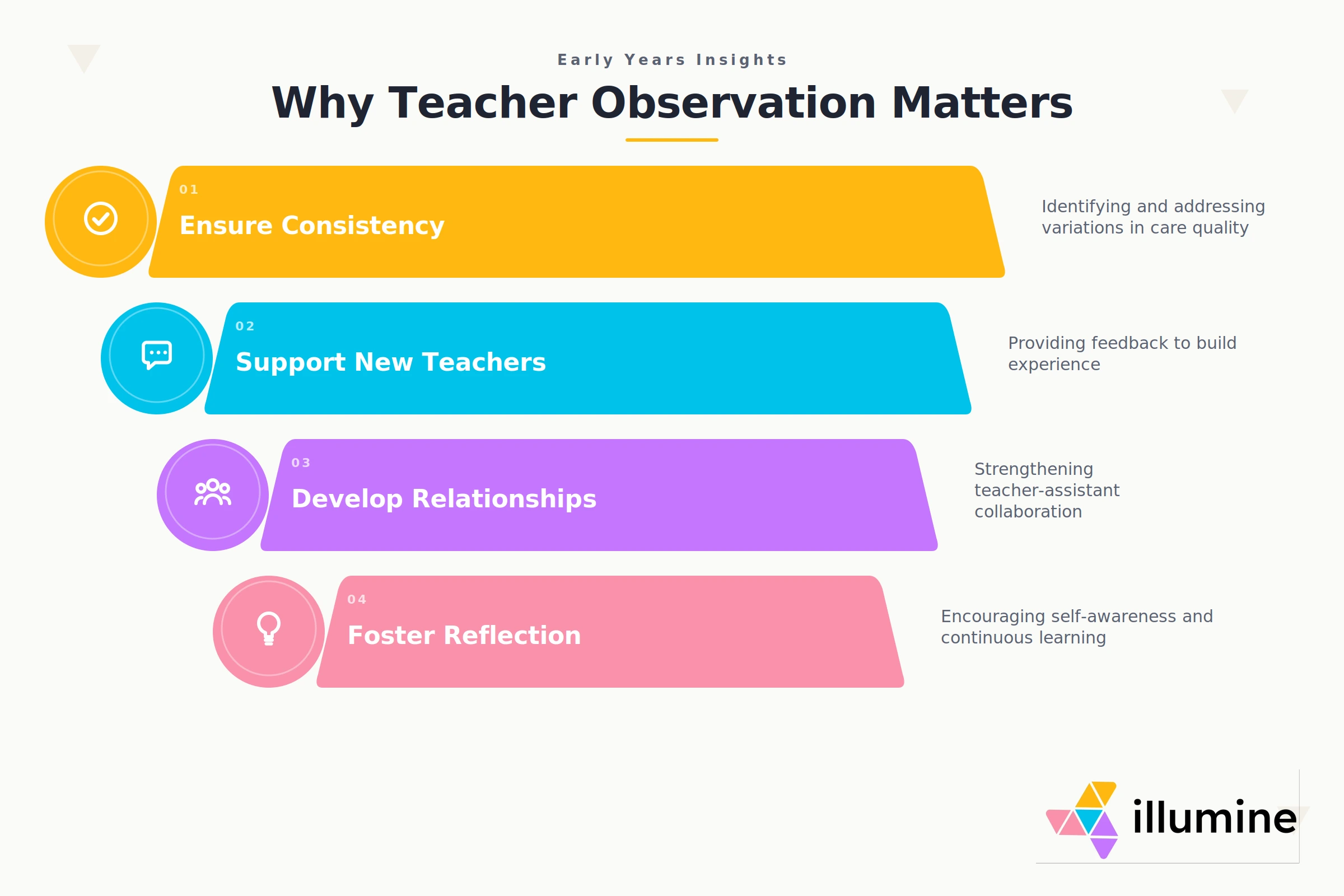
1. It protects consistency across the team.
In any nursery with more than one classroom, the quality of care is at risk of varying significantly from room to room. One teacher may be warm, responsive, and developmentally attuned. Another may be technically competent but emotionally flat. Without observation, both receive the same performance review and the same professional development allocation. With observation, differences in practice become visible and addressable.
2. It supports new and early-career teachers
Young practitioners and those new to the UAE early years context often have the theoretical knowledge but limited experience in applying it under the pressure of a live classroom. Observation followed by structured feedback is how experience is built deliberately, rather than left to accumulate however it happens to. A nursery that observes new teachers monthly in their first year is building practitioners.
3. It develops the teacher-assistant relationship
The UAE nursery classroom is almost always a two-adult environment, and the relationship between teacher and assistant significantly affects the quality of the children's experience. A strong team divides the room naturally, communicates through glance and gesture, and ensures no child goes unnoticed. A weak team has the teacher managing everything while the assistant waits for instruction. Observation is the mechanism that makes this visible and provides the evidence for the conversation that follows.
4. It creates a culture of reflection
In nurseries where observation is rare or feared, practitioners develop a relationship with their own practice that is defensive rather than curious. When observation is regular, normalised, and experienced as supportive, something shifts. Teachers begin to notice their own patterns. They start asking to be observed. They bring their own questions to the feedback conversation. This shift is the marker of a genuinely learning-oriented nursery culture.
What Should a Teacher Observation Include?
A teacher observation is looking for evidence across several interconnected dimensions of practice. The key areas, and the specific things to look for within each, are:
1. The learning environment and planning
Is the classroom set up purposefully, with activities that reflect the children's current interests and developmental stage? Are resources accessible, well-organised, and at the right level of challenge? Is there evidence that the teacher prepared and that the activities have intent behind them?
If the teacher deviates from the planned lesson, the observer should note this and understand why. In early years, planned deviation is often a mark of quality- a teacher who spots a child's spontaneous interest and reshapes the session around it is demonstrating exactly the responsiveness the pedagogy requires. The observer needs to be curious about deviations, not critical of them.
2. Adult-child interactions
This is the core of the observation. How does the teacher talk with children? Are they asking open questions that extend thinking, or closed questions that require a yes or a no? Are they at eye level with children, genuinely present in the interaction, or managing the room from a standing position? Do they use children's names, respond to children's ideas, and build on what children say?
Look specifically for sustained shared thinking. These are moments when a teacher and child are genuinely exploring an idea together, neither leading nor following, but both engaged in something that neither would have arrived at alone. These moments are the hallmarks of high-quality early years interaction and are visible during observation in a way that simply cannot be captured anywhere else.
3. Inclusivity and differentiation
Does the teacher's attention distribute across all the children in the room, or does it cluster around the most vocal, the most challenging, or the most capable? Are quieter children actively drawn in, or left to their own devices? Are there visible adaptations for children with different needs, like additional language support, visual cues, or modified tasks?
Emotional coaching is part of this, too. When a child is upset, frustrated, or dysregulated, does the teacher respond with empathy and language that names the emotion and supports the child toward regulation? Or does the response default to redirection without acknowledgement?
4. The teacher-assistant dynamic
In UAE nurseries, this is frequently where the most significant quality gaps exist. A strong teacher-assistant relationship looks like two adults who have a shared understanding of their roles in the session, communicate naturally without disrupting the flow, and both maintain active, intentional engagement with children throughout.
Signs of a weak dynamic include: the assistant spending significant time on non-child-related tasks (tidying, preparing resources, managing admin), the teacher doing all the direct work while the assistant supervises, a lack of communication between the two during transitions or activity changes, and a visible hierarchy that leaves the assistant feeling they don't have permission to interact at the level the teacher does.
5. Professional conduct and language
The language used in a nursery classroom shapes the environment more than any resource or decoration. Is the language warm, specific, and developmentally appropriate? Are instructions clear and delivered at the right level for the children? Are conversations between staff in front of children professional and child-focused?
.webp)
What is a Teacher Observation Checklist?
A teacher observation checklist is a structured tool that guides the observer through the key dimensions of practice they should be looking for, ensuring that observations are consistent, evidence-based, and comparable across different staff members and different observation cycles.
A good checklist for a UAE nursery setting covers the dimensions above — environment and planning, adult-child interactions, inclusivity and differentiation, teacher-assistant dynamic, and professional language. It also provides space for both a rating (to capture where practice sits on a continuum) and specific written evidence (to ensure the feedback conversation is grounded in what was actually observed rather than general impressions).
The distinction between a rating and evidence is important. A rating of "developing" on adult-child interactions without supporting evidence gives the teacher nothing to work with. A rating of "developing" supported by a note that reads "teacher asked three closed questions during the snack conversation and did not follow up on Layla's comment about the caterpillar" gives the teacher something specific to understand, reflect on, and change.
The observation form available to download with this guide is designed for UAE nursery settings specifically. It includes sections for each of the key dimensions, a simple three-point rating scale (strengths/developing/area for focus), and space for evidence notes alongside each rating — ensuring that every observation produces a document that is useful both for the feedback conversation and for the performance record.
How to Conduct a Teacher Observation in a Nursery?
Before the observation
Decide whether the observation will be announced or unannounced. Both have their place. Announced observations allow teachers to prepare and reduce anxiety, but they may not show you typical practice. Unannounced observations show you what normally happens, but require careful handling to ensure staff don't feel ambushed. In most nurseries, a mix works well: regular scheduled observations that teachers know about, and occasional drop-in visits that become a normal part of the leader's presence in the building rather than a formal event.
Brief the teacher before a scheduled observation and share the focus- "This observation, I'm particularly interested in how you're using questions to extend thinking," is useful information that helps the teacher engage reflectively rather than feeling generally watched.
Prepare your observation form before entering the room. Know what you're looking for and how you'll record it.
During the observation
Enter calmly and with as little disruption as possible. In UAE nurseries where the observer is the owner or director, the children often know them well — a brief, friendly acknowledgement is fine, but the focus should shift quickly to observation rather than interaction.
Sit or stand in a position where you can see both adults and most of the children without being in the middle of the action. A corner position usually works well. Do not participate in the session. The moment you start engaging with children, you stop observing.
Take notes continuously, not retrospectively. Memory of a 45-minute session degrades quickly, and the specific examples you'll need for the feedback conversation are most vivid immediately after the moment passes. Write down what you see and hear, not what you think about it. "Teacher said 'good boy' without specifying what the child had done" is an observation note. "Teacher uses vague praise" is an inference. The note is what you'll use as evidence; the inference is what the feedback conversation will explore.
How Long Should a Teacher Observation Last?
The answer depends on the purpose of the observation, but as a general principle: long enough to see the full arc of a session, not just a snapshot.
For a routine monitoring observation, 30 to 45 minutes is sufficient for most nursery settings, covering the setup, the main activity, and at least one transition.
For a formal appraisal observation that will form part of a performance review or a development plan, 45 to 60 minutes is more appropriate. This allows the observer to see how the teacher manages the opening of a session (when tone is set and routines are established), the main learning activity (when adult-child interaction is richest), and at least one transition or change of activity (when behaviour management and organisation are most tested).
For a focused observation targeting a specific aspect of practice, a shorter, more targeted observation of 20 to 30 minutes can be sufficient. Make sure it’s timed to capture the relevant part of the session.
How to Write a Teacher Observation Report?
The observation report is the written record that sits between the live observation and the feedback conversation. Its purpose is to create an evidence base that supports fair, specific, and developmental feedback — and that serves as a professional record over time.
A strong observation report has four elements:
Context — the date, time, teacher and assistant names, classroom and age group, number of children present, and the planned activity. This seems administrative, but matters: an observation of a teacher with eight familiar children during free play tells you something different from the same teacher managing fifteen children during a group session on their first week back from a school trip.
Evidence notes — written during the observation, as specifically as possible. The evidence notes are the raw material of the report. They should capture what was said and done, not what the observer thought about what was said and done.
Rated dimensions — the assessment of each key dimension, on whatever scale the observation form uses, supported by the evidence notes. Ratings without evidence are opinions. Evidence without ratings can make it harder to identify patterns across multiple observations. Together, they give a complete picture.
Development summary — two or three sentences that synthesise the observation into a clear narrative: what the main strength of the session was, what the primary area for development is, and what the agreed next step will be. This section is written after the feedback conversation, not before it — because the teacher's own reflection should inform what goes into the development summary.
How to Prepare for a Teacher Observation: A Guide for Nursery Leaders
Preparation is not just about having your form ready. It's about being in the right state to observe well.
Know your baseline. Before you observe a teacher, know what you've seen before — what their strengths are, what development areas have already been identified, and what has changed since the last observation. An observation seen in context is more useful than one seen in isolation.
Check your assumptions at the door. It is harder than it sounds to observe a teacher you already have strong feelings about. Strong observers train themselves to look for evidence that contradicts their assumptions, not just evidence that confirms them.
Be genuinely curious. The most useful question to carry into an observation is not "is this good or bad?" but "what is happening here, and why?" A teacher who deviates from the plan may be responding beautifully to the children, or struggling to manage the session, or something in between. The observation should help you understand which, not confirm a verdict you'd already reached.
How to Give Feedback After a Teacher Observation in a Nursery?
The feedback conversation is where the observation becomes useful. Without it, the form is a record. With it, it becomes a development tool.
1. Start with their reflection, not yours
Begin with a single open question: "How do you think that went?" Then listen. A teacher's answer to that question tells you more than any observation note. It reveals their level of self-awareness, their relationship with their own practice, and whether their perception of the session matches yours. It also gives them ownership of the conversation from the outset, which makes everything that follows more likely to land.
2. Acknowledge specifically, not generally
"You did really well" is warm but useless. "The way you followed Amir's question about the snail and turned it into a ten-minute group discussion. That was exactly the kind of sustained shared thinking we're aiming for across all our rooms," gives the teacher something to understand and repeat.
3. Frame development areas as questions or possibilities
"What do you think you might try if that happens again?" is more generative than "you need to handle transitions differently." The prompt "it would be even better if..." is a useful structure: it positions the development area as the next step of good practice, not a correction of bad practice.
4. Agree on one focus, not five
The temptation after a rich observation is to give feedback on everything. Resist it. One clearly articulated development focus, with a specific action and a timeframe, is more likely to change practice than five points that the teacher leaves the conversation trying to hold simultaneously.
5. Document the agreed next step
The feedback conversation should end with a written record of the strengths acknowledged, the development focus agreed upon, and the action to be taken before the next observation. This record is what turns a single observation into part of an ongoing professional development journey.
What Can a Student Teacher or Early-Career Practitioner Learn From Observation?
For early-career practitioners, being observed is often an anxiety-producing experience. Reframing what observation is for them is part of the nursery leader's job.
Observation is the fastest route to professional growth that exists in teaching. A practitioner who is observed monthly and given specific, evidence-based feedback will develop more in a year than one who works in isolation for three years. The feedback conversation is the mechanism through which the gap between what a teacher thinks they're doing and what they're actually doing becomes visible — and closeable.
For early-career teachers specifically, observations illuminate things that no training course covers: the moment when a planned activity stops working, and you have to decide in real time; the child who always seems fine but is consistently at the edge of every group; the interaction patterns that are hard to see from the inside. Being observed by someone whose job is to notice these things is a gift, when the culture around it is right.