


As a childcare leader, you can make your center more profitable without raising tuition.
You could fill empty seats through referrals. You could add part-time programs or seasonal camps. You could review marketing spend and invest more in the channels that bring enrollments.
These decisions can improve your bottom line.
Yet many childcare leaders spend that time chasing late payments, fixing invoices, checking balances, and collecting subsidy documents.
In this blog, we shall explore the processes that free up your time, so you can concentrate on the bigger picture, how to set up systems to support your vision, and how illumine plays a role in centers like yours:
Why Is Childcare Billing So Complicated?
Billing gets complicated because there is rarely one rule for the whole center.
Your infant program may bill monthly. A camp may require upfront payment. Another program may charge every two weeks. One family may receive a sibling discount. Another may split tuition between two guardians.
None of these cases is unusual. The problem starts when your team has to manually remember and reconcile all of them.
A stress-free billing system starts with clear rules, centralized data, and less repetitive work.
1. Different programs follow different billing cycles
A center may offer full-time care, part-time care, camps, drop-in programs, and extended care simultaneously.
Each may follow a different schedule. One program may bill monthly, another biweekly, while a camp may require payment upfront.
The difficulty is not the number of billing models. It is keeping the right rule attached to the right child every time.
2. Family bills are rarely Identical
Tuition is only one part of the final amount.
Meals, transport, extended hours, late pickup, registration fees, discounts, and credits can all change what a family owes.
Manual adjustments may feel manageable one at a time. Across dozens of families, they quickly become harder to track.
3. Subsidies create a second payment timeline
A subsidized family may owe one part of the bill while a government agency covers another.
These payments often arrive on different timelines. Your team still needs to know what was billed, what was approved, what has arrived, and what remains outstanding.
Good records also matter when it is time to submit or reconcile subsidy paperwork.
4. Late payments create repetitive admin work
Someone has to identify overdue balances, send reminders, record payments, and update accounts.
The task itself is simple. Repeating it across every billing cycle is what consumes time.
That is why a good billing system starts with process, not software.
What Are the 7 Steps to a Stress-Free Childcare Billing System?
Here is how to set up your childcare billing system through policies and procedures:
1. Price your program to cover more than today’s costs
A stress-free billing system starts before the first invoice goes out. Your tuition has to cover the real cost of running the program, with enough room for the unexpected.
A useful childcare budget can look roughly like this:
- 60–70% for salaries and benefits. Staffing is usually the highest cost because teacher-child ratios limit how many children each educator can support.
- 20–25% for facility costs, depending on rent, mortgage, maintenance, taxes, and insurance.
- 2–5% for marketing and admissions so enrollment does not depend only on word of mouth.
- 1–2% for professional development, alongside budgets for materials, food, software, licensing, and other operating costs.
- 3–5% as a contingency reserve, plus a 5–8% cushion for rising consumable and utility costs.
If your tuition only covers today’s expenses, a rise in food prices, utilities, wages, or repairs immediately eats into your margin. You are then forced to cut spending, raise fees mid-year, or absorb the loss.
The goal is not merely to break even. It is to price the program so normal cost changes do not become financial emergencies.
A simple way to check your numbers is to work backward:
Annual expenses + planned reserve + desired surplus ÷ realistic enrollment = required revenue per child
Use realistic enrollment, not licensed capacity. Experts recommend planning around 85–90% utilization to allow for normal churn.
For example, a 60-seat center should not build its entire budget assuming all 60 seats stay filled every month. If five families leave unexpectedly, the pricing model should still hold.
“But Won’t That Make My Tuition Too Expensive?”
Possibly, if families cannot see why your program costs more. That is why pricing and program design cannot be separated.
Do not start by copying the tuition charged by nearby centers. First ask what your team can offer particularly well. A nature-based center, for example, should not simply add “outdoor learning” to its website. It should invest in the outdoor environment, train teachers to use it, and show parents how that approach benefits their child.
“You can’t mindlessly try to duplicate what everyone else is doing, because that’s not setting yourself apart.” - Tim Seldin
If your program looks identical to the cheaper option down the road, families will compare you mainly on price. If the difference is clear and meaningful, tuition has context.
.webp)
2. Map every fee before you start invoicing
Most billing problems rise from ambiguity. You cannot have a stress-free system when there are unclear rules around when and how different fee components apply.
For each charge, define the trigger, the frequency, who it applies to, and how exceptions are handled.
That matters most for variable charges and discounts. If a sibling discount applies only to tuition, that should be built into the rule. If extended care starts after a specific time, staff should not have to interpret it differently each day.
It is also worth testing the structure against a few common edge cases, such as:
- What if a child joins mid-month?
- What if they move from three days to five?
- What if a family receives a subsidy halfway through the cycle?
- What if the child leaves before the billing period ends?
If those situations still require someone to make a judgment call every time, the billing rule is not clear enough yet.
A simple fee matrix can help. List each program in rows and map tuition, meals, transport, extended care, registration, discounts, and other charges across columns.
3. Create standard fee templates
A full-time preschool program, part-time care, camp, and extended-care offering may all need different fee structures and billing cycles. That does not mean every family account should become a custom setup.
Create a standard billing structure for each program, including its billing frequency, core charges, and common adjustments. Then handle genuine exceptions separately.
This becomes more important as you add programs or locations. If every administrator builds billing differently, small inconsistencies multiply quickly. Templates also make changes easier to control. If a program fee increases, the update should happen at the program level rather than through dozens of individual family accounts.
The important part is to keep templates flexible enough for genuine exceptions, but not so flexible that every account becomes a custom setup.
4. Set clear billing and collection policies
Once the billing structure is set, define what happens when payments do not follow the ideal path.
This is where you set the rules for due dates, grace periods, late fees, refunds, withdrawals, closures, failed payments, and overdue balances.
The important part is consistency. If one family is charged a late fee after three days and another after ten, the policy is not really a policy.
The same applies to collections. Decide what happens after a payment is missed and when the account should move from an automated reminder to a personal follow-up.
A clear policy gives staff a process to follow and gives families fewer surprises.
5. Make it easy for families to understand and pay
A billing system should not create extra work for parents.
Families should be able to see what they owe, why they owe it, when it is due, and how to pay without needing to contact the center for clarification.
That means keeping invoices easy to read and making common payment methods convenient. Autopay can also help with recurring tuition where it fits the center’s setup.
This is less about adding more payment options and more about removing friction.
If parents regularly ask what a charge means or where to pay, the billing experience still needs work.
6. Treat subsidies as their own receivable
Subsidies should not be tracked like regular parent payments.
The family may pay its share on time while the remaining amount takes weeks or months to arrive from the subsidy provider. If both are treated as one balance, it becomes difficult to see what is actually outstanding.
Track the parent portion, the expected subsidy amount, and the amount received separately.
This gives you a much clearer picture of cash flow and makes subsidy reconciliation easier when documentation is needed later.
{ The key distinction is simple: a subsidy claim is expected revenue, not received revenue. }
7. Reconcile before small errors compound
A good billing setup still needs regular checks.
Compare what should have been billed and collected with what actually happened. Look for missed charges, incorrect discounts, unapplied credits, subsidy gaps, refunds, and overdue balances that have not moved.
This is also where recurring patterns become visible. If the same billing error appears every month, fixing the account is not enough. The underlying rule or workflow probably needs to change.
Regular reconciliation turns billing data into a control system, not just a record of past transactions.
The goal is to catch small gaps while they are still easy to correct.
Where Does Childcare Billing Software Help?
Clear policies reduce confusion. They do not remove the admin work behind billing.
When staff still rely on manual inputs, spreadsheets, and separate records, there is room for error. Different programs may follow different billing cycles. Fee components may vary by child. Due dates, discounts, subsidies, and overdue balances may all need to be tracked separately.
That creates five problems technology can solve.
1. Manual billing leaves too much room for error
The more variables your team has to manage manually, the easier it is to miss something.
One spreadsheet may track tuition. Another may track additional fees. A third may be used for subsidies or overdue balances. Staff then have to remember which child belongs to which billing cycle and which charges apply.
Billing software brings those rules into one system. Once the fee structure is assigned to the right program or child, invoices can be generated from those rules instead of being rebuilt manually every cycle.
2. Repetitive collection work can be automated
Chasing payments adds very little strategic value, but it can take up a surprising amount of staff time.
Technology can automate routine work such as invoice generation, payment reminders, overdue notices, and late-fee application.
Staff still step in when a family needs a conversation or an exception. They simply do not have to manually repeat the same process for every overdue account.
3. Subsidies should sit within the same financial view
Subsidies create a different payment timeline, but they still affect the center's overall financial position.
Managing them separately makes it harder to answer a basic question: How much money are we actually waiting to receive?
A centralized system can show parent payments, subsidy receivables, amounts received, outstanding balances, and expenses together. That gives leaders a more complete view of cash flow instead of forcing them to reconcile separate records.
4. Multi-center billing needs more than shared policies
Consistency becomes harder as the organization grows.
A policy written in a document still depends on every administrator applying it correctly. Fee changes may also need to be updated across multiple centers, programs, or classrooms.
When billing rules live inside the system, the organization can control how they are applied. Access controls can limit who can make changes, while updates to fee structures can be managed centrally instead of recreated by each location.
5. Financial data should help you act before the cycle ends
Spreadsheets are good at recording information. But leaders shouldn’t have to dig through them to understand what needs attention today.
A billing dashboard can surface collections, overdue balances, subsidy receivables, and center-level performance as the data changes.
That matters because financial problems are easier to correct early. If one center is building up overdue balances or collections are falling behind, leadership should not have to wait until the end of the month to discover it.
How Does illumine Help Childcare Centers Manage Billing?
illumine brings billing rules, collections, subsidies, and reporting into the same system, so teams are not constantly moving between invoices, spreadsheets, and separate records.
1. Automate the billing work that repeats
Fee plans can be set around the way each program actually bills, including fixed-date or joining-date billing and different frequencies. Once those rules are in place, invoices can be generated automatically instead of rebuilt every cycle.
The same applies after an invoice is sent. illumine can automate due dates, reminder sequences, grace periods, and late fees based on rules set by the center. Discounts, credits, and sibling pricing can also be handled within the billing workflow.
That leaves staff to handle the situations that actually need judgment rather than spending time repeating the same collection process.
2. Track subsidies separately without losing the bigger picture
Subsidies can be configured by type and provider, then mapped to the relevant student and fee structure. More importantly, the receivables view separates what is expected from what has actually been received. Partial payments can also be recorded while the remaining subsidy stays visible against the student.
That solves one of the harder problems we discussed earlier. The parent billing cycle may be complete while government reimbursement is still pending.
Instead of treating the subsidy as paid income too early, the center can continue tracking the outstanding amount until the money actually arrives.
%20-%20Edited.jpg)
3. Keep billing consistent across centers
At one location, an informal workaround may survive. Across ten or twenty centers, the same workaround becomes a control problem.
illumine gives leadership a centralized billing view while allowing individual locations to continue managing their day-to-day accounts. Billing rules and reporting can be managed more consistently across the network, and closed billing periods can be locked so numbers are not changed later at the center level.
This is particularly useful when different locations have different prices or programs but still need to follow the same underlying rules for discounts, billing cycles, adjustments, and collections.
4. See problems while there is still time to act
A monthly report tells you what happened. A live billing view can tell you what needs attention now.
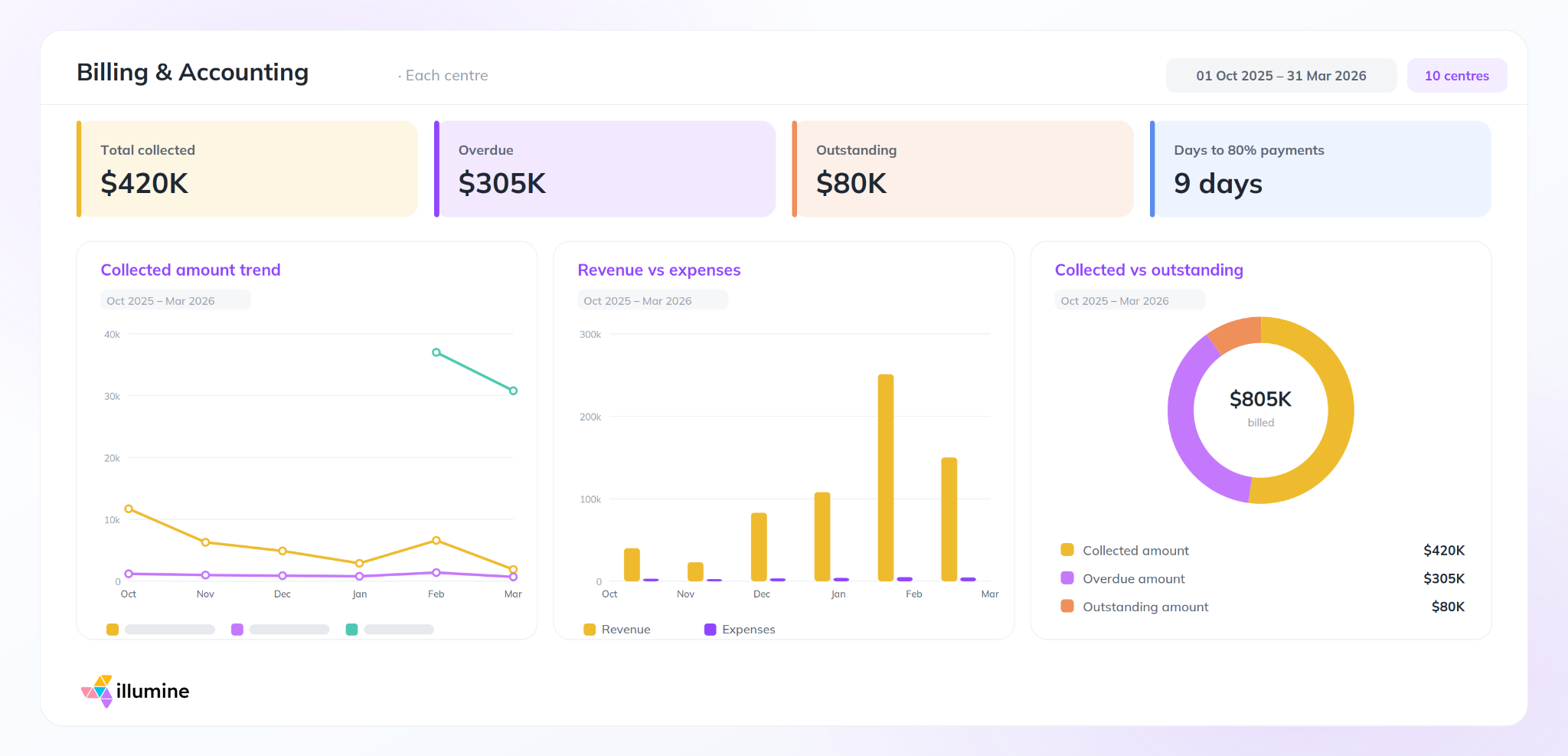
illumine's multi-center dashboard shows billed amounts, collections, outstanding and overdue balances, and revenue trends across the organization and by center. Leaders can use that view to spot collection issues or growing receivables without waiting for each location to prepare a spreadsheet at month-end.
That is the bigger benefit of centralizing billing data.
You are not just processing invoices more efficiently. You can see where expected revenue and collected revenue are starting to diverge and intervene before the gap becomes a month-end problem.
Stress-Free Billing Is Really About Better Use of Time
The goal of billing is not simply to send invoices faster.
The real value of billing technology is not simply faster invoicing. It is having the rules, workflows, and financial data in one place so your team can spend less time maintaining the process and more time acting on what the numbers are telling them.
A good childcare billing system gives leaders cleaner data and removes enough repetitive work for them to actually use that oversight.