





I am not a Certified Public Accountant, tax planner, or attorney. I'm an educator and school leader with decades of experience in child care, private education, and school leadership. Along the way, I have made my share of financial and structural mistakes. Many of the insights shared here were learned slowly, sometimes the hard way. I’ve learnt these lessons through experience, expert advisors, and years of observing what works and what doesn’t.
This blog will help you understand some of the strategic questions you should ask when working with qualified tax and legal professionals. Every business is different, and you should always consult your CPA, tax strategist, and attorney before making structural or tax decisions.
Why Child Care Taxes Matter More Than Most Owners Think
Running a child care center is busy, hands-on work. Most owners spend their energy on enrollment, staffing, licensing, compliance, and curriculum. Taxes often get pushed to the back burner until filing season. But for many centers, that is a costly habit.
- Childcare Taxes Are One of Your Largest Controllable Costs
Some expenses are hard to change quickly. Rent is rent. Staffing ratios are non-negotiable. Licensing requirements do not bend.
Taxes are different.
How much you pay in taxes is heavily influenced by choices you can control, such as:
- Your business structure
- How you pay yourself
- Payroll and contractor decisions
- How disciplined your bookkeeping is
- When you buy equipment or make improvements
2. Year-Round Decisions Create Childcare Taxes
Most owners treat taxes like a once-a-year event. The truth is simpler: April is just when the paperwork is due. The actual tax outcome is built slowly across the year.
Your tax bill is the cumulative result of decisions like:
- whether you tracked expenses consistently
- whether payroll was run correctly
- whether estimated taxes were reviewed and adjusted
- whether you made big purchases without planning for the impact
- whether you took owner draws without a clear strategy
This is why tax planning matters. It is not about complicated loopholes. It is about building a predictable system so you:
- Reduce surprises at tax time
- Protect cash flow throughout the year
- Make clearer decisions about hiring and expansion
- Lower your audit risk by keeping records clean
If you only think about taxes when you file, you are almost always making decisions too late.
Tax Preparation vs. Tax Planning for Child Care Businesses
Most child care owners have a tax person. That is good. But it helps to understand the difference between tax preparation and tax planning, because they solve two very different problems.
What Tax Preparation Does
Tax preparation is mostly about reporting and compliance. It looks backward at what already happened and helps you file correctly.
Tax preparation typically includes:
- preparing and filing federal and state tax returns
- making sure income and expenses are categorized properly
- applying deductions and credits you qualify for
- ensuring required forms are submitted on time
What Tax Planning Does
Tax planning is proactive. It looks forward and helps you make better decisions before the year ends.
Tax planning often includes:
- estimating your annual profit and tax liability during the year
- planning owner compensation strategy (where applicable)
- reviewing payroll structure and contractor decisions
- timing major purchases or upgrades in a smart way
- adjusting estimated tax payments as revenue changes
- stress-testing decisions like hiring, raises, or expansion
What Proactive Planning Can Improve
When tax planning is done regularly with qualified professionals, it can improve everyday stability, not just your tax return.
It can help you:
- Protect cash flow by making estimated payments more accurate
- Avoid surprise tax bills by spotting issues earlier
- Reduce audit risk by tightening recordkeeping and documentation
- Make stronger growth decisions because you understand after-tax outcomes
- Sleep better knowing the numbers are being tracked throughout the year
Choosing the Right Child Care Business Structure
Your business structure affects taxes, admin workload, and how easily you can grow. But there is no one “best” structure for every center. The right choice depends on your profit level, your involvement in daily operations, and your long-term plans.
Common Structures Child Care Businesses Use
Most child care businesses operate as one of these:
- Sole proprietorship
- Partnership
- LLC (Limited Liability Company)
- S-Corporation
- C-Corporation
Each has tradeoffs in liability protection, tax treatment, and paperwork.
Legal Structure vs. Tax Classification
This is where many owners get confused.
An LLC is a legal entity, not a tax status. For taxes, an LLC can be treated as:
- a sole proprietorship (single-member LLC)
- a partnership (multi-member LLC)
- an S-Corp (if you elect it)
- a C-Corp (less common in child care)
So “I’m an LLC” does not automatically tell you how you’re taxed.
How Structure Changes Your Taxes and Operations
Structure influences:
- Payroll vs. self-employment taxes
- How do you pay yourself?
- What counts as a business expense
- How much admin work do you take on
- How easily can you expand or add partners?
A simple rule: the more complex the structure, the more planning and compliance you need. Complexity is not bad; it just needs to match your stage.
Quick Comparison Table: Common Structures (High-level)
S-Corporation Taxes for Child Care Centers
Many profitable child care owners explore electing S-Corporation tax treatment (often through an LLC). It can create payroll tax efficiency, but only when done correctly and only when the business is consistently profitable.
How S-Corp Pay Works: Salary vs. Distributions
Under S-Corp rules:
- If you actively work in the business, you must be paid a reasonable salary.
- That salary is subject to payroll taxes (Social Security + Medicare).
- Additional profit can be taken as distributions, which are generally not subject to payroll taxes (but still subject to income tax).
This is why some owners consider it. In a sole proprietorship, most net profit is subject to self-employment tax. In an S-Corp, only the salary portion is subject to payroll taxes.
When S-Corp Treatment Is Worth Exploring
S-Corp status often becomes worth exploring when:
- The center is consistently profitable
- The owner works actively in operations
- Profit is meaningfully higher than a reasonable salary would be
- You can handle the extra compliance and payroll setup
Where Owners Get Into Trouble
The most common mistake is pushing the salary too low to increase distributions.
That can trigger:
- IRS scrutiny
- salary reclassification
Reasonable Compensation: The Rule You Cannot Ignore
If you elect S-Corp treatment and work in the business, “reasonable compensation” is not optional. It is one of the most common audit trigger points for owner-run businesses.
What the IRS Looks At
Reasonable compensation is typically evaluated based on:
- Duties performed and the responsibility level
- Hours worked
- Comparable wages in your area
- Your qualifications and experience
- What the business can afford
How to Document Your Salary Decision
You do not need a fancy report, but you do need a clear record.
Good documentation might include:
- A written role summary and responsibilities
- Estimated hours per week
- Local wage comparisons (even basic ones)
- A note from your CPA explaining the logic
Audit-Proof Financial Practices
Tax strategy is only as strong as the records supporting it. Even good strategies can fall apart if your books are messy, your accounts are mixed, or your receipts are missing.
Separate Business and Personal Finances
This one change prevents many problems:
- A separate bank account and a credit card for the business
- No personal expenses in the business account
- No “I’ll clean it up later” habits
Mixing expenses makes audits harder and can create liability headaches.
Bookkeeping Hygiene That Protects You
Audit-proof does not mean perfect. It means consistent.
Best practices include:
- Reconciling accounts monthly
- Using a reliable bookkeeping system
- Digitally saving receipts and invoices
- Keeping clear payroll records and contractor documentation
- Reviewing categories regularly so deductions are defensible
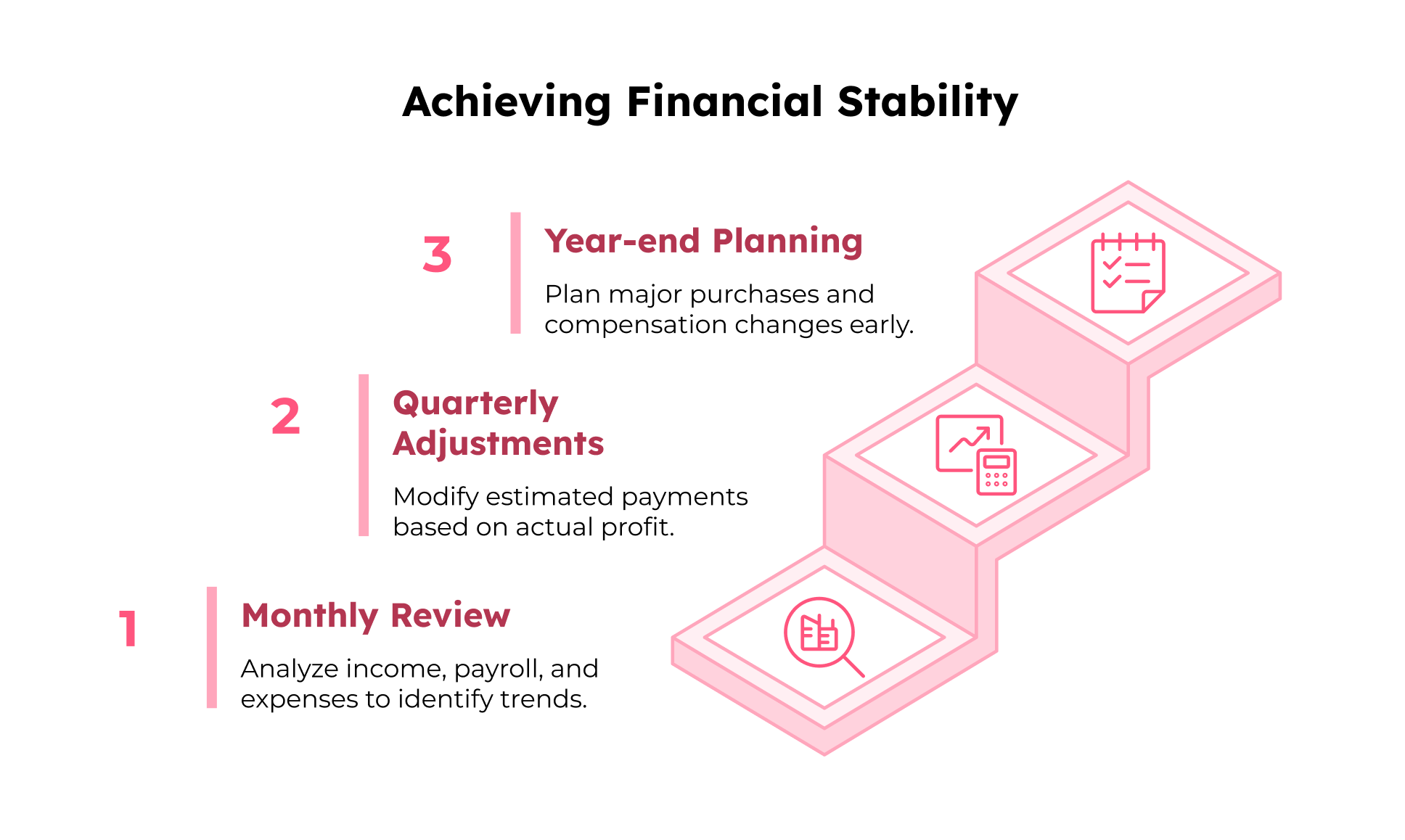
Cash Flow and Estimated Taxes
Even profitable centers can feel stressed if cash flow is unstable. Estimated taxes are one of the biggest reasons owners get caught off guard.
Who Usually Needs Quarterly Estimated Payments
If you are self-employed, take owner draws, or have profit not covered by payroll withholding, quarterly estimated payments may apply. Your CPA should confirm this based on your structure.
Common Problems Owners Face
Without a system, owners often run into:
- underpayment penalties
- surprise bills at filing time
- cash flow gaps during slower months
- emergency borrowing
Expansion and Multi-State Tax Considerations
Growth is exciting, but it adds tax and compliance complexity fast. Before you expand, model the after-tax reality, not just revenue projections.
What Changes When You Operate in Another State
Operating in multiple states may create:
- new state income tax filings
- payroll withholding obligations
- local compliance costs
- additional accounting and reporting needs

Model After-Tax Profit Before You Expand
Before signing a lease or opening a new room, run a simple model:
- projected revenue
- true staffing costs
- rent and operating costs
- expected profit
- estimated taxes and compliance overhead
This helps you avoid growth that looks good on paper but drains cash.
Should Each Location Be a Separate Entity?
Some organizations set up one entity per location.
Possible advantages
- Liability isolation
- Cleaner financial reporting per center
- Easier sale or transfer of one site
Possible disadvantages
- More filings, more payroll setup, more accounting
- Higher admin cost
- More complexity for leadership
Quick Pros/Cons Table: Separate Entity Per Location

Why These Steps Matter More Than They Look
Most owners do not lose money because they are careless. They lose money because they are busy, and the financial side becomes an afterthought.
The checklist is not busywork. It is what turns tax planning into something practical:
- clean books so your deductions are defensible
- predictable cash flow so taxes do not become a shock
- clearer structure so growth does not create hidden risk
Once you build that foundation, taxes become one more system you can manage, not one more thing that manages you.


