




Childcare enrollment is becoming more difficult to sustain.
Birth rates are declining across many regions, which means fewer families are entering the system each year. At the same time, public schooling systems are expanding their early education offerings, increasing competition for the same pool of families. For childcare operators, this creates a very different operating environment than what existed even a few years ago.
Demand is no longer something you can rely on. It has to be actively captured, managed, and converted.
At a small scale, inefficiencies in this process are manageable. A missed follow-up or an untracked enquiry might not feel significant. But as centers grow, and especially as operators expand across locations, these gaps begin to compound.
What looks like a marketing problem is often a systems problem.
Where Childcare Enrollment Starts to Break at the Center Level
At an individual center, enrollment challenges usually appear operational. Leads are coming in, but seats are not filling at the expected rate. Tours are happening, but conversions feel inconsistent. Follow-ups are happening, but not always on time.
These are not isolated issues. They are symptoms of an unstructured process.
.png)
1. Enquiries are not captured centrally
Most centers receive enquiries from multiple sources. Parents may reach out through website forms, phone calls, walk-ins, social media, or messaging platforms. Over time, this creates a fragmented flow of information.
In many cases, enquiry data ends up scattered across:
- Email threads
- Spreadsheets
- Notebooks
- Individual staff memory
This fragmentation makes it difficult to maintain a complete and accurate view of incoming demand. Leads are missed, details are incomplete, and follow-ups become inconsistent.
The issue is not the volume of enquiries. It is the lack of structure in how they are captured.
2. Follow-ups depend on individual execution
Enrollment conversion is highly sensitive to how quickly and consistently parents are engaged after their initial enquiry. A delay of even a day or two can significantly affect outcomes, especially in competitive markets.
However, in most centers, follow-ups are not system-driven. They depend on individual staff members remembering to call, message, or schedule a tour.
This creates variability in the parent experience. Two families with similar intent can have very different journeys based on who handles their enquiry and how quickly they respond.
Over time, this inconsistency directly affects conversion rates.
3. Limited visibility into the enrollment funnel
The enrollment journey is not a single interaction. It typically moves through several stages, from initial enquiry to tour scheduling, to visit, to final enrollment.
Without structured tracking, centers cannot clearly see where parents are dropping off.
For example, a center may see strong enquiry volume but still struggle with occupancy. Without visibility into the funnel, it is difficult to determine whether the issue lies in:
- Converting enquiries into tours
- Converting tours into enrollments
- Delays in communication or decision-making

4. Marketing efforts not connected to outcomes
Most centers invest in multiple marketing channels, including digital campaigns, referrals, and local outreach. These efforts generate enquiries, but the connection between marketing and actual enrollments is often unclear.
Leaders may know how many leads are coming in, but not:
- Which channels produce high-quality leads
- Which leads actually convert
- Where marketing spend is most effective
This lack of attribution makes it difficult to optimize marketing strategies, especially when budgets are limited.
5. Enrollment is reactive not predictable
When enquiry capture, follow-ups, and tracking are not structured, enrollment management becomes reactive by default.
Leads are handled as they come in. Decisions are based on short-term observations rather than consistent data. Forecasting becomes unreliable, making it difficult to plan capacity or anticipate enrollment trends.
The Multicenter Childcare Enrollment Challenges
At a single center, these gaps reduce efficiency. Across multiple centers, they create systemic problems that are much harder to detect and resolve.
1. Processes vary across centers
Each center tends to develop its own way of managing enquiries. Some may rely on spreadsheets, others on messaging apps, and others on informal processes built over time.
This leads to differences in:
- How leads are captured
- How quickly parents are contacted
- How consistently follow-ups are handled

2. Leadership lacks data visibility
For multi-center operators, one of the most significant challenges is understanding how each location is performing.
Without centralized data, it becomes difficult to answer basic but critical questions. Which centers are converting enquiries effectively? Which ones are losing leads? Where are follow-ups breaking down?
Data exists, but it is fragmented across systems and people. Without a unified view, leadership teams are forced to rely on partial information or delayed reports.
3. Channel performance is difficult to evaluate
Different centers often rely on different marketing channels based on local context. However, without structured tracking, it is difficult to evaluate how these channels perform across the network.
Operators may not be able to clearly see:
- Which channels work best in which locations
- Which channels consistently produce enrollments
- Where marketing spend is underperforming
This creates inefficiencies that scale with the organization.
4. Conversion rates vary
It is common for two centers with similar enquiry volumes to produce very different enrollment outcomes. Without detailed tracking, these differences are difficult to explain.
Possible factors may include responsiveness, follow-up discipline, or the quality of the parent experience during tours. But without structured data, these remain assumptions rather than insights.
5. Lead leakage becomes invisible at scale
At a single center, missed follow-ups or lost enquiries are often noticeable. Across multiple centers, these issues become harder to detect.
Small inefficiencies at each location accumulate into meaningful losses at the network level. Missed calls, delayed responses, and untracked leads translate into lower occupancy and slower growth.
At this point, the system is no longer absorbing complexity. It is amplifying it.
What Growing Childcare Enrollment Actually Requires
In a more competitive and constrained demand environment, enrollment needs to be managed as a structured, repeatable process.
This includes centralizing how enquiries are captured, standardizing how follow-ups are handled, and creating clear visibility into each stage of the enrollment journey.
At a practical level, this means building systems that allow operators to:
- Capture every enquiry, regardless of source
- Track movement through the enrollment funnel
- Identify where and why drop-offs occur
- Connect marketing efforts to actual outcomes
- Maintain consistency across centers
.png)
Without these elements, growth remains inconsistent and difficult to scale.
Why illumine is the Best Software for Growing Childcare Enrollment
It is clear that illumine is built around the actual workflow of enrollment teams: capturing enquiries, assigning stages, tracking sources, managing tasks, and automating communication.
1. Centralized enrollment funnel management
One of the biggest challenges in childcare enrollment is that enquiries often live in disconnected places. Teams may receive leads from forms, calls, social channels, or referrals, but without a common workflow, those leads are difficult to track consistently.
illumine brings that process into one place. The platform allows teams to define stages such as New Lead, Admitted, and Lost, turning enrollment into a visible pipeline instead of an informal list of names. That matters because once the funnel is clearly structured, it becomes easier to understand how enquiries are progressing and where they are getting stuck.
This has practical benefits at both the center and operator level:
- Center teams can manage day-to-day enquiries more clearly
- Managers can see where follow-up is slowing down
- Leadership gets a better view of conversion movement across the funnel
Instead of asking whether leads are coming in, teams can start asking the more useful question: What is happening to those leads after they enter the system?
2. Automated follow-ups
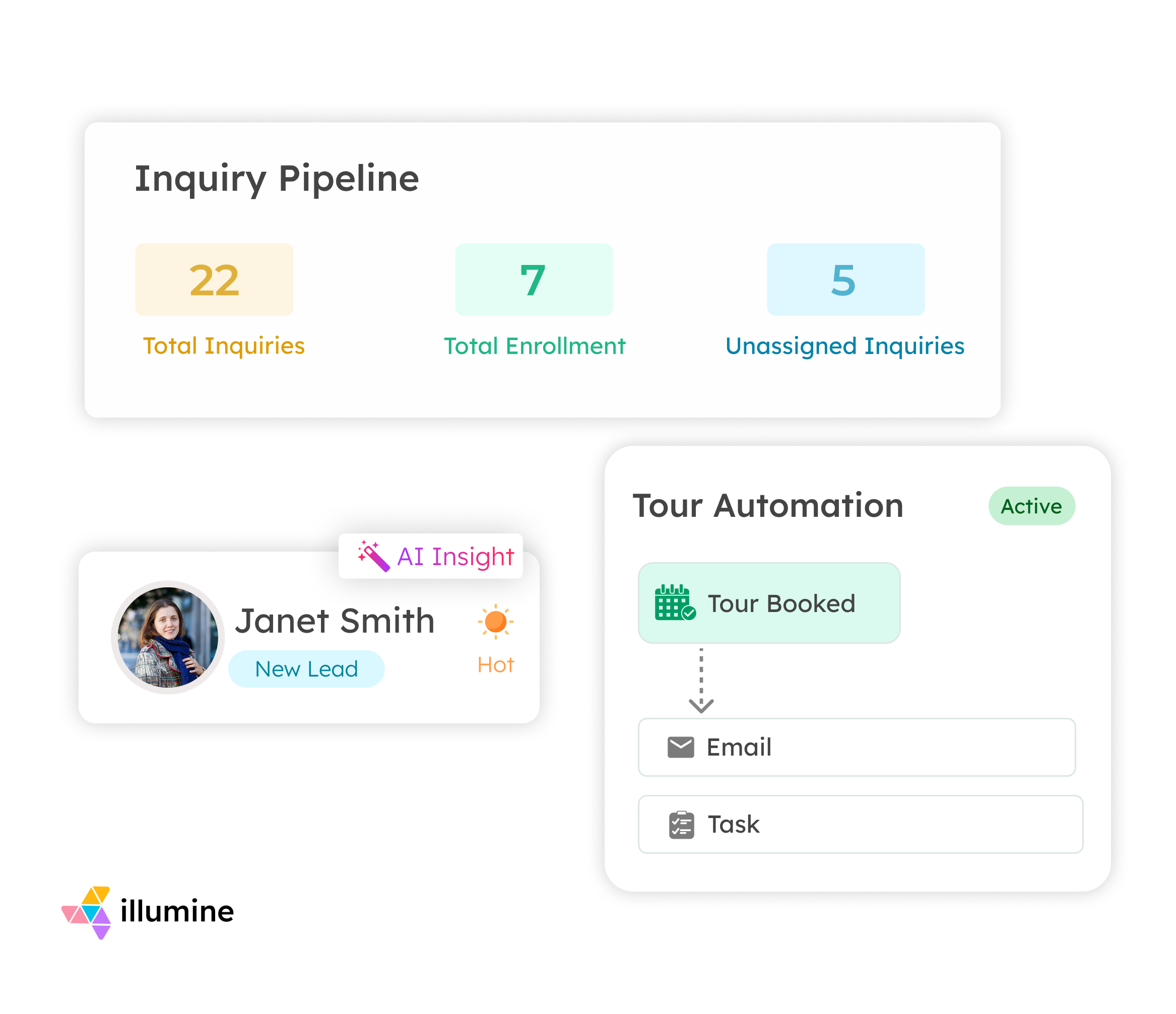
A large part of enrollment performance depends on follow-up consistency. In many organizations, this is still handled informally, which means it depends too heavily on staff memory and individual working styles.
illumine addresses this by making follow-up activity visible inside the workflow itself. From the enquiry dashboard, teams can see metrics such as:
- pending tasks
- overdue tasks
- unassigned enquiries
That changes how enrollment is managed. A missed follow-up is no longer hidden inside someone’s notes or inbox. It becomes something operationally visible.
The automation layer makes this even stronger. Based on the screens shared, illumine can trigger automated sequences when key events happen, such as:
- a new enquiry being captured
- a tour being booked
- a lead status changing
This helps standardize communication across the parent journey. It also reduces the amount of manual coordination required from staff, which is especially valuable when multiple centers are trying to maintain a consistent enrollment experience.
Why illumine is the Best Software for Multi-Centre Childcare Enrollment
1. Visibility for both center teams and leadership
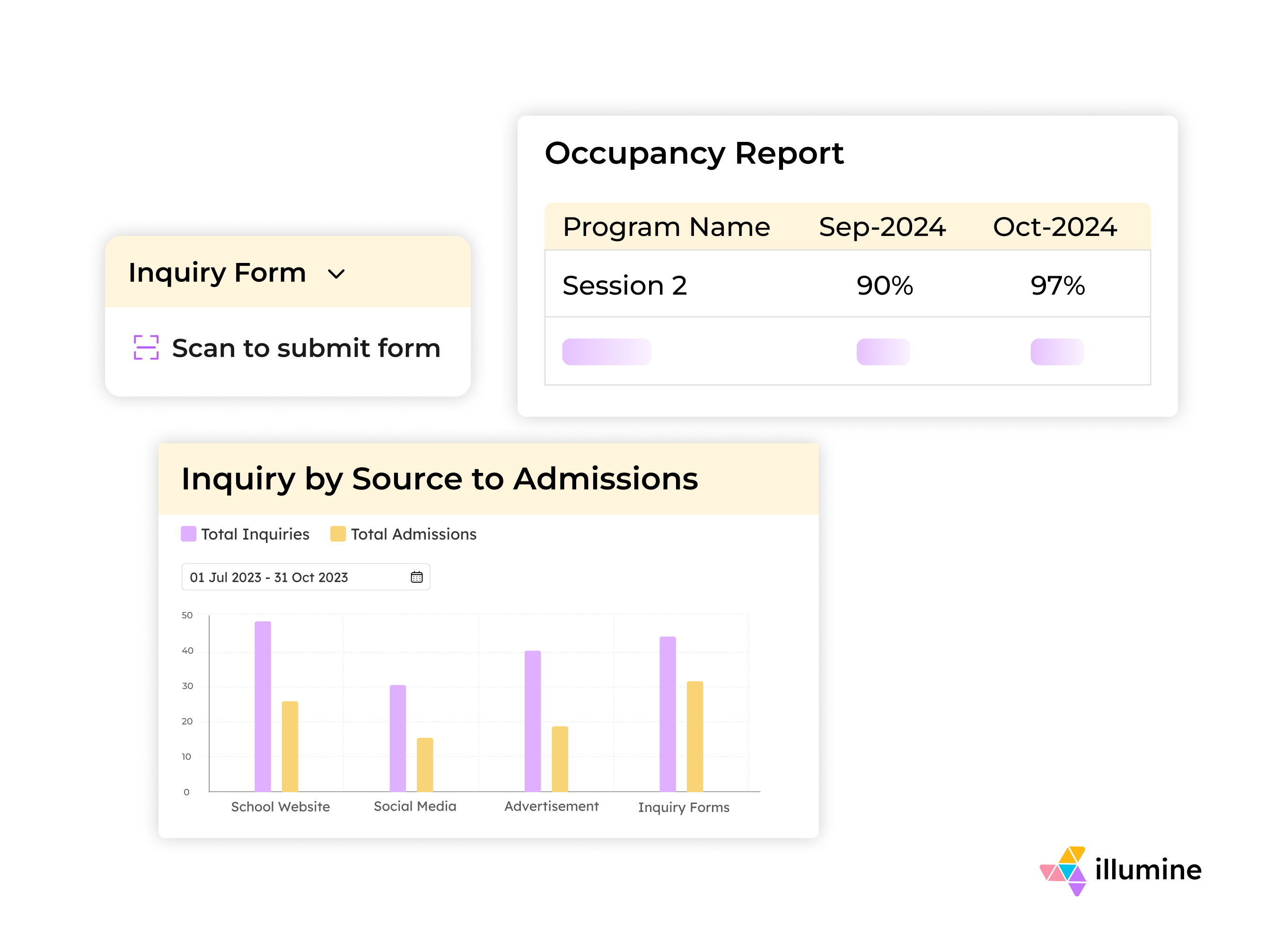
A common weakness in enrollment software is that it either works for frontline teams or for leadership, but not both. illumine appears to balance those needs well.
At the center level, the workflow is practical. Teams can move leads through stages, manage tasks, and monitor active enquiries without relying on disconnected tools. At the leadership level, the dashboard surfaces the metrics that actually matter, including:
- total enquiries
- total enrollments
- newly created enquiries
- unassigned leads
- task status
That means local teams can stay focused on execution, while leadership gets a clearer view of performance trends and breakdowns.
For multi-center organizations, that matters. It creates the kind of shared visibility that makes it easier to compare locations, spot inconsistencies early, and intervene before small gaps turn into occupancy problems.
2. Stronger source of data tracking
Most operators know they need to market actively to keep enrollment healthy. The harder part is understanding which channels are actually contributing to admissions.
illumine appears to solve this by allowing teams to define both sources and subsources. From the screenshot, categories like social media, website, parent referral, and custom forms can all be tracked within the system. That gives operators a much clearer link between marketing activity and enrollment outcomes.
This kind of visibility is useful because it helps answer questions like:
- Which channels are producing the most enquiries?
- Which channels are producing the best conversions?
- Which sources perform differently across centers?
Without this, marketing decisions remain too broad. With it, enrollment teams can make more informed decisions about where to spend, where to optimize, and where to scale.
Why This Matters in a More Competitive Market
The strongest part of illumine’s enrollment module is that it connects the process end to end. Enquiry capture, funnel stages, task tracking, automations, and source visibility are all part of one workflow rather than separate admin tasks handled across different systems.
That reduces several common problems at once:
- lead leakage from poor tracking
- inconsistent follow-ups across centers
- weak source attribution
- limited visibility into conversion performance
In a tighter market, that kind of structure matters. Multi-center enrollment growth is no longer just about generating more interest. It depends on how consistently that interest is captured, managed, and converted across the organization.
That is the operational shift illumine supports. It helps turn enrollment from a fragmented process into a more disciplined growth system.