


For years, private childcare centers in New York mostly competed with the center down the street. That competitive landscape is starting to change as free public childcare moves down the age ladder.
NYC already offers free Pre-K for 4-year-olds and 3-K for 3-year-olds. This fall, the city will add more than 2,000 free 2-K seats for two-year-olds, with plans to grow the program to roughly 12,000 children in 2027. The longer-term goal is to make 2-K available to every family that wants a seat.
Families have responded quickly. More than 5,700 families applied for just over 2,000 seats in the first application cycle, and the city estimates that a free 2-K seat could save a family about $26,000 a year.
For parents, the appeal is obvious. For childcare providers, the implications are more complicated. Free care creates new competition for tuition-paying families, but New York is also relying on community-based centers and licensed family childcare homes to help deliver the program. That means public funding could become a source of enrollment for some private providers rather than simply a competitor to them.
The opportunity comes with a different operating model too. Government-funded care can mean more documentation, longer reimbursement cycles, tighter reporting requirements, and less room for inconsistent processes.
So the bigger question for providers is not simply whether universal childcare will hurt private childcare. It is where their center fits if publicly funded care becomes a much larger part of the childcare market.
What Is Mamdani’s Universal Childcare Plan?
Mayor Zohran Mamdani campaigned on making childcare free for New York City children from six weeks to five years old. The basic idea is to treat early care more like public education, where access does not depend on a family's ability to pay private tuition.
It is important, however, to separate that long-term ambition from what has actually been funded so far. The first major step is 2-K, which extends publicly funded care to two-year-olds.
Governor Kathy Hochul initially committed $73 million to launch the first 2,000 seats. With continued state support, investment in 2-K is expected to increase to $425 million in 2027. That sits within a broader $1.2 billion increase in state support for early care and education in New York City.
The administration is also continuing to expand other parts of the early childhood system, including 3-K and programs for younger children. Universal childcare is therefore not arriving as one citywide program overnight. It is being built age by age and program by program.
What Is 2-K, and How Will It Work?
2-K provides free childcare for children who turn two during the calendar year. The first 2,000 seats are being launched in selected communities in Manhattan, the Bronx, Brooklyn, and Queens, with Staten Island expected to join as the program expands in 2027.
One detail makes the program particularly important for childcare providers: most 2-K seats are not being designed around a normal school day.
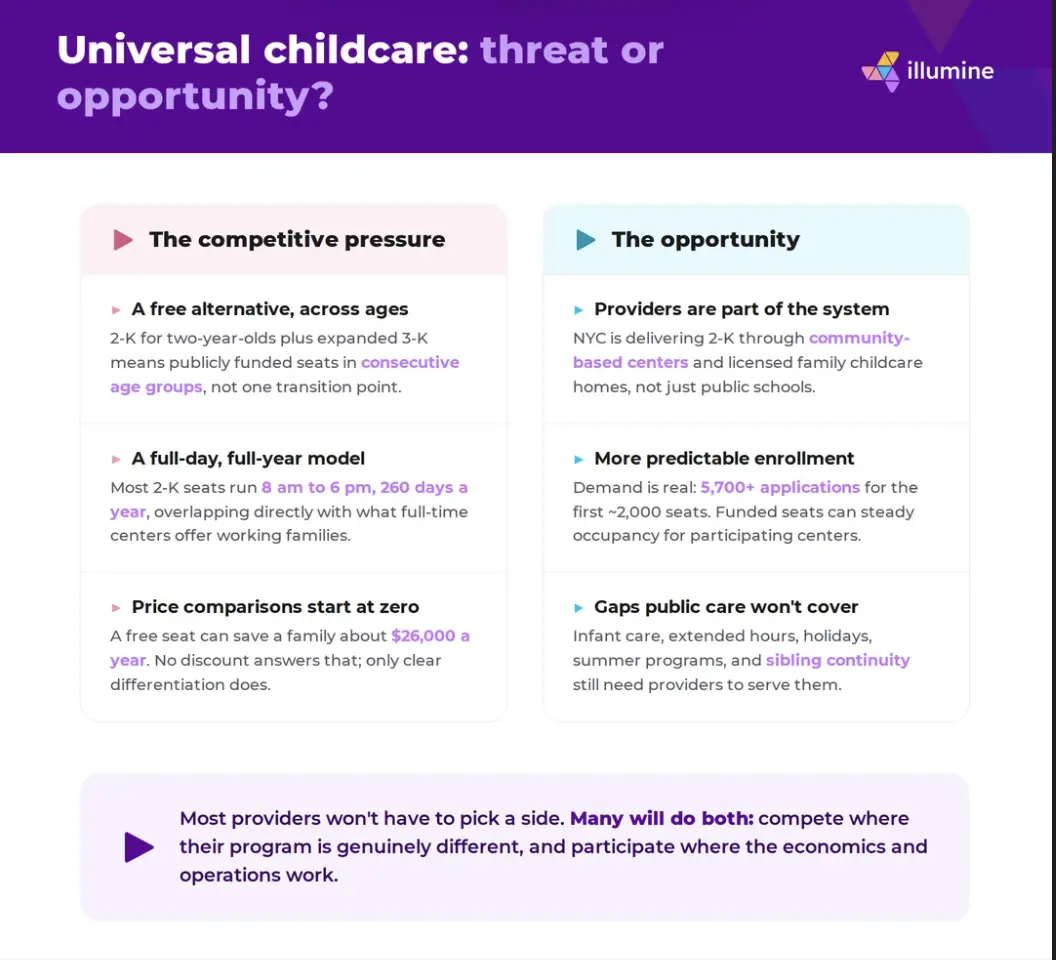
The majority of the initial seats are planned to operate from 8:00 a.m. to 6:00 p.m., 260 days a year. That is much closer to the schedule a full-time childcare center already provides than a traditional 180-day school calendar. Families can access 2-K through center-based programs and licensed family childcare homes, and NYC also offers both school-day and expanded-day, full-year models.
That distinction matters. If public childcare only covered a short school day, private providers could continue serving many working families through wraparound and extended care. An 8-to-6, full-year model competes much more directly with traditional childcare.
Demand already exceeds supply. In August, the city announced that more than 5,700 families had applied for the first roughly 2,000 seats, almost three applications for every available place.
The Current 2-K Timeline
The rollout begins with more than 2,000 children receiving free 2-K in fall 2026. The city plans to expand the program to around 12,000 children across all five boroughs in 2027, then continue growing until every NYC family that wants a 2-K seat can access one.
That is a significant expansion, but 2-K is only one part of what is changing.
The Bigger Shift Goes Beyond 2-K
New York City is also adding capacity elsewhere in its early childhood system.
The administration initially announced more than 1,000 additional 3-K seats in areas where demand was high. By May, the city said those efforts had expanded to roughly 2,000 additional seats across all five boroughs.
This matters because providers serving two- and three-year-olds could feel public competition across consecutive age groups rather than at one transition point.
The city is also continuing programs aimed at younger children, although these remain much smaller than 2-K and 3-K. The broader policy direction is still clear: publicly supported childcare is gradually extending into ages that have traditionally relied much more heavily on private tuition.
Another experiment worth watching is The Little Apple. The city is opening a free, on-site childcare program for municipal employees in the David N. Dinkins Municipal Building. It is expected to serve about 40 children from six weeks to three years old and operate from 8 a.m. to 6 p.m. throughout the year. The facility is being created through a $10 million renovation.
Forty seats will not reshape the NYC childcare market, but the model is still worth watching. It tests whether full-day childcare can work as an employee benefit and workforce-retention tool, which could influence how other employers think about childcare support.
What Does Universal Childcare Mean for Private Childcare Providers?
The easiest conclusion is that free public childcare is bad news for private centers. That is too simple.
The policy creates both competitive pressure and potential opportunity.
Free Care Changes the Value Comparison for Families
Consider the decision from a parent's perspective. If two programs meet their basic needs and one costs more than $20,000 a year while the other is free, price becomes very difficult to overcome.
A center cannot solve that with a 5% discount. This makes differentiation much more important.
“Safe, nurturing care” is not enough because every credible provider should be safe and nurturing. Centers need to understand what families are actually paying them for. It might be a teaching philosophy, smaller groups, bilingual education, a strong nature program, flexible schedules, particular enrichment, better continuity of care, or a community families strongly identify with.
But Private Providers Are Also Part of the Public System
This is where the story becomes more interesting.
NYC is not trying to build every new classroom inside a public school. 2-K includes center-based programs and licensed family childcare homes, and the city has actively sought participation from childcare providers as it builds the new system.
That means some private providers may have the opportunity to convert part of their capacity into publicly funded seats.
For a center struggling with irregular enrollment, that could create a more predictable source of demand. But predictability on the enrollment side does not automatically mean simplicity on the operational side.
Public Funding Can Make Enrollment More Predictable and Administration Less Forgiving
A privately paying family creates a relatively direct financial relationship. The center provides care, the family receives an invoice, and the family pays the center.
Government-funded childcare adds another party to that relationship. The provider may need to prove attendance, maintain specific records, meet contract requirements, submit documentation, track reimbursements, and reconcile money that arrives on a very different timeline from a normal parent billing cycle.
That is not an argument against participating. It is an argument for understanding the operational cost before doing so.
New York's existing childcare system already shows some of these tensions. Research from the Center for New York City Affairs has warned that expansions in publicly funded care need enough funding not only for seats, but also for the workforce and provider infrastructure required to deliver them.
Providers considering publicly funded seats therefore need to understand both what they will be paid and what it will take to reliably earn, document, and collect that payment.
A center with clear attendance records, centralized family data, consistent billing processes, and good financial reporting will be in a very different position from one that still reconciles government payments across several spreadsheets. This becomes even more important if a provider operates several locations, where a small inconsistency at one center can become a much larger reconciliation problem when repeated across ten.
Providers May Need to Rethink Their Programs, Not Just Their Tuition
When a lower-priced competitor enters a market, businesses often respond by cutting prices. That strategy has obvious limits when the competitor is free.
Instead, providers should look at the structure of demand.
Suppose publicly funded 2-K expands rapidly in your neighborhood. It may reduce demand for a conventional full-time two-year-old program, but that does not mean every childcare need disappears.
Families may still need infant care, extended hours, flexible days, holiday coverage, summer programs, specialized teaching approaches, care close to a workplace, or continuity for siblings across several ages.
This is why centers should not respond to policy changes with a blanket price cut. They should look for where family needs and public provision do not perfectly overlap, then ask whether their center is particularly well positioned to serve that gap.
This is also where differentiation becomes more than a marketing exercise. A center should not invent a new brand message because 2-K exists. It should identify what its team can genuinely deliver well, develop that part of the program, and then communicate the difference.
What Should Multi-Center Providers Watch?
For groups operating several childcare centers, the impact is unlikely to be uniform.
2-K is being introduced geographically rather than everywhere at once. Demand, available seats, public-provider participation, and competitive pressure can therefore vary by neighborhood.
One location might lose inquiries for two-year-old care. Another might be well placed to become a contracted provider. A third may barely feel the policy in the short term.
That makes center-level data important.
Instead of asking whether “2-K is hurting enrollment,” compare inquiry volume by age group, conversion rates by center, occupancy by program, withdrawals and stated reasons, waitlists, and tuition sensitivity. Then compare those changes with the publicly funded capacity being added around each location.
The point is not to create another report. It is to avoid making a network-wide decision based on what is happening at one center.
Can New York Afford Universal Childcare?
This remains one of the largest open questions.
The first phase has real funding behind it. The state committed $73 million for the initial 2-K seats, and 2027 investment is expected to rise to $425 million. Governor Hochul's broader commitment adds $1.2 billion for early childcare and education in New York City.
The state has also committed funding across the first two years of the city's 2-K expansion. Beyond that, the long-term financing model remains less settled. At the August 2-K announcement, Mamdani confirmed that the existing two-year commitment covers the expansion from roughly 2,000 to 12,000 seats, while later years will require further decisions about how the system is funded.
Full universality is also much more expensive than the pilot. A July 2026 model from the nonpartisan Center for New York City Affairs estimated that a fully implemented universal childcare system in New York would require substantial new spending and emphasized that policymakers still need to determine the revenue required for a year-by-year expansion.
Estimates based on that model put a fully universal NYC system for young children at roughly $8.7 billion to $9.3 billion a year, depending on assumptions about participation, staffing, wages, and delivery.
That does not mean universal childcare will fail, nor does the initial rollout prove that every part of the larger vision will be funded exactly as proposed. For providers, the sensible position lies between those conclusions.
The direction of policy is already affecting the market. The final shape of that market is still being decided.
What Should NYC Childcare Providers Do Now?
Providers do not need to redesign their entire business around a program that has only just begun. But waiting until thousands of additional seats arrive in the neighborhood is not much of a strategy either.
Understand Where Your Enrollment Is Exposed
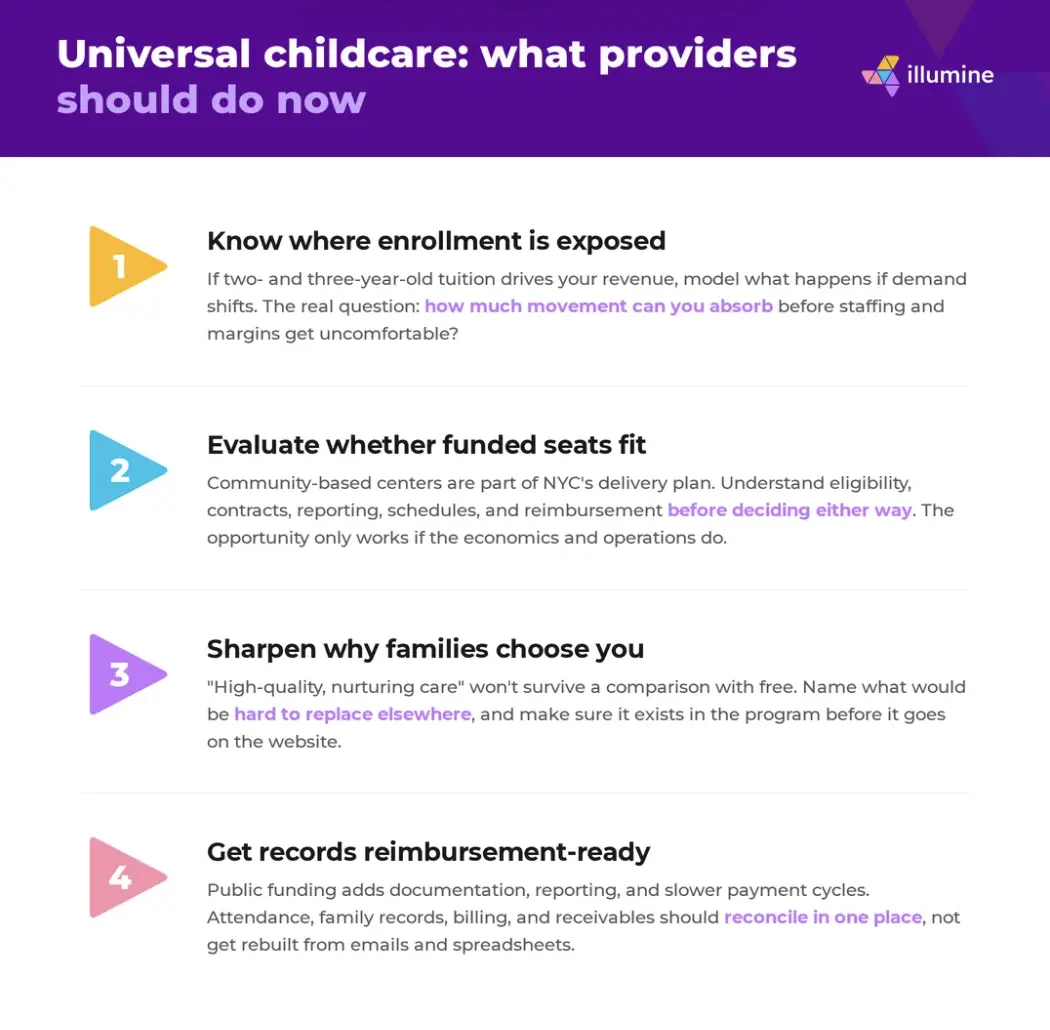
Look at the age groups driving your revenue. If two- and three-year-old tuition represents a large share of enrollment, model what happens if demand changes.
Do not assume every family will leave for free care. The more useful question is how much movement your center could absorb before staffing, classroom utilization, or margins become uncomfortable.
Find Out Whether Publicly Funded Seats Fit Your Model
Public funding does not have to sit on the other side of the competitive line. Community-based providers are part of NYC's delivery strategy.
Understand the eligibility, contract, staffing, reporting, schedule, and reimbursement requirements before deciding whether participation makes sense for your center. The opportunity is only attractive if the economics and operational requirements work together.
Revisit Why Families Choose You
If your positioning can be reduced to “high-quality childcare in a nurturing environment,” this is a good time to go deeper.
Ask what families can get from your program that would be difficult to replace elsewhere. Then make sure that difference exists in the actual program before putting it on the website.
Get Your Records Ready for More Complex Funding
If public funding becomes part of your revenue mix, clean operations matter.
Attendance, family records, billing, subsidy receivables, documentation, and reporting should reconcile without staff rebuilding the story from emails and spreadsheets.
This does not mean buying technology for the sake of digitizing everything. It means being able to quickly answer basic questions: who received care, what should you receive for that care, what has actually been paid, and what is still outstanding.
When those answers live in several systems, public funding can add even more administrative work to an already complex operation.
Universal Childcare Will Change the Market, but Providers Still Have Choices
New York's 2-K rollout is bigger than a new government preschool program. It changes who pays for childcare, what families will compare when choosing a provider, and how some private childcare centers may eventually generate revenue.
Some providers will compete with publicly funded programs. Some may become part of the publicly funded system. Many will probably do both.
There are still significant questions about funding, workforce capacity, reimbursement, and how quickly universal access can realistically expand. Providers do not need every policy question answered before preparing for the direction of travel.
They can understand where enrollment is vulnerable, strengthen the parts of their program families genuinely value, explore funded-care opportunities carefully, and build systems capable of handling a more complicated mix of private and public revenue.
For childcare operators, the question is no longer simply whether universal childcare will change the New York market. It is where they want to sit within that market as it changes.