.png)
.webp)


Some conversations with parents stay with you long after they end. The moment a parent sits across from you, anxious about their child's development, waiting to hear something difficult, that moment is one of the most important things an early years educator does.
Nursery parental communication is talked about constantly in the context of daily updates, newsletters, and learning reports. What gets far less attention is the harder end of it: the conversations where a concern needs to be raised, a recommendation needs to be made, or a parent's distress needs to be met with both empathy and honesty.
These conversations are not optional. They are part of the work. And when they are handled with genuine care, professional clarity, and the right preparation, they do not damage the relationship between the nursery and the family. They deepen it.
Why Difficult Conversations Are a Core Part of Nursery Parental Communication
There is a version of parent communication that is easy: the end-of-day update, the photo in the app, the newsletter about the upcoming trip. That version matters too. But the quality of a nursery's relationship with its families is really tested in the harder moments.
These are the conversations that parents remember:
- When a child's development gives cause for concern,
- When behaviour is escalating
- When a referral to a specialist is recommended
How they are handled shapes whether a family trusts the setting, whether they stay, and whether they become advocates for the nursery or quietly lose confidence in it.
A well-managed conversation reassures a parent that their child is in the hands of people who truly know and care about them. A conversation managed poorly does not just affect the individual family. It affects the culture of trust that the entire nursery depends on.
Difficult conversations are not a failure of the relationship between the educator and family. They are evidence of it. The willingness to raise something hard, rather than avoid it, is one of the clearest signals a nursery can send that a child's well-being comes first.
How to Prepare for a Difficult Parent Conversation in Early Years Settings
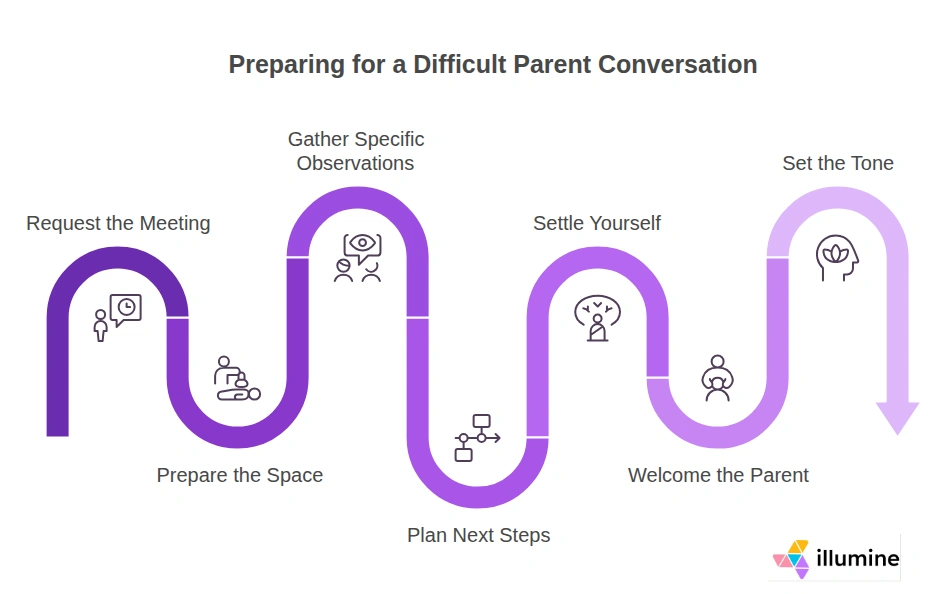
Difficult conversations rarely begin when the parent walks through the door. They begin long before - in the way the meeting is requested, the way the space is prepared, and the way the educator arrives at that conversation.
Preparation is about being clear on what needs to be communicated, what the specific observations are, and what the next steps look like. Vague concerns shared without examples undermine confidence. Specific, observed behaviours shared with context build it.
The physical setting also matters more than most educators realise. A private space, away from the classroom and the main entrance, signals that this conversation is being taken seriously. An offer of water, a moment for the parent to settle before anything is said - these are not small gestures. They regulate the emotional temperature of the room before a word has been spoken.
A calm, grounded presence sets the tone. If the educator arrives in a rush or visibly anxious, the parent reads that immediately. Settling yourself before the conversation is as important as settling the parent during it.
What Does Active Listening Look Like in Parent-Teacher Communication?
The most common mistake in difficult conversations is starting with what you need to say, rather than with what the parent needs to express. Parents arrive carrying their own fears, assumptions, and prior experiences. If those feelings are not given space first, they will surface mid-conversation and derail everything.
Listening before speaking is not passive. It is strategic. When a parent feels heard, they become open. When they feel unheard, they become defensive. The entire arc of the conversation depends on which state they are in when you begin sharing your observations.
Reflecting what has been said is one of the most powerful tools available. It shows the parent that you have understood them. It does not require agreement. A response like 'I hear that this has been really worrying for you' acknowledges their experience without conceding your professional position.
Validation is not the same as agreement. A phrase like 'I am sorry you feel that way' acknowledges a parent's feelings while leaving space to offer a different perspective. The parents' emotions are real and deserve recognition, even when the concern behind it needs to be reframed.
How to Share Developmental Concerns With Parents Without Creating Panic
Specificity is protective. A general statement like 'we have some concerns about Amir's development' creates a vacuum that anxiety fills immediately. A specific observation like 'we have noticed that Amir finds it difficult to sustain attention during group activities, and this is something we have seen consistently over the past few weeks' gives the parent something concrete to work with.
Avoiding labels does not mean avoiding honesty. The goal is to describe what behaviours and patterns have been observed rather than to name a diagnosis or category. Parents are not equipped to process clinical language in an emotional moment. Plain, specific description is more useful and more kind.
Professional authority matters here. Parents draw confidence from knowing that a concern is being raised by someone who has spent years observing young children, recognising developmental milestones, and understanding when something warrants further attention. You do not need to overstate your credentials - your calmness, specificity, and experience speak for themselves.
This is also the moment to be honest about what is not yet known. Acknowledging uncertainty is not a weakness. It is integrity. And parents respond to it with far more trust than they would to false certainty.
Balancing Empathy and Assertiveness in Nursery Parent Meetings
Empathy and assertiveness are not opposites. They are partners. Empathy without assertiveness produces conversations where important concerns get softened into ambiguity. Assertiveness without empathy produces conversations where parents feel judged rather than supported. The goal is to hold both simultaneously.
Holding professional boundaries kindly but firmly means not allowing a parent's distress to prevent a concern from being communicated clearly. It means staying with the topic even when a parent deflects, becomes upset, or disputes your observation. The child's best interests are the anchor. When the conversation feels difficult to continue, returning mentally to that anchor clarifies what needs to be said.
Taking notes throughout the conversation is professional. It signals that the conversation is being taken seriously. It also protects both the educator and the family by creating an accurate record of what was said, what was agreed, and what the next steps are.
If a parent becomes particularly distressed or the conversation escalates, it is entirely appropriate to pause. Offering to take a short break or suggesting that a follow-up meeting be arranged to continue is skilled management of a conversation.
How to Close a Difficult Parent Conversation and Agree on Next Steps
The way a difficult conversation ends is as important as how it begins. A conversation that trails off without clear conclusions leaves both parties more anxious than when they arrived. A conversation that closes with clarity leaves parents feeling held rather than abandoned.
Summarising the key points before closing does several things at once. It confirms shared understanding, it identifies where there may still be misalignment, and it gives the parent the chance to ask anything that has not yet been addressed.
Outlining next steps concretely is essential. Who will do what, by when, and how will the nursery communicate progress? A clear plan transforms a difficult moment into a collaborative pathway. When parents leave, knowing that something specific is happening and that they will be kept informed. This means the anxiety that came in with them has somewhere to go.
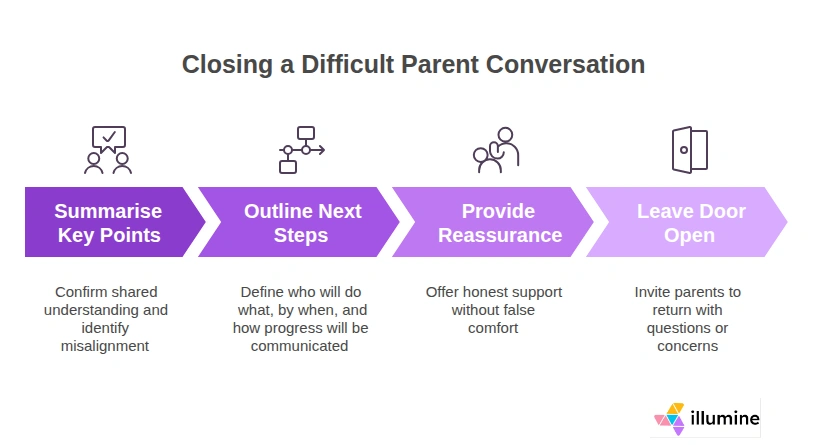
Reassurance is not the same as false comfort. Reassuring a parent that they will be supported throughout the process is honest and appropriate. Reassuring them that everything will be fine when it may not be is not. The difference matters, and parents can always tell.
Leave the door open explicitly. Let the parent know they are welcome to come back with questions, concerns, or simply to check in. That open invitation is the final signal that this conversation was not a transaction but the beginning of a deeper partnership.
Difficult Conversations Build the Foundation of Trust in Early Years
These conversations will never be easy. That is not the goal. The goal is for them to be meaningful. For every difficult conversation to leave the family feeling more confident in the nursery, more seen as partners in their child's care, and more assured that their child is with people who will always put their well-being first.
When approached with genuine empathy, professional clarity, and the quiet authority that comes from experience, difficult conversations become some of the most important work an early years educator does. They are not a departure from the warmth of the setting. They are an expression of it.
The families who trust a nursery most deeply are almost always the ones who have been through a hard conversation - and came out the other side feeling genuinely held.