.png)
.webp)


Emergency preparedness in a nursery means training your team to respond calmly and correctly when something goes wrong, whether that is a fire, a medical incident, a lockdown, or a building hazard. It is built through clear roles, short repeated drills, and honest debriefs, not a single annual lecture. The goal is a team that acts from memory under pressure, so children stay safe, and parents stay confident.
In early years settings, safety is a daily habit. As nursery providers, we are responsible for making sure every staff member knows what to do in an emergency. This is not about fear. It is about clarity. When the team knows its job, children feel secure, and families trust the setting.
This guide gives UAE nursery directors and managers six steps to train staff for emergencies, from assigning roles to reviewing each drill.
Why Traditional Emergency Training in Nurseries Fails
Most compliance lectures do not work. Staff sit through a long session once a year, then forget the details within days. This matches the forgetting curve, a well-documented pattern where unused information drops out of memory quickly after a single exposure.
Training works better when it is active. Scenario-based practice asks staff to make decisions, move through the building, and handle small complications. This builds two things at once: the thinking needed to assess a situation and the muscle memory needed to act without hesitation.
Short and frequent beats long and rare. A ten-minute drill every few weeks holds better than a two-hour session once a year.
6 Steps to Train Your Nursery Team for Emergencies
These six steps turn emergency preparedness into a routine your team can run on instinct. Work through them in order. Each step builds on the last, from setting roles to rehearsing real scenarios and reviewing what happened.
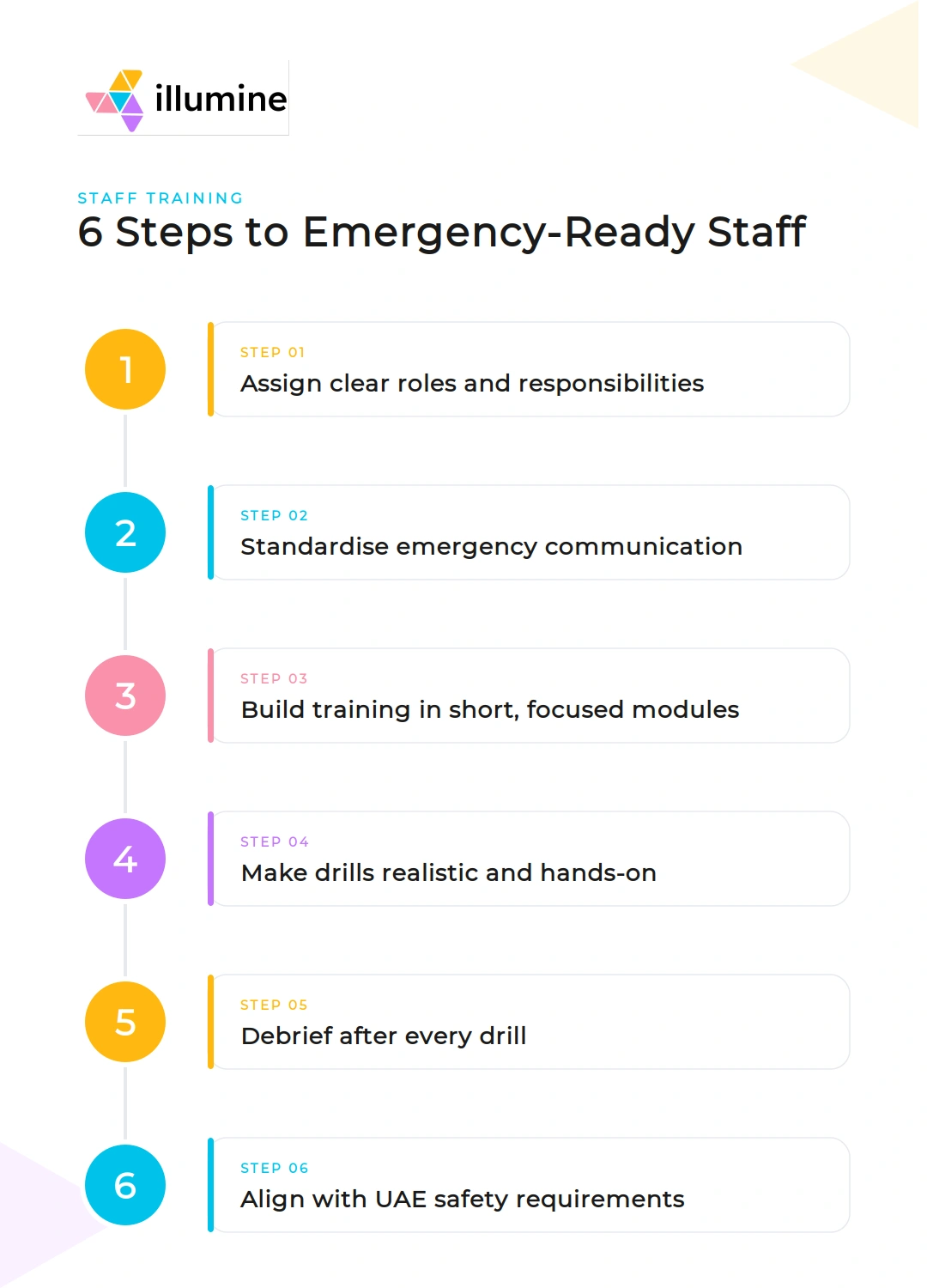
Step 1: Assign clear roles and responsibilities
Effective training begins with role clarity. Every team member should know exactly what they own during an emergency before any drill begins. When roles are assigned in advance, the team moves as one unit instead of waiting for instructions.
Assign these core roles for each room and shift:
- Lead. Calls the emergency, directs the response, and makes decisions.
- Sweep. Checks every space, including toilets, sleep rooms, and quiet corners.
- Grab bag carrier. Takes the emergency bag and registers at the assembly point.
- Communicator. Call emergency services and contact parents.
- Child support. Keeps children grouped, counted, and calm.
Rotate these roles during training so that cover exists when someone is absent. A plan that depends on one person fails the day that person is off.
Step 2: Standardise emergency communication
Staff need a simple script for emergency calls so panic does not scramble the message. A short structure helps a stressed caller give responders the right information in the right order.
Many settings use a method like L.I.N.E. to structure emergency calls. The idea is to state, in order:
- Location. The exact address and the part of the building affected.
- Incident. What has happened, in one clear sentence.
- Numbers. How many children and adults are involved or at risk?
- Emergency need. What help do you need, and any access notes?
Adapt the wording to your setting, then practise it until staff can run through it without a prompt. The same clarity applies to parents. Agree in advance who contacts families, what they say first, and which channel they use.
Step 3: Build training in short, focused modules
Step 4: Make drills realistic and hands-on
The strongest learning comes from practice that mirrors a real emergency. Move the imagined hazard around the building so staff rehearse different exits, not just the one nearest the main door.
Try these drill formats:
- Blocked exit. The usual route is closed, so the team must choose another.
- Smoke in a corridor. Staff keep low, guide children, and avoid the affected area.
- Baby room at sleep time. The team evacuates infants who are asleep, the hardest scenario in any nursery.
- What's Missing. Remove an item from a first aid kit or grab bag and ask staff to spot it. This sharpens attention to detail.
- Floor plan mapping. Staff mark safe zones, exits, and equipment on a plan to build spatial awareness.
Add small complications to role play, such as a missing register or a child who will not move. These details build the judgment that a clean, predictable drill never tests.
Step 5: Debrief after every drill
A short debrief after each drill turns practice into improvement. Spend five minutes as a team and answer four questions.
- What went well?
- What felt confusing?
- What slowed us down?
- What do we change next time?
Write the answers down. These notes show patterns over time and flag staff who need more practice. The debrief is also where a good safety culture forms, because the team learns that speaking up about a gap is welcomed, not punished.
Step 6: Align with UAE safety requirements
Nursery emergency planning in the UAE sits inside a regulated framework. Your emirate's licensing authority sets health and safety standards for early years settings, and UAE Civil Defence guidance shapes fire and evacuation expectations.
Practical steps to stay aligned:
- Keep evacuation routes, fire equipment, and signage compliant and checked.
- Run and log fire drills on a regular schedule.
- Record incidents and keep the documentation that an inspector may ask to see.
- Confirm your specific obligations with your local regulator, since requirements differ by emirate.
Make Readiness an Ongoing Habit
Emergency preparedness is not a one-off session. It is a routine you keep. Work through the six steps, make the practice interactive and role-specific, and your team will respond with clarity when it matters.
The outcome is simple. Children, families, and staff know the setting is ready for whatever comes.CTA BLOCK: See how nurseries run safer, calmer operations with illumine.