



The past few weeks have sent ripples of anxiety through the early childhood education community. Trump Administration proposed federal funding freezes for the Child Care and Development Fund (CCDF) and Head Start programs—initially affecting Minnesota and then expanding to California, Colorado, Illinois, and New York—have reminded us all of a sobering reality: federal government policy can shift quickly, and centers that rely on heavily on government funding without strong operational foundations are vulnerable.
While litigation may resolve the current situation, and while these federal government freezes may not directly impact your center, the broader lesson remains clear. We live in an era of policy volatility. The programs that will not just survive but thrive are those that have built robust systems—systems that ensure compliance, demonstrate value, and maintain financial sustainability regardless of which way the political winds blow.
Let me be clear from the outset: federal government support for early childhood education is both vital and deserved. Our sector needs and merits public investment. But we also need to be realistic. In today's environment, the strongest preschool programs are those that can deliver excellence, regardless of whether government funding flows predictably. This isn't about abandoning advocacy for stable public support—it's about ensuring your program stands on solid ground while that advocacy continues.
The Wake-Up Call: What Recent Events Tell Us
Recent legal challenges—some already reviewed by a federal judge—have raised broader questions about efforts to eliminate Head Start or restrict Head Start services under shifting federal priorities. Because Head Start serves as a foundational early learning pathway across the country, even temporary disruption sends shockwaves across the entire early child care ecosystem.
The recent federal scrutiny has centered on three key areas: attendance verification, eligibility documentation, and fraud prevention. Even if your center isn't one of the grant recipients, these concerns create ripple effects:
- State licensing agencies may adopt stricter documentation requirements
- Parents receiving subsidies will need better verification from providers
- The entire sector faces heightened expectations for operational transparency
- Your reputation increasingly depends on demonstrating operational excellence, not just warm relationships
The question isn't whether increased scrutiny is coming—it's whether you'll be ready when it arrives.
Part 1: Administrative Systems That Protect Your Program
Most preschool directors entered this field because they love working with young children and supporting children and families. Very few of us dreamed of becoming experts in compliance documentation. Yet here's the uncomfortable truth: in 2026, your program's survival may depend as much on your administrative systems as on your educational philosophy.
Recent events have shown us that the government's ability to freeze funding—or demand extensive documentation before releasing it—can happen with little warning. Centers scrambled to produce attendance records, eligibility verification, and financial documentation under tight deadlines. Some couldn't do it quickly enough.
You don't want to be in that position.
1. Attendance Tracking Systems That Actually Work
Paper sign-in sheets are no longer adequate. They're hard to audit, easy to lose, and nearly impossible to aggregate for reporting. Here's what modern attendance tracking should look like:
- Digital systems with timestamps: check children in and out electronically, creating an automatic record
- Daily attendance records that are easily retrievable: You should be able to pull any child's attendance history for any date range in under five minutes
- Create backups: Maintain both digital records and paper trails, stored in multiple locations
- Regular internal audits: Review your attendance records monthly, looking for patterns, gaps, or anomalies
If someone from your state licensing agency walked in tomorrow and asked to see attendance records for the past 90 days for a specific child, could you produce them in 10 minutes? If not, your system needs work.
2. Student Records Management
Every child's file should be complete, up to date, and easily accessible. Create a centralized digital filing system with:
- Clear naming conventions: "LastName_FirstName_DOB" prevents confusion when you have multiple children with the same first name
- A required documents checklist: Immunization records, emergency contacts, enrollment agreements, permission forms, subsidy documentation (if applicable), assessment records
- Automated expiration tracking: Set calendar reminders 30 days before documents expire (immunization records, subsidy eligibility, enrollment agreements)
- Quarterly compliance audits: Schedule time every three months to review every child's file and ensure nothing is missing or outdated
3. Staff Documentation
Your teachers are your program's most valuable asset—and the area most scrutinized during inspections. Maintain comprehensive digital files for each employee:
- Background checks and clearances with expiration dates tracked
- Certifications and credentials (CPR, First Aid, CDA, teaching licenses)
- Training hours and professional development records
- Clear protocols for when credentials lapse (Who follows up? What's the timeline? What happens if someone works with expired credentials?)
Create a simple spreadsheet that shows every staff member's credential expiration dates at a glance. Review it monthly. Set reminders 60 days before any expiration.
4. Financial Documentation
This is where many programs get tripped up. Clear separation of National Head Start Association funds, child care subsidies, and private tuition, especially for centers that receive funding through federal or state health and human services programs. Your financial records need to be transparent, detailed, and easily auditable:
- Every payment tracked with purpose and category: Not just "supplies" but "classroom materials - Toddler Room - January 2026."
- Separate accounting for government funds vs. private pay: If you receive any public funding, keep it in completely separate ledgers
- Monthly reconciliation between attendance and billing: Your attendance records should match your invoicing perfectly
- Clear audit trail: Anyone—including an external auditor—should be able to reconstruct your finances from your records
The standard should be this: if an auditor showed up unannounced, you could pull clean, organized financial records within an hour.
5. The Technology Solution
Technology is not a silver bullet for funding instability. It won’t protect your program from political shifts or replace the need for strong leadership. But when used intentionally, technology becomes an extension of operational discipline. It reduces human error, standardizes critical processes, and ensures that your institutional knowledge does not disappear when a staff member leaves.
In an environment where funding can be delayed, frozen, or audited with little warning, the real value of technology is preparedness. Digital systems make your operations legible to outsiders. They allow you to demonstrate compliance quickly, consistently, and calmly rather than scrambling to assemble documentation under pressure.
Well-designed childcare management platforms are built around this exact reality:
- They make attendance defensible
Digital check-in and check-out systems with timestamps create a clear, auditable trail of service delivery. When attendance records are directly tied to billing and funding eligibility, discrepancies surface early. This matters because attendance inconsistencies are often the first trigger for deeper scrutiny.
- Create continuity beyond individuals
Paper files and informal systems rely heavily on memory. When a director, administrator, or office manager leaves, critical compliance knowledge often leaves with them. Centralized digital records ensure that documentation standards stay consistent regardless of staff turnover.
- They prevent silent compliance risks
Expired credentials, missing forms, and outdated subsidy documents rarely cause problems until the moment they suddenly do. Automated alerts surface these risks early, giving directors time to resolve issues before they become violations.
- They align finances with reality
Integrated billing systems that sync directly with attendance records create a verifiable link between services delivered and money received. This alignment is exactly what auditors and licensing agencies expect to see. When attendance, invoices, and payments match cleanly, audits move faster and with far less friction.
Platforms like illumine are designed around these principles. They bring attendance tracking, digital records, staff credential management, compliance alerts, and billing into a single system so that directors aren’t stitching together spreadsheets, folders, and reminders across multiple tools.
The true cost of weak systems is the leadership time lost to manual reconciliation, the stress of last-minute audit preparation, and the reputational damage that comes from appearing disorganized under scrutiny. Strong systems free directors to focus on staff support, family relationships, and long-term planning rather than constant administrative firefighting.
We’ve seen this play out in real programs. Centers using illumine to connect attendance, billing, and documentation have reported significantly fewer billing adjustments during audits because discrepancies are caught early, not months later.
The Monthly Discipline
Here's a practical framework: treat each month as if you're preparing for an audit. Set aside two hours on the first Friday of each month to:
- Review all attendance records from the previous month
- Check for any missing or expiring documents in child files
- Verify that all staff credentials are current
- Reconcile billing with attendance
- Update your financial records
If you can pull clean, organized records for any aspect of your operation in under 30 minutes, you're in good shape. If it takes hours of scrambling and searching, your systems need work.
Part 2: Financial Systems That Create Real Sustainability
Now we come to the harder conversation that many executive directors avoid until a crisis forces their hand. Let's talk about money.
Many successful preschool programs operate using tiered payment systems. These aren't arbitrary discount schemes—they're carefully designed financial models that balance mission with sustainability.
Here's how thoughtful programs structure their tuition:
1. Income-Based Sliding Scales
Rather than having just one tuition rate or offering ad-hoc "financial aid," establish clear tiers:
- Families earning above 250% of the federal poverty level: Full tuition
- Families earning 150-250% of the poverty level: 75% of full tuition
- Families earning below 150% of the poverty level: 50% of full tuition
- Emergency assistance fund: For families facing a temporary crisis
2. Family Size Considerations
Programs often offer:
- Second child: 10-15% reduction
- Third child: 20% reduction
- Single-parent households: 5-10% reduction on base tuition
3. Special Circumstances
Some programs provide additional consideration for:
- Military families
- Essential workers (healthcare, emergency services)
- Families with special needs children requiring additional support
- immigrant families
The Math That Makes This Sustainable
Here's where many directors go wrong: they set tuition based on what they think people can afford rather than what the program actually costs to operate.
Step 1: Calculate Your True Cost Per Child
Most directors underestimate this by 20-30%. Your true cost includes:
- Staff salaries and benefits (typically 60-70% of operating costs)
- Facility costs (rent/mortgage, utilities, maintenance, insurance)
- Curriculum materials and supplies
- Food (if you provide meals/snacks)
- Administrative time (yours counts!)
- Professional development
- Technology and software
- Licensing and accreditation fees
- Reserve fund contributions (yes, this belongs in your operating costs)
Divide your total annual operating budget by the number of full-time enrollment slots you have. That's your true cost per child in every fiscal year. Divide by 12 for the monthly cost.
Many directors are shocked when they do this math honestly. A program that charges $1,200/month might discover its true cost is $1,500/month per child.
Step 2: Design Your Financial Model
Once you know your true cost, you can design a sustainable model. Here's an example:
Small center with 60 children, true cost of $1,400/month per child
- 36 families (60%) pay full tuition: $1,400/month
- 15 families (25%) pay reduced tuition: $1,050/month
- 9 families (15%) pay deeply subsidized: $700/month
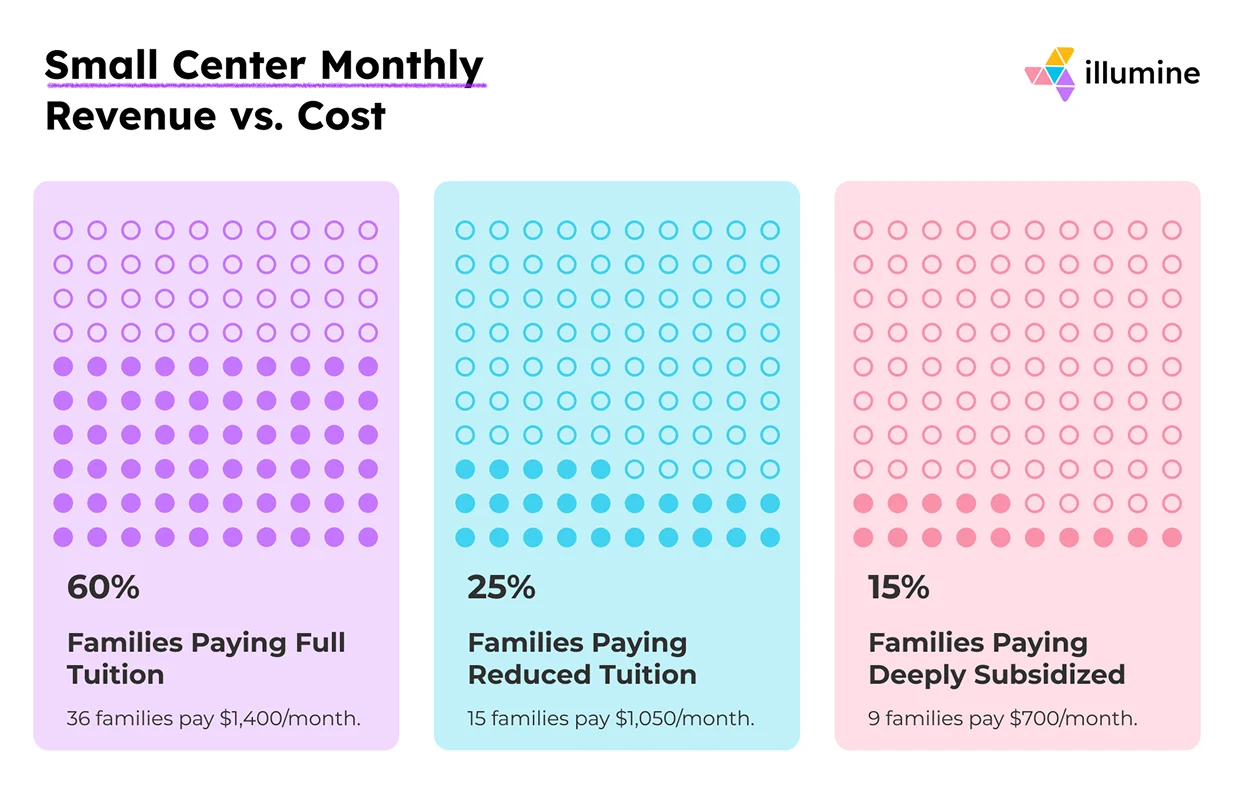
Total monthly revenue:
(36 × $1,400) + (15 × $1,050) + (9 × $700) = $72,390
Total monthly cost: 60 × $1,400 = $84,000
Wait—that doesn't work! Exactly. This is where many programs discover they need to either:
- Raise their base tuition
- Reduce the percentage of deeply subsidized spots
- Secure grants or donations to cover the gap
- Accept that they're operating at a loss (not sustainable)
A sustainable model might look like:
- 40 families (67%) pay $1,500/month (full tuition set higher than true cost)
- 15 families (25%) pay $1,200/month
- 5 families (8%) pay $900/month
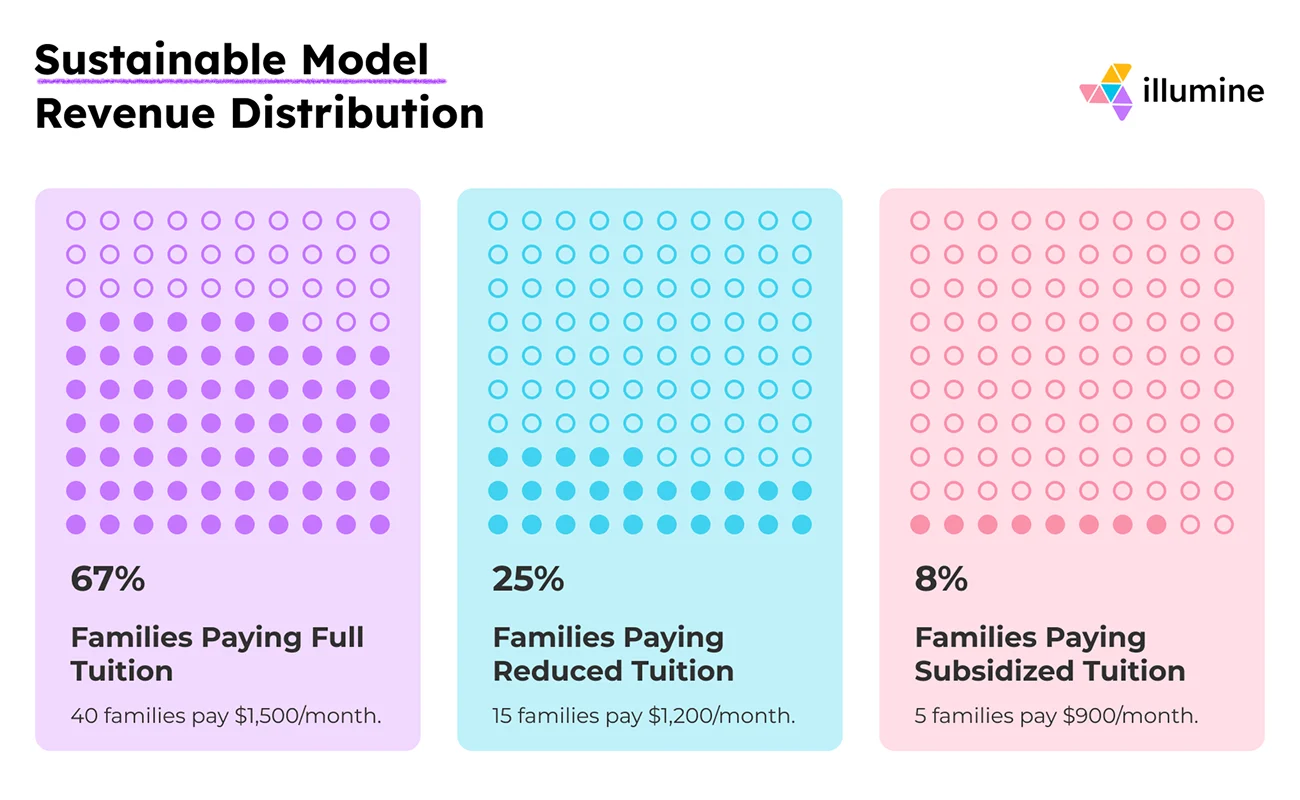
Total monthly revenue: $90,300 Total monthly cost: $84,000 Monthly surplus: $6,300 (which goes into the reserve fund)
Step 3: Set Clear Eligibility Criteria
Your tiered payment system only works if prospects can't simply choose which tier they want. You need clear, defensible criteria:
Required Documentation:
- Most recent tax return or three months of pay stubs
- Proof of single-parent status (custody documents, etc.)
- Verification of special circumstances (military ID, healthcare worker badge)
Application and Re-qualification Process:
- Families apply for reduced tuition at enrollment
- Annual re-qualification (circumstances change!)
- Written policy that families sign, acknowledging they understand the criteria
- Consistent application across all families (no exceptions based on relationships)
Important Legal Note: Your eligibility criteria must be applied consistently and documented. You're creating a scholarship program, and it needs to be administered fairly.
Why This Isn't Charity
Some directors feel uncomfortable with tiered pricing, seeing it as a form of charity. Reframe it: this is strategic enrollment management.
The reality is:
- Some families can afford full tuition and will pay it for a quality program
- Some families can't quite afford full price, but can pay most of it
- Some low-income families need significant support to afford critical services like early education
A thoughtful tiered system lets you serve a diverse community while maintaining financial sustainability. The full-pay group isn't subsidizing the others; they're paying the true cost of excellence. The people receiving support are getting access to that same excellence.
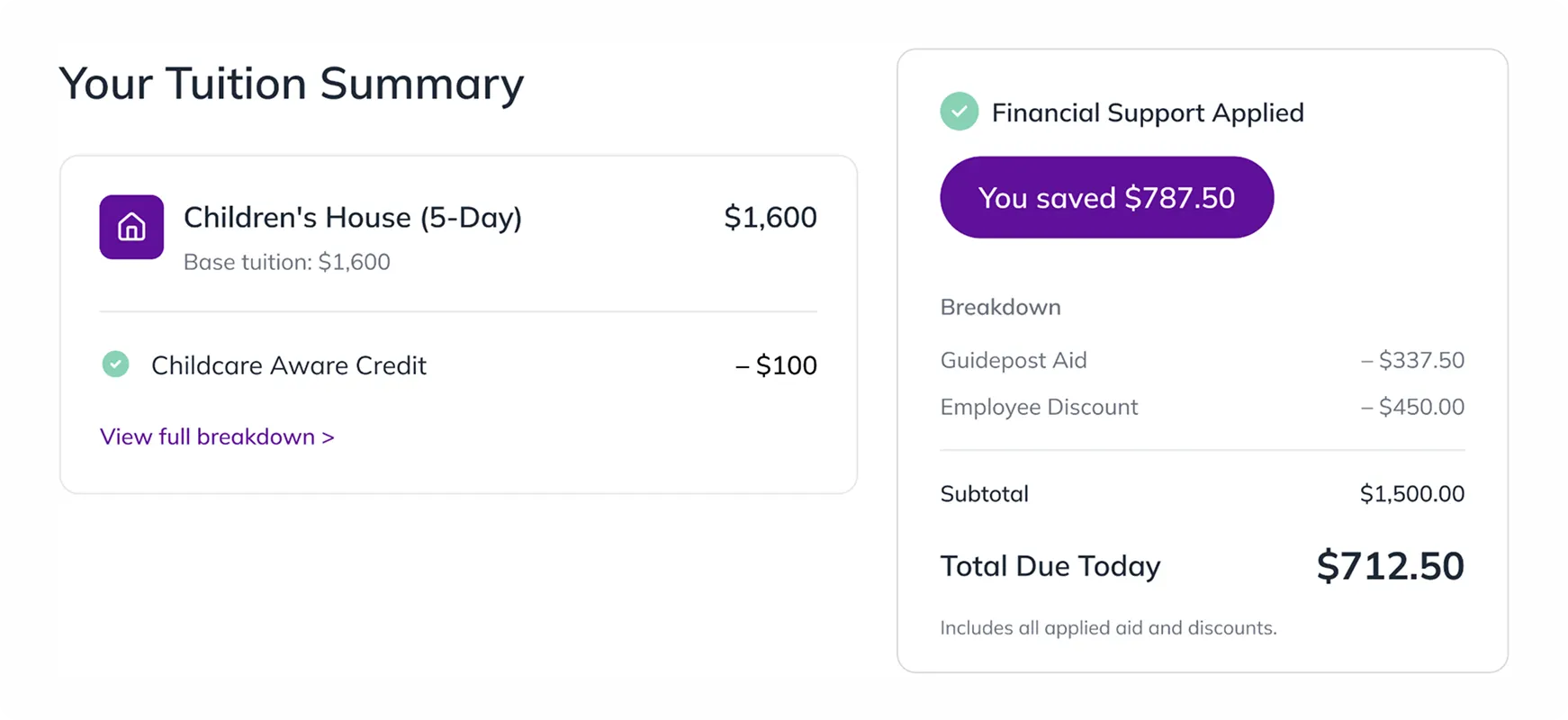
Directors define the subsidy or fee structure once by linking a funding provider to a specific program and tuition plan. From there, they assign that plan to the child enrolled in the program. Once saved, the system automatically applies the correct subsidy or discount every time an invoice is generated.
For programs funded through daily subsidies, the calculation can be set at a per-day level. The system automatically factors in working days, attendance, and approved subsidy amounts to calculate the government contribution and the parent co-pay accurately, without staff needing to do the math each month.
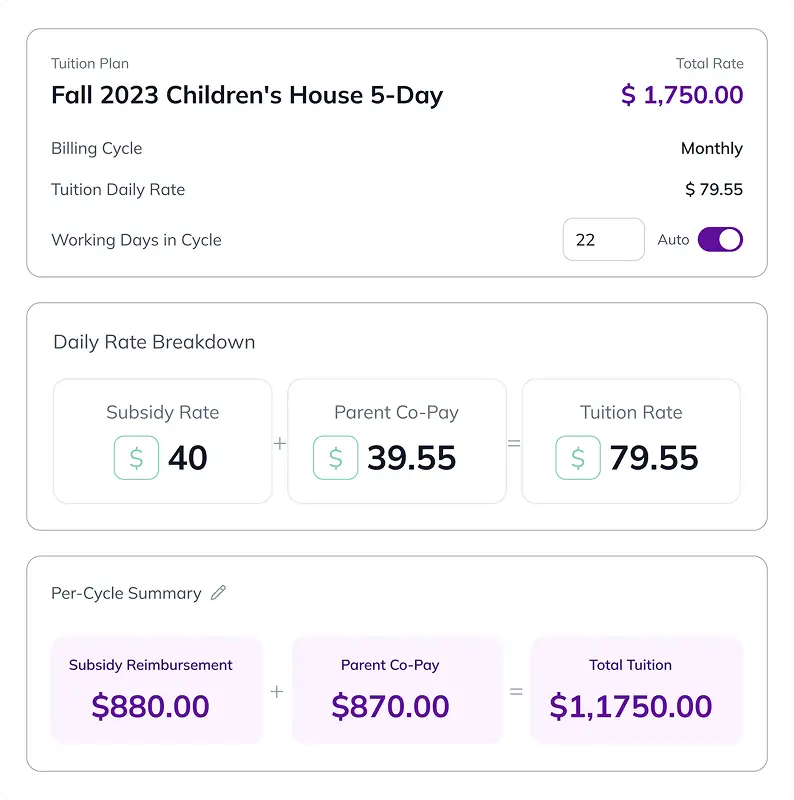
For programs funded through daily subsidies, where the per-day subsidy is defined. Illumine’s inbuilt calculator allows you to input the number of days attended, to calculate the government contribution and the parent co-pay accurately, without staff needing to do the math each month.
The key advantage is that the invoicing setup happens in just a few steps and then runs quietly in the background. Future invoices are generated with the correct subsidy applied, totals are split clearly between government reimbursement and parent responsibility, and billing remains consistent even as attendance or billing cycles change.
Part 3: Overcoming the Price Increase Fear
Let's address the elephant in the room: many directors reading this have realized their current tuition doesn't cover their true costs. You need to raise prices. And you're terrified.
Why Directors Hesitate
The fear is real and understandable:
- "Families will leave": Empty classrooms haunt your dreams
- Guilt: "I'm making critical services like early education expensive and inaccessible."
- Discomfort: Asking for more money feels awkward, especially from groups you know are struggling
- Imposter syndrome: "Who am I to charge this much?"
The Uncomfortable Truth
Underpricing your program doesn't help anyone in the long run. Here's what happens when you charge less than your true costs:
- You can't pay teachers competitively
- Teachers leave for better-paying jobs
- Quality declines due to turnover
- You cut corners on materials, ratios, or professional development
- The program slowly deteriorates
- Eventually, the program closes or gets sold
You cannot sustainably deliver quality at below-cost pricing. Every time you absorb a cost increase (insurance goes up, minimum wage increases, utilities rise) without adjusting tuition, you're slowly killing your program.
The Reality That Should Give You Confidence
Quality programs with fair pricing have waiting lists. You can show value when you communicate it effectively.
Consider what parents readily pay for:
- Private music lessons: $40-60 for 30 minutes ($80-120/hour)
- Youth sports programs: $200-400/month for 2-3 hours per week
- Tutoring: $50-100/hour
- Summer camps: $300-500/week
Your program provides:
- 8-10 hours daily of care, education, and enrichment
- Professional early childhood educators
- Curriculum designed around child development research
- Social-emotional learning in a safe, nurturing environment
- Preparation for kindergarten and beyond
When you break it down to a per-hour cost, quality child care is often less expensive than other services prospects pay for without hesitation.
How to Implement Price Increases Successfully
The Timeline (90-120 Days Before Implementation)
Don't surprise families. Give them time to adjust their budgets:
Month 1: Initial Announcement
- Send a detailed letter home explaining the increase
- Include specific reasons (rising costs, teacher wages, quality improvements)
- Announce the new rates and effective date
- Schedule a meeting to discuss
Month 2: Multiple Touchpoints
- Set meetings to answer questions
- One-on-one conversations with low-income groups you know will struggle
- Send home a second communication highlighting value (teacher credentials, curriculum, outcomes)
- Offer resources for people who may need support (information about state subsidies, flexible payment options)
Month 3: Transition Support
- Introduce any new payment plans or family support programs
- Continue individual conversations
- Remind them of the upcoming change
- Share specific improvements they'll see (new equipment, additional staff training, curriculum enhancements)
The Framing That Works:
Don't apologize. Don't be defensive. Be clear and confident:
"To continue providing the exceptional child care your children deserve, we're adjusting our tuition rates effective September 1st. This increase allows us to:
- Pay our teachers competitive wages that reflect their education and expertise - Maintain our low student-teacher ratios (better than state requirements) - Invest in ongoing professional development - Upgrade our curriculum materials and learning environments - Ensure the long-term sustainability of your child's school
We know this increase requires planning for your budget. We're committed to transparency about our costs and our quality. Here's what your tuition covers..."
Then provide a breakdown. You need to show that tuition pays for people and quality, not profits.
Transition Support Options
Help them adjust:
- Payment Plans: Split tuition into weekly instead of monthly payments
- Annual Payment Discount: Pay the full year upfront, get 5% back
- Referral Credits: Refer prospects who enroll, and receive a $100 credit
- Sibling Discounts: If not already offered
- Transition Scholarships: A limited number of partial scholarships for families in temporary financial difficulty
What to Expect
Be realistic about the short-term impact:
- You might lose 5-10% of families
- Some families who left would have left anyway (due to financial instability, moving, etc.).
- A few families will be genuinely upset
- Many families will be understanding, especially if you've built strong relationships
But here's what happens over 6-12 months:
- You attract families who value quality and can afford it
- Your financial position stabilizes
- You can invest in your teachers and program
- Teacher retention improves
- Quality increases
- Your reputation strengthens
- Enrollment rebounds with families who are committed long-term
The families who leave over a 10-15% increase—while painful to lose—might have been your highest turnover families anyway. Families financially stretched to the breaking point often leave unexpectedly, creating enrollment chaos.
Part 4: The Tour That Sells Your Value
When prospective families visit, you're not just showing them a space—you're demonstrating why your tuition is worth every dollar.
Lead With Confidence, Not Apology
Never say: "I know we're more expensive than some other programs..."
Instead: "Our tuition reflects our commitment to quality. Let me show you exactly what that means."
Show, Don't Just Tell
Teacher-Child Ratios: Walk them into a classroom and explain the costs to them. "State licensing allows up to 10 toddlers per teacher. We maintain 6:1 ratio because we believe toddlers deserve individualized attention. That's why you see genuine, calm interactions rather than teachers just managing chaos."
Teacher Credentials: "Every lead teacher has at minimum their CDA, and most have bachelor's degrees in ECE. Miss Sarah has been with us for seven years—that longevity means she deeply knows child development, and your child benefits from her expertise."
Curriculum in Action: Don't just say you have a great curriculum. Show them:
- Learning centers with clear purposes
- Documentation of children's learning on the walls
- Age-appropriate materials that are well-maintained
- Evidence of individualized learning (different children working on different skills)
Outcomes Share data if you have it: "Our kindergarten teachers tell us our graduates enter school ready—95% meet or exceed kindergarten readiness benchmarks. Many are already reading. We notice that children are ahead of their peers academically and socially."
The Parent Voice
Nothing sells quality like testimonials from current families. Have written testimonials available, but better yet:
"I'd love to give you contact information for two or three current families who've offered to speak with prospects. They can give you the real perspective on what it's like here."
The Comparison They're Making
Parents tour multiple centers. Help them make an apples-to-apples comparison:
Create a simple handout:
When you justify that your $300/month difference translates to $1.50 per hour—for better ratios, more experienced teachers, and superior curriculum—the value becomes clear.
The Script for Tuition Questions
When parents ask about cost:
"Our monthly tuition is $1,500 for full-time care, which breaks down to about $7.50 per hour. That covers 8-10 hours daily of care and education from experienced, degreed early childhood educators. You're getting professional-quality child care, not just babysitting.
Many programs charge less because they cut corners—larger class sizes, less experienced teachers with high turnover, minimal professional development, and older materials. We've chosen a different path because we believe your child's early years are too important for compromises.
We do offer tiered tuition for families who qualify based on income. Let me give you information about that process."
Then stop talking. Let them process. Answer their questions.
The Follow-Up
After the tour, send a summary email that includes:
- Thank you for visiting
- Recap of what makes your program special (3-4 bullet points)
- Current family testimonials (2-3 brief quotes)
- Clear next steps for enrollment
- Tuition information and payment options
- Link to schedule another visit or meet with the director
Make it easy for them to say yes.
Part 5: Building Long-Term Resilience
Let's zoom out from the immediate tactical steps to the bigger strategic picture.
Diversify Your Revenue Streams
The most vulnerable programs depend on a single funding source. Resilient programs have multiple revenue streams:
Primary Revenue: Tuition
- A mix of full-pay, reduced-tuition, and subsidy-supported families
- Regular tuition adjustments that keep pace with costs
Secondary Revenue:
- Grants: Local foundation grants, corporate sponsorships, quality improvement grants
- Fundraising: Annual fund drive, special events, legacy giving program
- Auxiliary Services: Before/after school programs, summer camp, enrichment classes (art, music, movement)
- Facility Rental: Rent space during off-hours (weekends, evenings) to community groups
Emergency Reserve Fund: Every program should aim to maintain 3-6 months of operating expenses in reserve. This cushion allows you to weather:
- Unexpected major repairs
- Temporary enrollment drops
- Delayed subsidy payments
- Economic recessions
Start small if you need to: add 2-5% to your operating budget each year specifically for reserve building.
Build Your Brand and Reputation
When policy changes threaten funding, programs with strong reputations can pivot more easily. Families choose these programs and will work harder to afford them.
Invest in Your Reputation:
- Collect and share parent testimonials
- Document and share outcomes (kindergarten readiness, developmental milestones)
- Maintain an active social media campaign showing daily life in your program
- Get involved in community events
- Pursue quality recognition (NAEYC accreditation, state quality rating systems)
- Create referral relationships with pediatricians, family therapists, local schools
When you're the program families want, you have leverage. You're less dependent on any single funding source because families will prioritize your program in their budgets.
Join Collective Advocacy Efforts
None of this means you should stop advocating for better public policy. In fact, the stronger your individual program, the more credibility you have as an advocate.
Join:
- Your state's early childhood advocacy organization
- National associations (NAEYC, NAFCC)
- Local coalitions working on early childhood issues
Preschool directors speaking collectively about the need for stable, adequate funding carries enormous weight with policymakers. But we advocate more effectively when we're speaking from positions of operational strength rather than desperation.
The Culture of Excellence
Finally, the most resilient programs cultivate a culture where excellence is the standard:
- Teachers who stay because they're paid fairly and supported professionally
- Families who rave about your program to their friends
- Operations that run smoothly because systems are strong
- Finances that are stable because pricing is sustainable
- Leadership that makes decisions based on long-term thinking, not crisis response
This culture doesn't happen by accident. It requires:
- Clear standards and expectations
- Consistent follow-through on operational systems
- Honest conversations about money
- Investment in people (staff and families)
- Willingness to have difficult conversations when necessary
The Path Forward
The current policy environment is a wake-up call. Federal funding freezes—whether they affect your center directly or not—remind us that external factors can shift rapidly.
The question isn't whether you support public investment in child care providers (of course, you do). The question is whether your program can deliver consistent excellence regardless of political winds.
The strongest preschool programs are those that:
✓ Have impeccable operational systems that could withstand an audit at any moment
✓ Charge sustainable tuition based on true costs, not wishful thinking
✓ Communicate value clearly and confidently to families
✓ Build financial resilience through diverse revenue and reserve funds
✓ Invest in teacher compensation and retention
✓ Cultivate reputations that make them the program families choose
✓ Participate in collective advocacy while maintaining operational independence
This isn't about abandoning the fight for government support but building a program that can weather any storm and continue delivering exceptional early childhood education to the families who rely on you.