


Lesson planning is one of the most time-intensive parts of teaching. Not because the concept itself is difficult, but because of how the process is structured in most centers.
In practice, teachers are expected to think through activities, define learning outcomes, structure plans, and document everything clearly. This happens alongside classroom responsibilities, parent communication, and administrative work. Over time, the effort required to maintain this process consistently becomes difficult to sustain.
At a surface level, lesson planning appears to be a simple documentation task. In reality, it sits at the center of how learning is delivered, tracked, and communicated. When the system around it is inefficient, the impact is felt across the entire classroom experience.
Where Traditional Childcare Lesson Planning Starts to Break Down
The problem is not that teachers are unable to plan effectively. It is that the process around planning is heavily manual and repetitive, which creates pressure over time.
Most lesson planning workflows rely on a combination of templates, past plans, and individual teacher effort. While this works in the short term, it introduces structural inefficiencies that become more visible as workload increases.
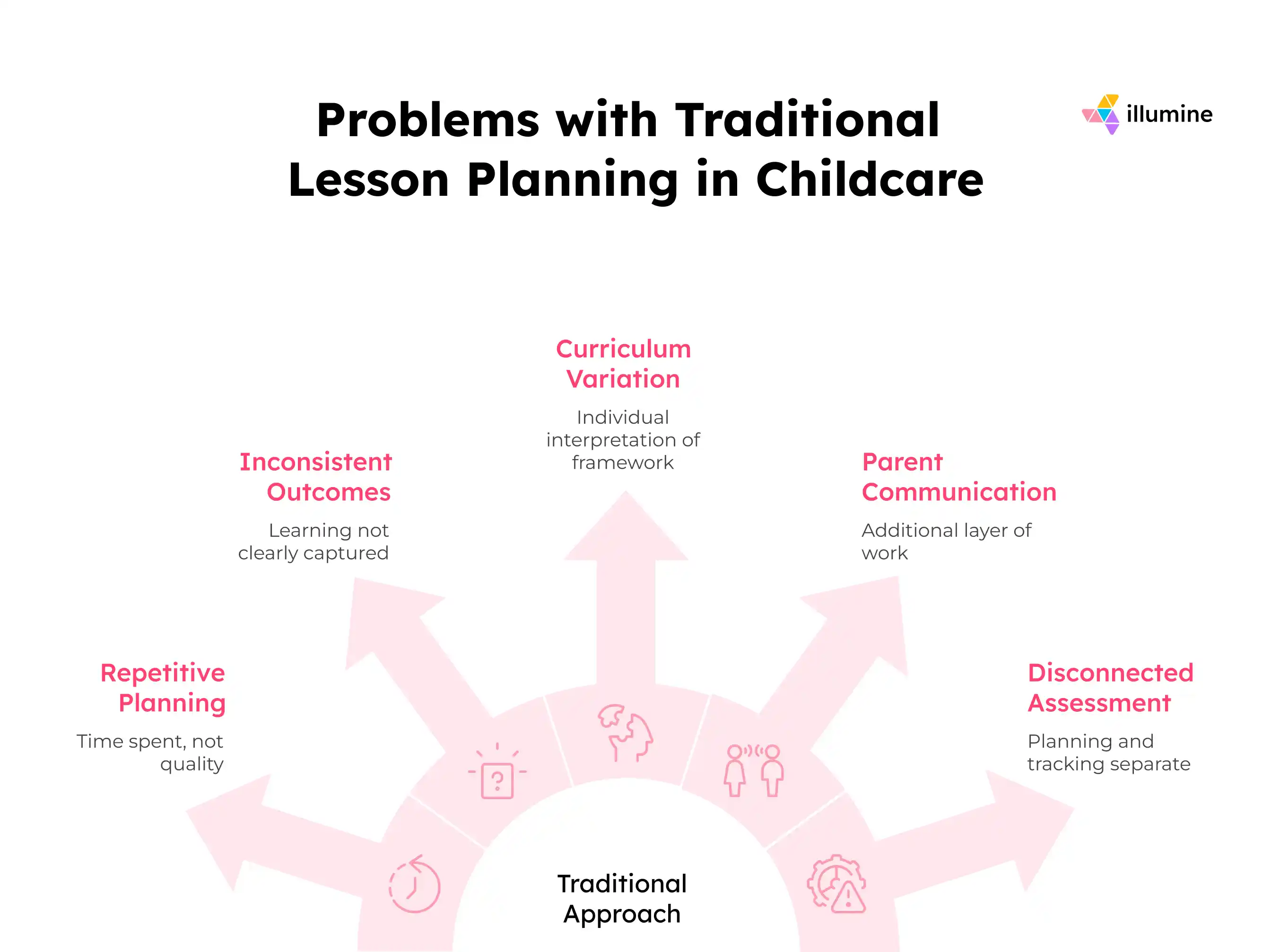
1. Planning is repetitive by design
Even when activities change, the process of creating a lesson plan remains largely the same. Teachers are required to define objectives, structure the activity, list materials, and document expected outcomes every single time.
This repetition adds a significant amount of time to the planning process without necessarily improving the quality of the lesson itself. Over time, teachers begin to optimize for speed rather than depth, which leads to reused plans or partially completed documentation.
2. Learning outcomes are not consistently captured
One of the most important functions of a lesson plan is to clearly connect activities to developmental outcomes. However, in most systems, this connection is not enforced during planning.
As a result, the lesson plan reflects what was done, but not always what the child gained from it. This creates challenges later when teachers need to assess progress or communicate learning outcomes to parents. Without a structured way to capture this during planning, much of it depends on recall rather than recorded data.
3. Curriculum alignment depends on individual interpretation
Most centers operate within a defined curriculum framework. However, these frameworks are often treated as reference documents rather than integrated planning tools.
Teachers interpret and apply the curriculum independently, which leads to variation in how learning objectives are translated into daily activities. While some flexibility is necessary, the lack of structured alignment can result in inconsistencies across classrooms.
4. Parent communication is an additional layer of work
After planning and executing lessons, teachers are also expected to communicate updates to parents. This typically involves summarizing the day’s activities and explaining what children learned.
Because this process is separate from lesson planning, it adds to the overall workload. In many cases, communication becomes shorter and more generic, not due to lack of intent, but due to time constraints.
5. Planning and assessment remain disconnected
Lesson planning and milestone tracking are often treated as separate workflows. Teachers plan lessons first, and later document observations or assessments based on those lessons.
This separation creates duplication. The same information is processed multiple times, increasing the effort required for reporting and reducing overall efficiency.
Why Templates and Basic AI Tools Don’t Fully Solve the Problem
Templates provide structure, but they do not reduce the underlying effort. Teachers still need to manually think through and fill in each section, which means the time required for planning does not change significantly.
Similarly, many AI tools focus on generating lesson content quickly. While this improves speed, it does not address the broader workflow challenges. Most tools do not connect lesson planning with curriculum alignment, developmental mapping, or assessment tracking.
As a result, they optimize one part of the process without improving the system as a whole.
A More Practical Approach to Lesson Planning
The shift is not about changing how teachers plan lessons. It is about removing the repetitive and manual work that surrounds that process.
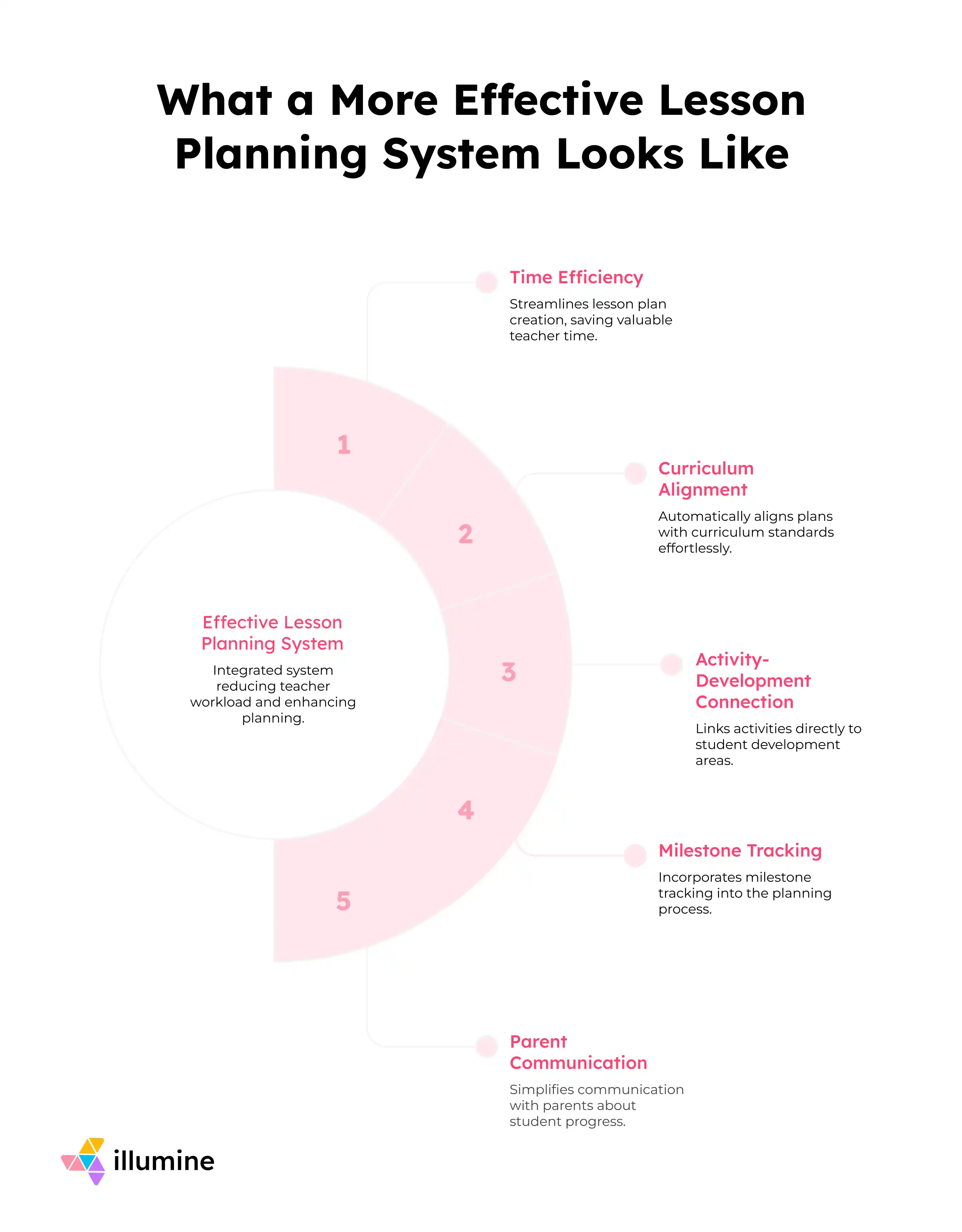
1. Use AI assistance for planning
Instead of requiring teachers to structure every lesson manually, the system should support plan creation through guided inputs. Teachers can define the core idea of the lesson, while the system helps organize it into a complete and structured format.
This reduces time spent on formatting and repetition, allowing teachers to focus on the quality of the activity itself.
2. Embed curriculums into workflows
When curriculum frameworks are built into the system, they become part of the planning process rather than something teachers need to reference separately.
This ensures that:
- Learning areas are predefined
- Activities align with expected outcomes
- Teachers do not need to manually map every lesson
Consistency improves without adding extra steps.
3. Map activities by development areas
A well-structured system should automatically connect each lesson to relevant development areas, such as cognitive, language, or social-emotional growth.
This ensures that learning intent is captured during planning itself, rather than being added later during assessment.
4. Milestone tracking should be a part of planning
When lessons are properly structured, the data generated during planning can directly support milestone tracking. This removes the need for separate documentation and reduces duplication.
Teachers can focus on observing children rather than re-entering information.
5. Lesson data included in parent communications
Instead of creating updates separately, communication should be generated from the lesson plan itself. This allows parents to receive clear and meaningful updates about what their child learned and why it matters, without requiring additional effort from teachers.
What to Look for in an AI Lesson Planning Tool
When evaluating AI tools for lesson planning, it is important to look beyond content generation.
The right system should:
- Reduce repetitive work rather than just speed it up
- Align with curriculum frameworks
- Connect lesson planning with development tracking
- Support clear parent communication
- Be simple enough for daily use
The goal is not to produce more lesson plans, but to make the entire workflow more efficient.
Why Many Centers Are Moving Toward Connected Lesson Planning Systems Like illumine
Most lesson planning tools focus on helping teachers write faster. The real shift happens when planning becomes part of a connected system that reduces effort across teaching, assessment, and communication.
This is where platforms like illumine take a different approach.
1. Curriculum-led planning instead of manual structuring
In illumine, lesson planning does not start from a blank template. Centers can upload their curriculum framework, which the system uses to identify and structure learning areas and developmental domains.
This changes how teachers plan.
Instead of interpreting the curriculum separately and then applying it manually, planning happens within a guided structure. Learning areas are already defined, which reduces variability and ensures consistency across classrooms.
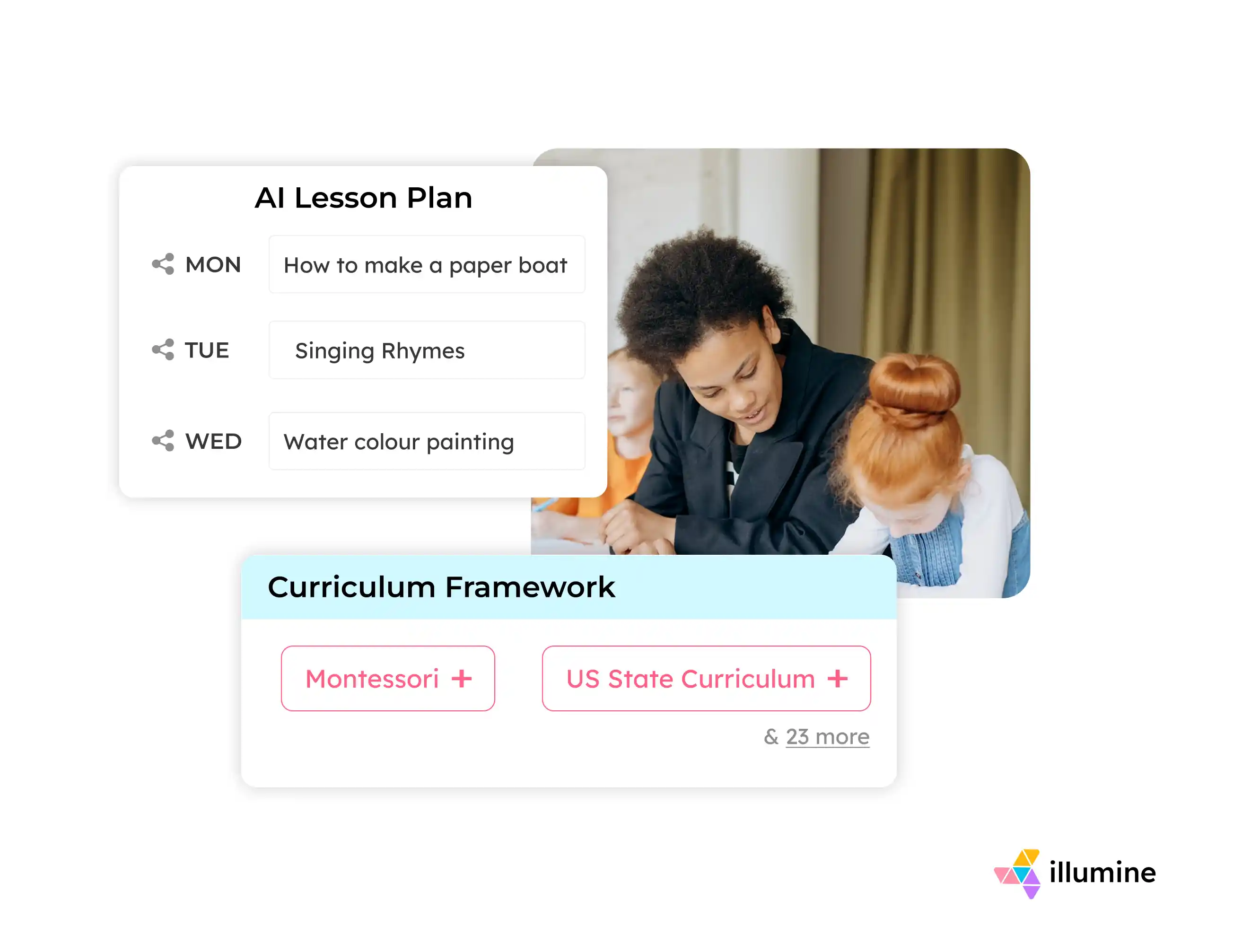
2. AI-assisted lesson creation that reduces repetition
Rather than building each lesson from scratch, teachers can input key details and let the system generate a structured plan.
This removes the repetitive parts of planning, such as formatting, structuring, and rewriting similar sections. Teachers still control the activity and intent, but spend significantly less time documenting it.
Over time, this has a measurable impact on workload.
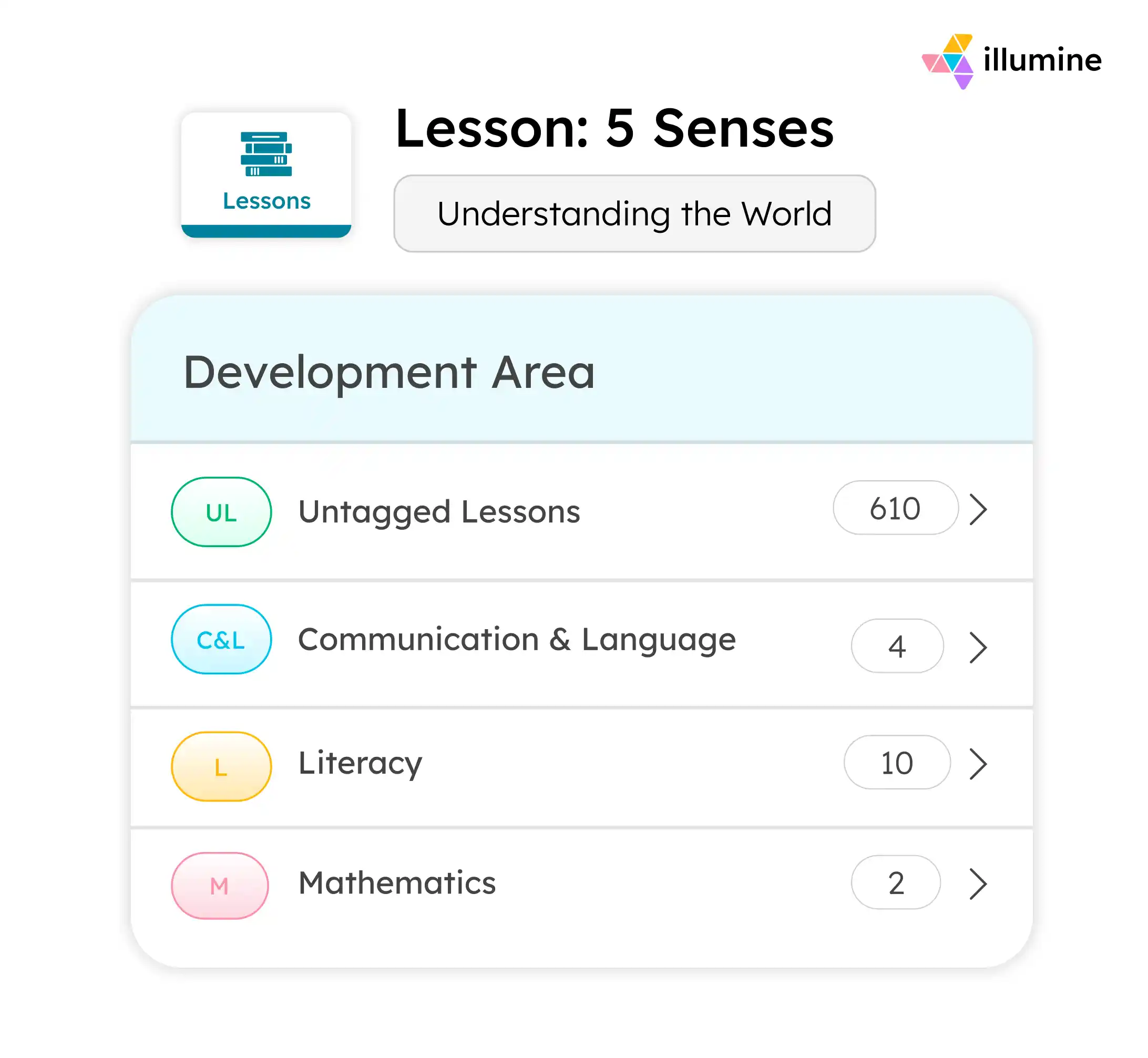
3. Automatic mapping to development areas
Every lesson created in illumine is tied to specific areas of development.
This ensures that activities are not just recorded, but meaningfully categorized. Teachers do not need to manually map each activity to learning outcomes later. The system captures this during planning itself.
As a result, the connection between what is taught and what is learned becomes much clearer.
4. Milestone tracking without duplicate work
Because lessons are already mapped to development areas, the same data can be used for assessments.
Teachers are not required to re-enter observations or reconstruct learning outcomes after the fact. Planning feeds directly into milestone tracking, reducing duplication and improving accuracy.
This becomes especially valuable during reporting periods, where time pressure is usually highest.
5. Parent communication is built into the workflow
Instead of creating separate updates, illumine generates parent communication directly from lesson plans.
Parents receive structured updates that explain:
- What the activity was
- What the child learned
- Why it matters
This improves transparency without increasing the teacher’s workload. Communication becomes more consistent and more meaningful, without requiring additional effort.
6. A system that supports teachers' day-to-day
The impact of these changes is not limited to efficiency alone.
When repetitive tasks are reduced and workflows are connected:
- Planning takes less time
- Documentation becomes easier to maintain
- Teachers spend more time on actual classroom interaction
Over time, this contributes to a more sustainable workload. For centers, this translates into better teacher satisfaction and improved retention.
Closing Thoughts
Time pressure is one of the most consistent challenges in early education.
Teachers are expected to plan, document, assess, and communicate, often through disconnected workflows that require repeated effort. Over time, this creates unnecessary strain. When routine tasks like lesson planning take longer than they should, the workload extends beyond classroom hours and contributes to long-term burnout.
Reducing the effort required for planning does not just improve efficiency. It improves sustainability.
When teachers spend less time on repetitive documentation:
- Planning becomes more manageable
- Work stays within reasonable hours
- Job satisfaction improves
When lesson planning becomes part of a connected system, the impact is immediate. Time spent on documentation reduces, learning outcomes become clearer, and communication improves without adding to the workload.
The question is not whether teachers can plan effectively. It is whether the system they use supports them in doing it efficiently.