
.png)


Tuition at many programs now rivals college costs, and parents understandably ask the same question: Why has early childhood education become so expensive?
Food, supplies, insurance, and facility maintenance are all rising dramatically, and programs are being forced to pass those costs on to families who often simply cannot afford to pay more.
But the real story is even more troubling.
The crisis in early childhood education is not just about rising prices. It is about a fundamental mismatch between what quality early education actually costs and what families can realistically afford to pay.
And unless we address that gap honestly, we will continue to see programs close, educators leave the profession, and families struggle to find care.
Understanding The Gap Between Childcare Cost and Affordability
When costs rise, most businesses simply increase prices. Childcare programs often have no choice but to do the same.
Yet raising tuition creates its own problems. Families are already stretched thin.
A recent analysis found that the average annual cost of childcare for two young children can exceed $28,000 per year. For many families, that is simply unsustainable.
More than half of the programs surveyed reported losing families after raising tuition. At the same time, 61 percent said they were under-enrolled because many families can no longer afford to pay.
This is the cruel paradox facing early childhood education today. Programs cannot survive without charging more, but families cannot afford to pay more.
The Factors Affecting Rising Childcare Costs in the USA
Many people assume that childcare centers must be generating healthy profits because tuition appears so high. In reality, most early childhood programs operate on extremely thin margins. Many struggle simply to break even.
Running a high-quality early childhood program is inherently expensive.
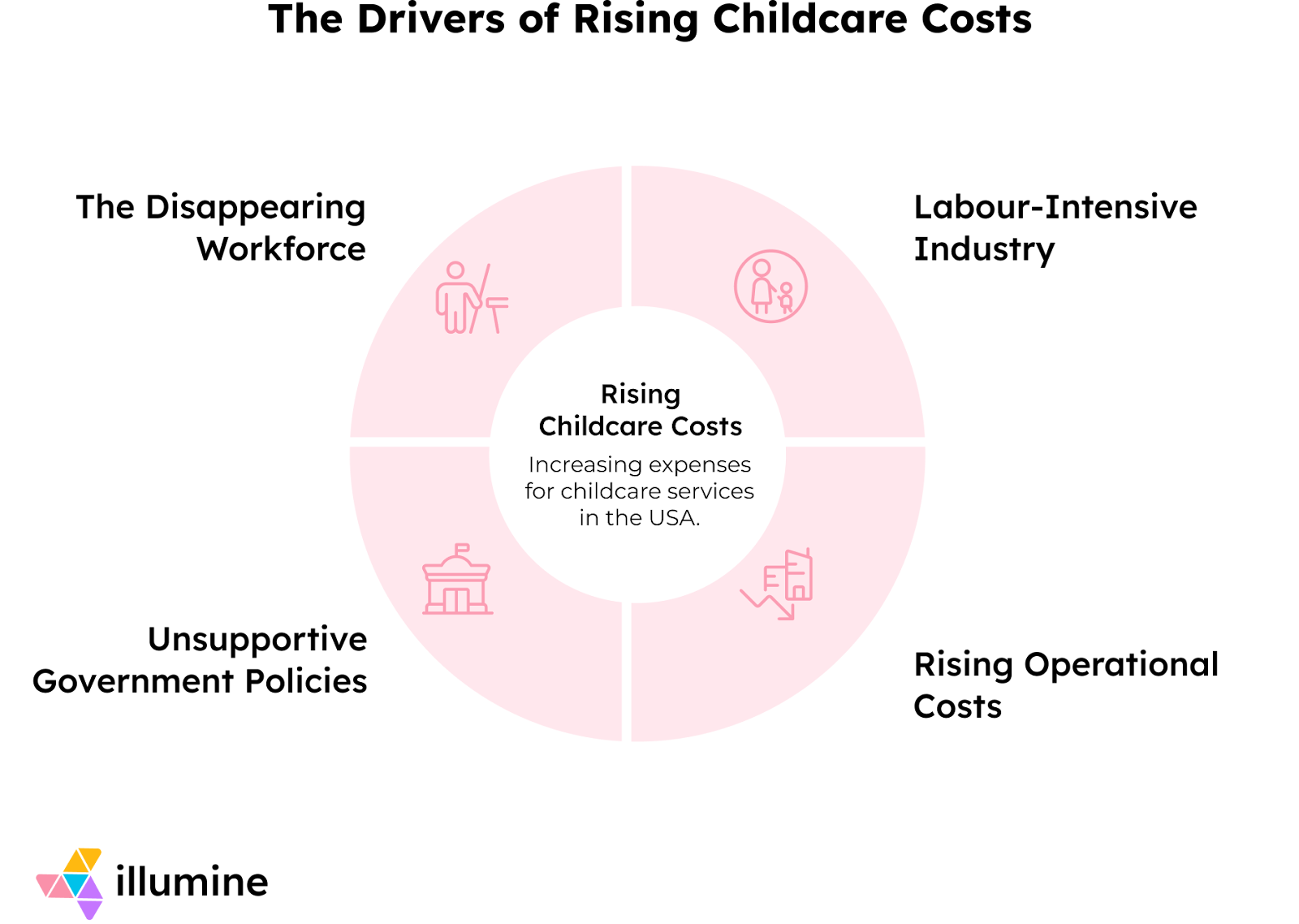
The pressure on childcare costs is coming from several directions at once. Schools are not simply charging more because they are trying to absorb a growing list of expenses. All of this while serving families whose budgets are already stretched.
1. Labour-Intensive Industry
State regulations require specific ratios of teachers to children, and for good reason. Infants and toddlers need attentive care, and preschool classrooms function best when adults have the time to guide children individually.
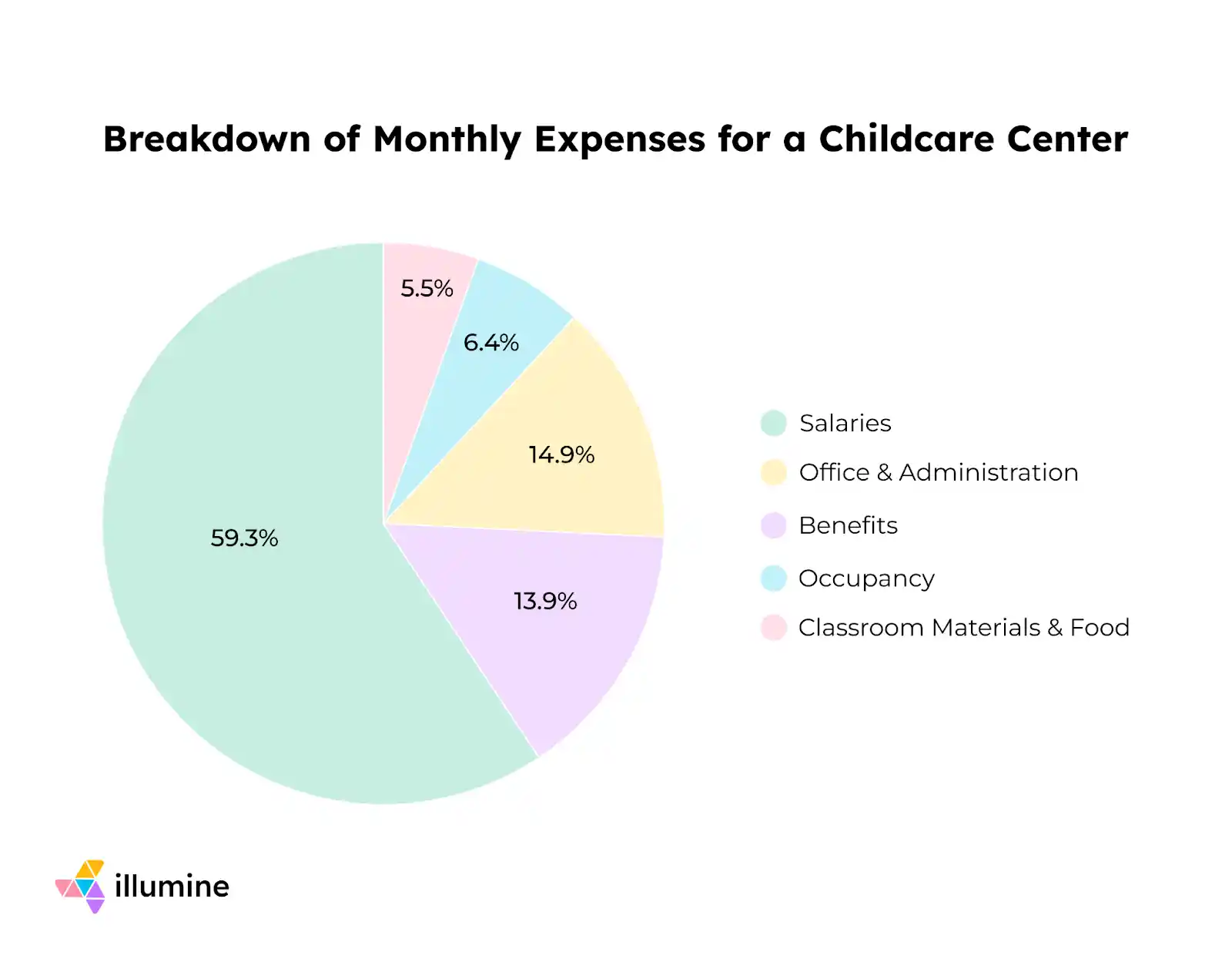
Personnel costs, therefore, make up the overwhelming majority of a program’s budget. Teachers and assistants must be paid, and in responsible programs, they receive benefits such as health insurance, workers’ compensation coverage, and professional development.
Yet despite these expenses, early childhood educators remain among the lowest-paid professionals in the education sector.
2. Rising Operational Costs
Beyond staffing costs, programs are facing a series of rapidly rising expenses that are largely outside their control.
Insurance costs have surged dramatically in many regions. Liability insurance is required for most licensed programs, yet premiums have climbed sharply as insurers reassess risk across the industry. Some programs report increases of tens of thousands of dollars per year.
Food and supplies have also become significantly more expensive. Inflation has driven up the cost of everything from snacks and cleaning materials to classroom furniture and art supplies.
Facilities are another major factor. Rent, maintenance, utilities, and property insurance have all increased, especially in communities where housing and commercial property costs are rising.
For many programs, these increases come all at once. A school that was operating sustainably five years ago can suddenly find itself facing a six-figure deficit.
One program director interviewed recently described watching her insurance bill jump from $45,000 to $62,000 in a single year. After decades of balanced budgets, the program suddenly found itself operating at a $200,000 loss.
These are not unusual stories.
3. Unsupportive Government Policies
At the heart of the problem is a gap that policymakers have long struggled to address.
Quality early childhood education is expensive to provide because it requires well-trained adults working closely with small groups of children.
But the families who need these services most often cannot afford to pay the full cost.
For decades, this gap has been filled through a fragile mix of tuition, limited public funding, and the personal financial sacrifices of educators and program owners.
When any part of that system weakens, whether through inflation, insurance increases, or reductions in public funding, the entire structure begins to wobble.
4. The Disappearing Workforce
The financial pressure does not stop with families and program owners. It also affects teachers.
Early childhood educators enter the profession because they care deeply about children and believe in the importance of early development. But passion alone cannot pay rent or support a family.
As operating costs rise, many programs cannot afford to raise salaries meaningfully. Directors often face painful decisions: reduce staff, delay salary increases, or eliminate support positions such as substitute teachers.
Some programs must reduce services for children who need additional support because they simply cannot afford the extra staffing required.
When this happens, educators understandably begin to leave the field.
And when experienced teachers leave, programs struggle even more to maintain quality.
Why the Cost of Childcare Matters Beyond Tuition
The consequences of this crisis reach far beyond the childcare industry.
High-quality early childhood education is one of the most powerful investments society can make. Research consistently shows that children who attend strong early learning programs develop better language skills, stronger executive functioning, and more positive social relationships.
These benefits ripple outward into later academic success, workforce readiness, and long-term economic stability.
When early childhood programs close or reduce services, communities lose more than childcare slots. They lose a vital foundation for children’s development.
Families also face impossible choices. Parents may reduce work hours, leave the workforce entirely, or patch together unstable arrangements that do not truly meet their children’s needs.
Rethinking How Childcare Costs Are Financed
If we want early childhood education to remain available and sustainable, we need to rethink how it is financed.
There is growing recognition that early education should not be treated solely as a private consumer service. It is an essential public good that benefits children, families, and the broader economy.
Businesses depend on reliable childcare so parents can work. Communities depend on strong early education to support children’s development. Schools depend on children arriving ready to learn.
A more sustainable system will likely require a combination of approaches: better public investment, more realistic tuition structures, stronger support for educators, and innovative models that blend early education with community resources.
Closing Thoughts
The current crisis presents an important moment of choice.
We can continue to allow early childhood programs to struggle quietly, raising tuition year after year until families and educators alike reach a breaking point.
Or we can recognize that early education is one of the most important foundations of a healthy society and treat it accordingly.
Parents, educators, policymakers, and community leaders all share a stake in this conversation.
The question is not whether high-quality early childhood education is worth the investment.
The real question is whether we are willing to build a system that makes it possible.
Because if we fail to do so, the cost will ultimately be borne not only by families and schools, but by the children whose futures depend on getting the strongest possible start in life.