

Starting a daycare or preschool business is rewarding, but it is not simple. Beyond classrooms and curriculum, you need clear planning around licensing, costs, staffing, and timelines.
Most founders get stuck early because they underestimate what it takes to open legally and sustainably. That is why a realistic daycare business plan matters before you commit to a location, staff, or lease.
This guide explains how to start a daycare business or preschool step by step. It applies whether you are opening a daycare center, launching a preschool program, or planning a blended model. To reduce overwhelm, the process is broken into clear phases so you can focus on one set of decisions at a time.
Phase 1: Defining Your Preschool Vision and Program Type
Before licensing, staffing, or facilities, decide what kind of program you are creating.
Early childhood programs fall under different regulatory categories. These distinctions affect licensing, staffing requirements, operating hours, and costs. Choosing the wrong category early can lead to delays or costly changes later.
Common program types include:
- Child-Care Center or Nursery School
Typically licensed under child-care regulations and designed for full-day care. - Private or Nonpublic Preschool
Often overseen by the US Department of Education, especially for programs serving children over age five. - Faith-Based or Exempt Programs
Some programs qualify for partial exemptions but are still required to meet core health and safety standards. - Montessori or Hybrid Programs
These may fall under more than one regulatory framework. For example, toddler classrooms may follow child-care regulations, while older classrooms fall under private preschool guidelines.
Defining your program type early ensures your licensing path, staffing model, and daycare business plan are aligned from the start.
Crucial Must-Read: How to Start a Daycare Franchise: Your 15-Step Guide 🔗
Phase 2: Business Planning and Financial Reality
Creating a Comprehensive Preschool Business Plan
Think of your business plan as a roadmap. It does not need to be complicated, but it does need to be complete and realistic.
Key elements to include:
- Executive Summary: A brief statement of your school’s purpose and what makes it distinct.
- Market Analysis: Key insights from competitor and parent research.
- Operational Plan: Day-to-day operations, including hours, staffing roles, and curriculum structure.
- Financial Plan: Start-up costs, tuition projections, and break-even analysis.
- Marketing Plan: How you will reach families and build trust in your community.
Understanding the Economics of Scale
Smaller schools are often more personal, but they can be harder to sustain. Preschools with fewer than 75 students may struggle to cover leadership, administrative, and maintenance costs while paying fair wages.
In most communities, stability begins around 100–120 students, when tuition income can consistently support salaries, training, and reserves for growth.
Arranging Capital and Funding
Starting a preschool requires a significant upfront investment. Plan early for facility costs, licensing fees, business insurance, and classroom materials.
Common funding sources include:
- Personal Savings and Loans: Often combined with small-business or SBA loans.
- Grants and Community Programs: Some states and education-focused organizations offer early childhood grants.
- Investors or Partners: Mission-aligned families or local supporters.
- Crowdfunding: Useful when backed by a strong story and community support.
To set expectations, here are typical cost ranges:
Expense Category
Typical Range
Lease Rate
$18–$35 per sq ft per year ($25–$40 for new space)
Renovation
$100–$200 per sq ft
New Construction
$250–$400 per sq ft (excluding land)
Playground & Site Work
$50,000–$150,000
Soft Costs (permits, furnishings, materials)
+20–30%
A modest leased facility for 60–80 children can require $250,000–$400,000 to launch.
Larger owned facilities for 100–120 students may reach $600,000–$900,000 or more.
Phase 3: Researching Demand and Your Community
Understanding the Market for Your Daycare or Preschool
Once your vision is clear, study your surroundings carefully. A successful daycare or preschool meets real needs within its community.
Focus on four areas:
- Identify Local Competitors:
Visit nearby preschools and childcare centers. Review pricing, operating hours, enrollment models, teaching approaches, and parent reviews to see what families value and what feels missing. - Survey Parents:
Talk directly to parents through quick surveys or conversations. Learn whether they prioritize safety, small group sizes, a Montessori approach, flexible hours, or strong communication. - Analyze Demographics:
Look for areas with growing numbers of young families, new housing developments, nearby schools, or high commuter activity. - Track Early Education Trends:
Watch demand for STEM learning, bilingual programs, and nature-based education to position your program effectively.
Strong market research helps you start a daycare business based on real community needs, not assumptions.
Phase 4: Licensing, Ratios, and Legal Requirements
Daycare and Preschool Licensing Requirements
Licensing is one of the most time-consuming parts of starting a daycare business or preschool. Each state regulates childcare differently, and requirements affect how many children you can enroll, how you staff classrooms, and when you are allowed to open.
At a minimum, licensing rules usually define:
- Staff-to-child ratios
- Group size limits
- Facility safety standards
- Teacher qualifications
Staff-to-Child Ratio Examples by State
For example, here are two states with different requirements:
Florida (Child Care Facility Standards):
Age Group
Staff-to-Child Ratio
Birth – 1 year
1: 4
1 – 2 years
1: 6
2 – 3 years
1: 11
3 – 4 years
1: 15
4 – 5 years
1: 20
5 years and older
1: 25
Maryland (COMAR 13A.16.08.03):
Age Group
Staff-to-Child Ratio
Max Group Size
2-year-olds
1: 6
12
3- & 4-year-olds
1: 10
20
Montessori Ratio Considerations
Montessori classrooms often operate differently. In an authentic environment, children work independently and rely on a prepared classroom rather than constant adult direction.
Typical Montessori ratios include:
- Toddler Community (18 months – 3 years): 1 adult to 5–8 children
- Primary (3 – 6 years): 1 adult to 12–15 children, sometimes higher when led by an experienced, certified guide
Permits, Inspections, and Required Policies
Before opening, you will also need:
- Zoning approval for childcare use
- Fire, health, and building inspections
- Written policies for admissions, health, discipline, and emergencies
- Liability and workers’ compensation insurance
Good documentation protects your staff, families, and business. It also reduces delays during inspections and renewals.
Phase 5: Facility and Daycare Building Setup
Choosing and Preparing a Daycare Building or Preschool Facility
Your facility impacts enrollment, safety, and long-term growth. Choosing the right daycare building is both an operational and financial decision.
When evaluating locations, consider:
- Proximity to families and workplaces
- Safe access, parking, and drop-off flow
- Zoning approval for childcare use
- Ability to secure outdoor play areas
You can lease, purchase, or build a facility. Leasing allows faster entry with lower upfront costs, while ownership offers long-term control but higher initial investment.
Space Requirements and Growth Planning
Most states require at least 35 square feet of indoor space per child and about 75 square feet of outdoor space. Once you add storage, bathrooms, and offices, plan for roughly 60–75 square feet per child overall.
Enrollment
Classroom Space (≈35 sf/child)
Total Building (≈65 sf/child)
Outdoor Play Area (≈75 sf/child)
50 children
1,750 sq ft
3,250 sq ft
3,750 sq ft
75 children
2,625 sq ft
4,875 sq ft
5,625 sq ft
100 children
3,500 sq ft
6,500 sq ft
7,500 sq ft
150 children
5,250 sq ft
9,750 sq ft
11,250 sq ft
CTA:
Get all the information here at your fingertips
Download Free Checklist
Phase 6: Staffing, Certifications, and Safety
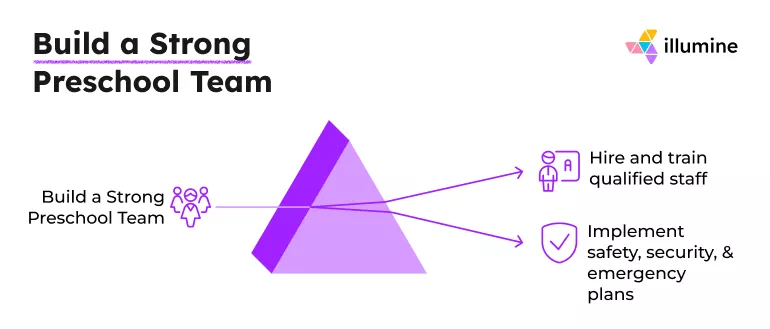
Hiring Qualified Daycare and Preschool Staff
Your staff shapes the daily experience for children and families. Hiring qualified educators is essential for both compliance and quality.
Most states require:
- Early childhood education credits or a CDA
- CPR and first-aid certification
- Background checks for all staff
Staffing decisions directly affect your ratios, payroll, and ability to stay compliant as enrollment grows.
Must Read: Strategies to Hire and Retain Preschool Teachers in a Competitive Market 🔗
Health, Safety, and Emergency Planning
Safety expectations are strict for every daycare business and preschool.
You will need:
- Daily cleaning and sanitization routines
- Illness and medication policies
- Emergency preparedness plans and drills
- Regular equipment and playground inspections
Safety planning is not just about meeting requirements. It builds trust with parents and protects your team.
Phase 7: Curriculum and Daily Operations
Curriculum Planning for Daycare and Preschool Programs
Curriculum gives structure to your program and clarity to families.
Common approaches include:
- Montessori
- Waldorf
- Play-based or Reggio-inspired models
Regardless of approach, consistency matters. Families want to know what their child’s day looks like, and staff need clear expectations.
Even if your approach is eclectic, keep consistency across classrooms. Families appreciate knowing what to expect, and teachers thrive when their structure is clear.
Phase 8: Marketing, Enrollment, and Growth
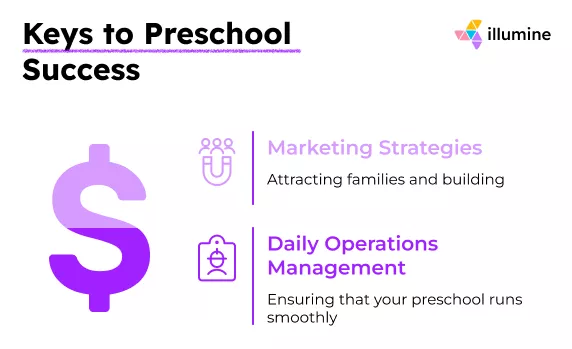
Marketing Your Daycare or Preschool Business
Even a well-run program needs visibility. Marketing helps families discover and trust your daycare business.
Effective strategies include:
- A clear, informative website
- Local listings and search visibility
- Open houses and referrals
- Consistent communication with families
Marketing is not about competition. It is about helping the right families find the right environment for their child.
Useful Read: Harnessing Social Media for Preschools: A 6-Step Marketing Strategy 🔗
Day-to-day operations are where most daycare leaders feel the pressure first. Not during inspections. Not during audits. But in the constant flow of small decisions that repeat every single day.
Attendance has to be recorded accurately. Staff schedules need to reflect ratios, breaks, and last-minute changes. Parents expect timely updates and clear communication. Billing and records need to stay organized, even when enrollments shift or families move in and out mid-cycle.
Individually, none of these tasks are complicated. But together, they create a steady administrative load that often falls on the same few people. As enrollment grows and classrooms multiply, manual processes begin to crack. Spreadsheets get outdated. Messages get missed. Small errors start consuming disproportionate amounts of time and energy.
This is where strong operational systems make a meaningful difference. When attendance, staffing, communication, and billing are connected, work stops feeling reactive. Information lives in one place. Teams spend less time reconciling data and more time supporting children and teachers.
Well-designed systems don’t add more steps to your day. They remove friction. They reduce repeat work, minimize errors, and help directors step out of constant problem-solving mode. Over time, this isn’t just about efficiency. It’s about sustainability. Fewer late nights, fewer fire drills, and a team that isn’t quietly burning out under administrative pressure.
As your program grows, the goal isn’t to work harder to keep up. It’s to put structures in place that allow your center to run smoothly, even on the busiest days.
CTA Banner:
Don’t just run!
Build your center to scale from Day 1.
Button: Start Free Trial Now
FAQs
How do I start my own daycare business?
Start by defining your program type, researching licensing requirements, and creating a daycare business plan. Then secure funding, prepare a compliant facility, complete inspections, hire staff, and set up daily operations before enrolling children.
How do I open my own daycare?
To open your own daycare, you must meet licensing, zoning, and safety requirements, prepare your space, hire qualified staff, and pass inspections. The exact process depends on your state or region.
What should a daycare business plan include?
A daycare business plan should cover your program type, age groups, operating hours, staffing needs, startup and ongoing costs, tuition pricing, licensing considerations, and marketing approach.
How much does it cost to start a preschool or daycare?
Costs vary by location, size, and setup. A small leased center for 60–80 children can cost $250,000–$400,000, while larger or owned facilities may reach $600,000–$900,000 or more. Home daycares typically cost much less.
Is starting a daycare or preschool business profitable?
It can be, but profitability depends on enrollment consistency, staffing ratios, rent, and cost control. Most centers become more stable once enrollment and staffing levels are predictable.
What licenses do I need to open a preschool or daycare?
Most states require a childcare license, zoning approval, and health and safety inspections. If meals are served, a food handling permit may also be required. Always check state-specific regulations early.
How long does licensing take?
Licensing and inspections usually take three to nine months, depending on your state and facility readiness. Starting early helps avoid delays.
Do daycare and preschool licensing rules differ by state?
Yes. Licensing rules vary widely by state and sometimes by city or county. Requirements may differ for daycare centers, preschools, and home-based programs.
How many children can I enroll?
Enrollment limits depend on staff-to-child ratios and available classroom space. A common guideline is 35 square feet of indoor space and 75 square feet of outdoor space per child, but state rules vary.
What is the difference between a home daycare and a daycare center?
A home daycare operates from a residence, serves fewer children, and has simpler facility requirements. A daycare center operates from a dedicated building, enrolls more children, and must meet stricter licensing and staffing standards.
Can I start with a home daycare and expand into a center later?
Yes. Many owners start small and expand later. Planning ahead for licensing, zoning, and staffing makes the transition smoother.
Do I need special training to run a preschool or daycare?
Training requirements vary by state. While education experience helps, leadership and organization are equally important. Montessori programs typically require certified guides for lead roles.
FAQs
How much does it cost to start a preschool?
−
The cost depends on location, size, and whether you lease, renovate, or build.
A small leased center for 60–80 children can range from $250,000–$400,000.
Larger or owned facilities may reach $600,000–$900,000 or more.
What licenses do I need to open a preschool?
Most states require a childcare license, zoning approval, and health and safety inspections.
If meals are served, a food handling permit may also be necessary.
Always check your state’s specific regulations early in the process.
How many children can I enroll?
Enrollment limits depend on your state’s staff-to-child ratios and available classroom space.
A general rule is at least 35 square feet of indoor space and 75 square feet of outdoor space per child.
What curriculum should I choose?
Select a framework that reflects your values and supports holistic child development.
Montessori, Waldorf, HighScope, and play-based approaches are all respected options.
The key is consistency and alignment with your school’s philosophy.
Do I need special training to run a preschool?
While a background in education helps, leadership, organization, and empathy are equally important.
If you plan to offer a Montessori program, consider formal Montessori training or hire certified guides to lead your classrooms.
How long does licensing take?
Licensing and inspections can take between three and nine months.
Starting early prevents delays and helps you open on schedule.
How can technology help manage my preschool?
Preschool management platforms such as illumine automate daily reports, attendance, billing, and communication.
This reduces administrative workload and ensures compliance, allowing educators to focus on children.