

Almost every childcare founder remembers the day they realized they couldn’t be in every room anymore.
For some, it’s the morning a new center opens in another state, run by a director they’ve met twice. For others, it’s a parent’s concern they hear about a week late, or a month-end report that explains what went wrong after it was too late to fix.
Nothing has gone wrong, exactly. The organization has simply grown past what one person can hold.
We call it the moment of scale.
We’ve worked alongside Early Years operators in more than 60 countries. Different regulators. Different languages. Different currencies. Different ideas about what a good day for a child looks like.
And yet the moment of scale looks remarkably the same everywhere.
Before it, an exceptional center runs on people. A childcare founder who is in the building most days. A director who knows every family by name, who notices which child is quiet this morning and which invoice is late this month. The standard lives in them.
After it, the standard has to travel. Through layers of leadership. Through trusted center directors who run the ground operations every day. Across cities and states, into sites the CEO or COO may visit only a few times a year.
“At one or two sites, the standard lives in a person. Past ten, it has to live in how the whole organization works.”
What happens next decides whether growth raises an organization’s standard or slowly wears it down.
We’ve seen both across the countries we work in, including the UAE, Southeast Asia and Malta, and now across the United States.
The signs appear long before the moment itself.
1–2 sites
The childcare founder holds everything together.
3 to 10 sites
The foundations of scaling get built, and the first cracks show.
11 to 100 sites
Leadership has to form across every level: trusted center directors run the ground operations, regional leaders connect them to the CEO or COO, and the organization builds the oversight it needs, because no one can be present everywhere.
Past 100 sites
The organization has to run as one system.
At five locations, a childcare founder can still understand the business through conversations. At fifty, that becomes much harder. One center may be struggling with enrollment while another has a waiting list. Staffing costs may be rising in one region while capacity remains underused in another. The answers exist somewhere across the organization, but they don’t always reach the people who need them in time.
The challenge isn’t just maintaining standards. It’s creating the visibility and systems that help leaders make the right decisions, quickly and consistently, without losing what makes each center special.
That is why we built illumine.
We exist to raise the standard for Early Years. For us, that means giving childcare leaders the visibility to see what’s happening, the intelligence to make better decisions, and the technology to act faster, across every location.
We believe the best technology should make growing an Early Years organization easier, not more complicated.
Technology has an enormous role to play here, especially now, with AI creating new possibilities for how we operate, analyze information and support teams. But technology only creates value when people actually use it.
We’ve seen organizations invest in sophisticated software, only to spend months migrating data, rebuilding processes, training teams and trying to get everyone on the same page. By the time the system is fully adopted, much of its promised value has been delayed. We believe implementation should be simple, adoption should feel natural, and the impact should be visible early.
Four commitments behind everything we build
Visibility across the organization
Leaders understand performance across brands, regions, locations, programs and teams, without waiting for spreadsheets or manual reports.
Better decisions, faster
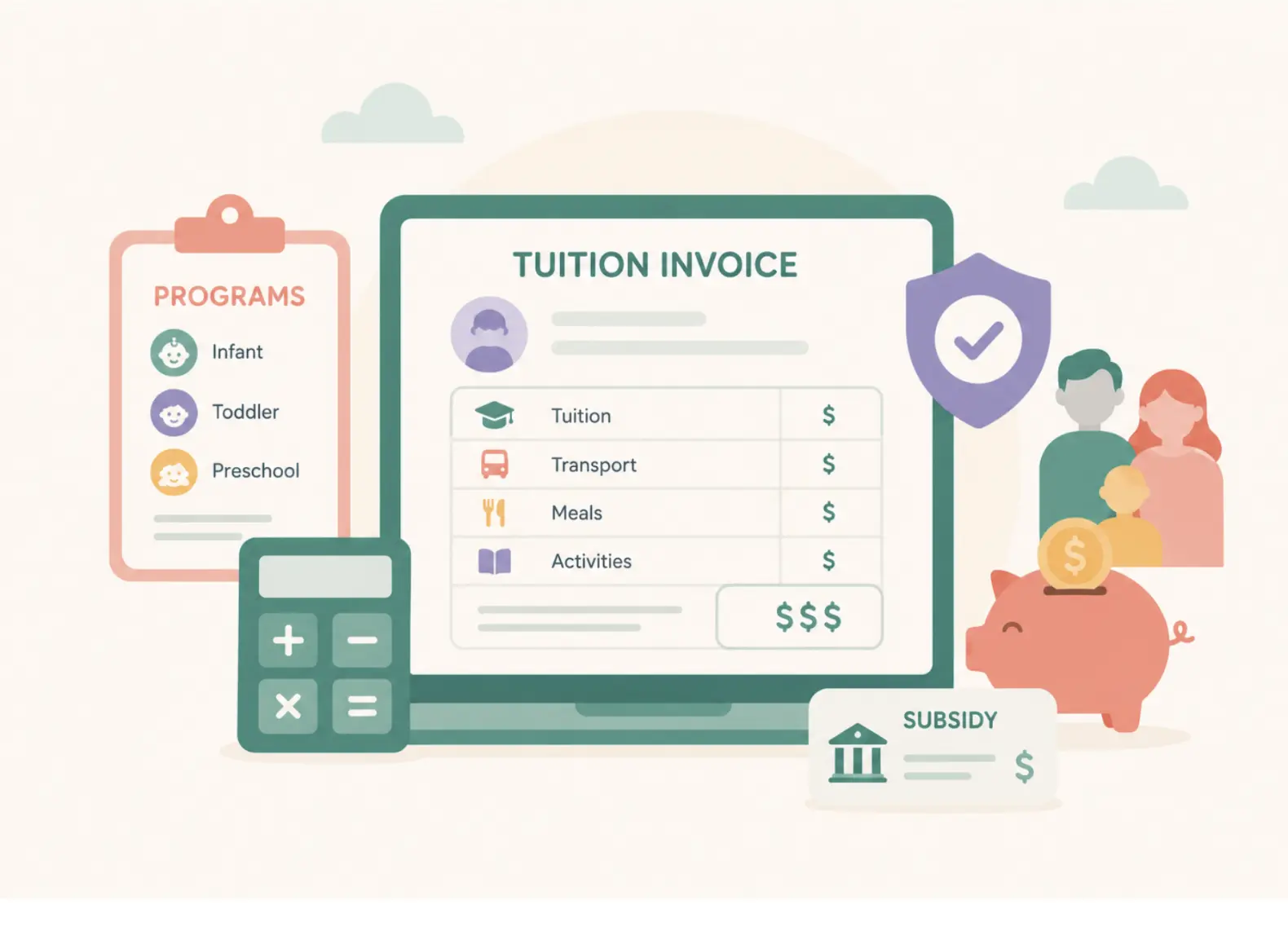
Operational data becomes decisions on enrollment, staffing, tuition, capacity and quality. AI should help teams act, not add another dashboard to manage.
Value from the first months
Implementation and adoption are part of the product. Teams should not have to rebuild how they work before they see results.
Growth without compromising quality
New locations, acquisitions and stronger financial performance, while keeping the experience that made the organization successful.
Why we built illumine matters. How we build it matters just as much.
How we build is the real reason anyone should trust us with their business. I learned this in person last year, when I flew to Florida to meet childcare operators for the first time. A school owner we knew kindly introduced us to a few others, and we hosted a small breakfast.
Ten minutes into my presentation, someone in the audience stopped me. “The companies serving this market have been here for decades,” she said. “You just got off a flight, and your company isn’t even here. How do I trust you?”
It was a fair question. So I asked one back. “In the last five years, have you ever needed something from your software, and felt that anyone heard you?”
The room went quiet, and then people started to smile. I never went back to my slides. For the next forty minutes, we just talked.
What surprised me was how simple their wish list was. Nobody asked for AI. Most of their families spoke Spanish, and they wanted to talk to those families in Spanish. That was it. We built it, and it helped childcare centers in Florida connect with the families they serve.
That morning taught me something I still hold onto. Trust isn’t earned with a pitch deck. It’s earned in rooms like that one, by listening closely and delivering something useful quickly.
Too many Early Years leaders have spent years feeling unheard by the technology they depend on. We want every one of them to feel heard. We are here to hear their problems out first, and to build second. That is how we build illumine, and how we earn that trust.
We picture a future where Early Years leaders never have to choose between scale and quality. They see what is happening across every site without being in every room, and make the right call while it still matters. Their center directors in a new city have what they need on day one. Every family feels the same care at the hundredth site as at the first. And their ambition is never held back by what is available today.
Our ambition with illumine is to bring together powerful technology, deep operational capabilities and a remarkably simple experience, so that leaders can spend less time managing complexity and more time building great organizations.
Because the real measure of technology isn’t how many features it has. It’s how quickly and meaningfully it helps people do better work.
More than 60 countries have also taught us what not to assume.
The details are always local. Subsidy rules in one state look nothing like fee structures in another. A Montessori school and a childcare group may share a street and little else. So we build a common foundation, and let each organization shape what sits on top of it.
Behind every new site, every switch and every school year is a team at illumine that treats an operator’s business as if it were our own. We stay close through the hard weeks, we listen, and we learn from every organization that lets us in.
And the best operators never stop raising their own bar. The standard they set at their first site is the standard they want at their hundredth. Our job is to make sure it arrives intact.
Early Years is growing up, everywhere at once.
More entrepreneurs are building organizations, not just centers. More families expect the same care at every location. More teams want technology that gives them time back instead of taking it.
Our hope is to be the right partner at every stage of that growth. Beside a childcare founder opening a second site, and beside a CEO or COO leading a hundred. Not because we’ve seen everything, but because we’ve seen this moment often enough to know how to help, and because our team lives to support the people who trust us with their business.